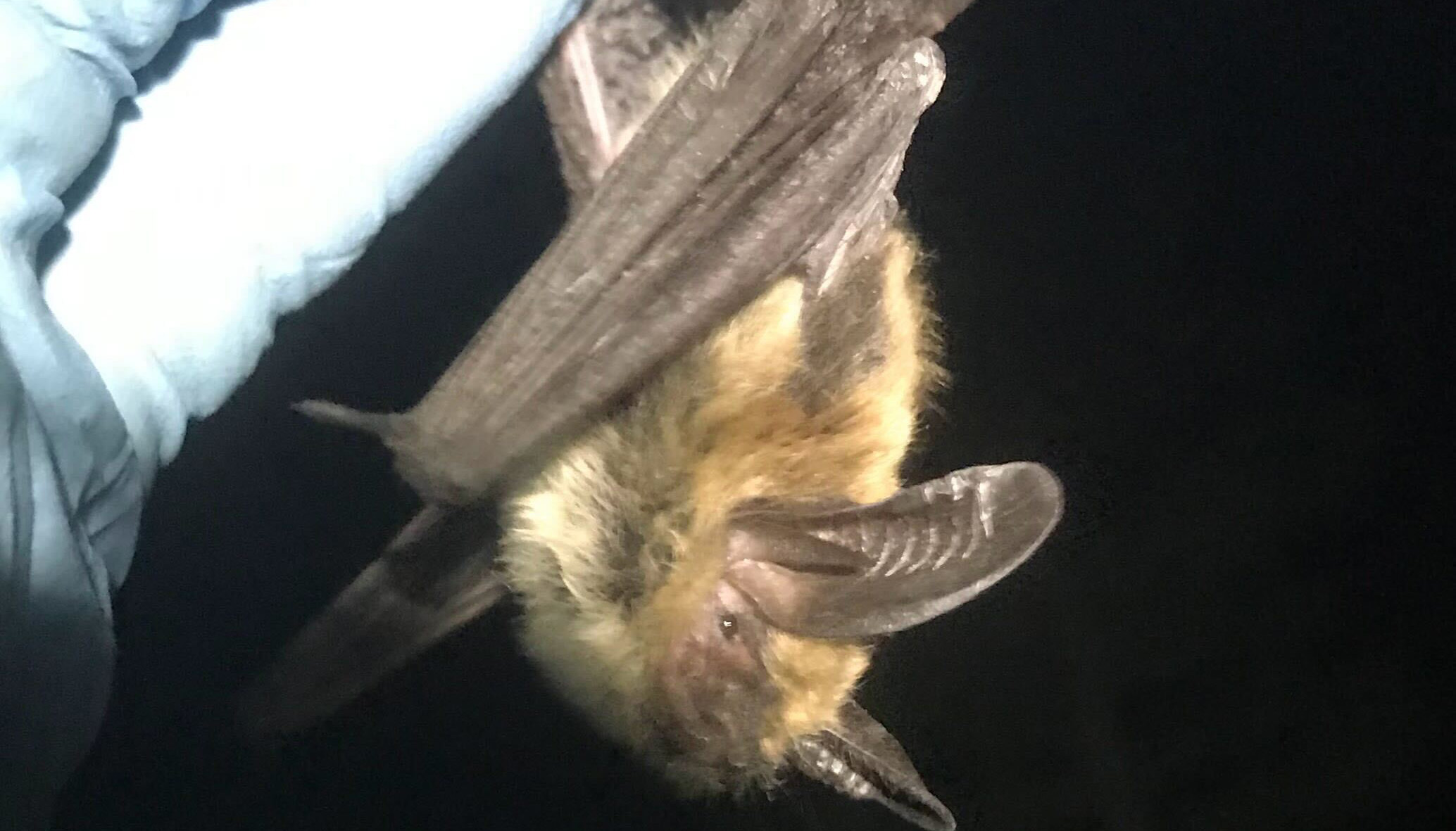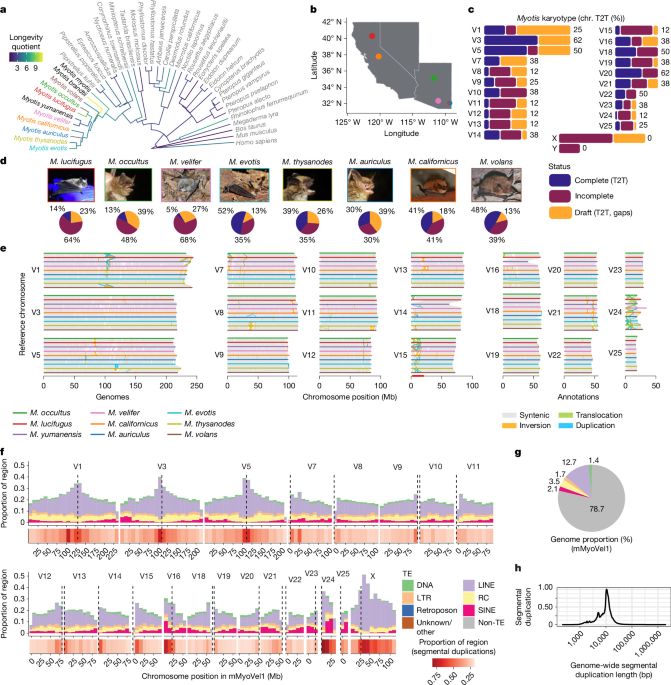
MainBats (order Chiroptera) represent approximately 20% of all known mammalian species and are one of the most phenotypically diverse clades of mammals4. Since their emergence 60 million years ago5, many bat lineages have independently evolved a wide variety of life history strategies and phenotypic traits, including exceptional longevity, viral tolerance and immune defences2,3. Systems in which shared traits have evolved de novo multiple times are powerful resources for dissecting the genetic basis of phenotypes. The largest genus of bats, Myotis, emerged approximately 33 million years ago6 and encompasses over 139 described species spanning 6 continents and a wide range of ecological niches7. Myotis species demonstrate some of the most extreme variation in lifespan among mammals1,8, including a sixfold difference in lifespan between the longest-lived species9 (Myotis brandtii, 42 years; Fig. 1a) and the shortest-lived species10 (Myotis nigricans, 7 years), which diverged approximately 10.6 million years ago11. Moreover, Myotis species are representative of bats’ notable immune mechanisms that enable viral tolerance and pathogen resistance12 contributing to their role as key zoonotic reservoirs2,13. Fig. 1: Near-complete reference assemblies reveal a varied structural variation landscape across nine Nearctic Myotis species.a, Phylogeny of Nearctic Myotis bats in this study, including outgroup species of bat, cow, mouse and human. Branches are coloured by their estimated longevity quotient, a ratio of observed-to-expected lifespan1. b, Map of capture sites in Arizona and California for samples generated in this study; each dot colour indicates the species. c, The completion status of each chromosome in assembly. The percentages next to the ideograms indicate the proportion of T2T-assembled chromosomes across species. d, The completion status of all chromosomes within each assembly, with representative images for the species shown above. For c and d, ‘complete (T2T) status’ indicates that a chromosome is fully assembled T2T without gaps; ‘draft (T2T, gaps)’ status indicates that a chromosome is fully scaffolded with both telomeres, but has one or more gaps in the assembly; ‘incomplete’ status indicates that a chromosome was positively identified, but was not scaffolded from telomere to telomere (contains only one telomere). e, Synteny between chromosomes of nine Myotis species showing syntenic regions (grey), inversions (orange), translocations (green) and duplications (blue). The red bar below chromosome V15 (x axis) indicates a locus of approximately 10 Mb where introgression was recently described in other Myotis18. f, The distribution of TEs (top) and segmental duplications (red heat map, bottom) in M. velifer. Putative locations of centromeres are denoted by the dotted lines. g, The overall genomic proportions of TEs in M. velifer. h, Histogram of segmental duplication size distributions genome wide in M. velifer. LINE, long interspersed nuclear element; LTR, long terminal repeat; RC, rolling circle transposon; SINE, short interspersed nuclear element. Images are from iNaturalist: Juan Cruzado Cortés (M. californicus, M. volans, M. occultus, M. auriculus and M. thysanodes) under a CC BY SA 4.0 licence; and Marlo Perdicas (M. lucifugus), Ansil B. R. (M. velifer) and Issac Krone (M. evotis) under a CC BY 4.0 licence.To study how longevity and infectious disease resistance have evolved in Myotis, we used an integrated field-to-functional-genomics approach to assemble near-complete genome assemblies for eight Myotis species with primary cell culture resources for functional validation. We identify copy-number-variable genes associated with RNA viral tolerance and stress response, as well as a trans-species copy number polymorphism of a key immune factor, PKR. Consistent with the extreme lifespans of Myotis relative to its body size, we identified selective evolutionary signatures in genes associated with longevity- and cancer-related processes. In contrast to humans and other primates, in which virus adaptation is driven by interactions with RNA viruses, we find that modes of virus adaptation in bats differ between DNA and RNA viruses. Together, our results highlight pleiotropic adaptations contributing to the lifespan and immune phenotypes of Myotis bats.Eight near-complete Myotis genome assembliesWe collected skin punches and derived primary cell lines from several North American (nearctic)14 species (Fig. 1a,b,d), including from one of the longest-lived bats, M. lucifugus15. Using these cell lines and flash-frozen tissues, we generated de novo haplotype-resolved, chromosome-scale genome assemblies for eight species (Fig. 1c,d and Extended Data Fig. 1) using a combination of long-read PacBio HiFi sequencing and HiC scaffolding. These genomes are highly contiguous and near complete, with an average of 98.6% (98.1–99%) of nucleotides assembled into the 22–23 syntenic16 chromosomal scaffolds; an average quality value score of 66; and among the highest contig NG50 values of any Chiropteran genome thus far (where NG50 is the length of the shortest contig in the ordered set of longest contigs making up at least 50% of the total assembly length; Extended Data Fig. 1 and Supplementary Table 1). We identified an average of 20,869 protein coding genes with mammalian homologues per genome, with BUSCO17 scores ranging from 98.2% to 98.5% (Extended Data Fig. 1e), which we used to build a time-calibrated, maximum-likelihood tree of Chiroptera (Extended Data Fig. 2a and Supplementary Table 1). Across all eight genomes, each autosome has been completely assembled telomere-to-telomere (T2T) in at least one species (Fig. 1c); within assemblies, 29–70% of chromosomes are fully assembled with an average of less than one gap per chromosome (Fig. 1d and Supplementary Table 1). Overall, these fully annotated genomes represent some of the most contiguous mammalian assemblies thus far.Abundant structural variation in Myotis
Insights into longevity and virus-driven adaptation from Myotis bat genomes - Nature
Comparative and functional analyses of Myotis bats uncover unique patterns of adaptation in virus-interacting proteins and longevity-associated pathways, linking two hallmarks of bat biology.
12,829 words~58 min read