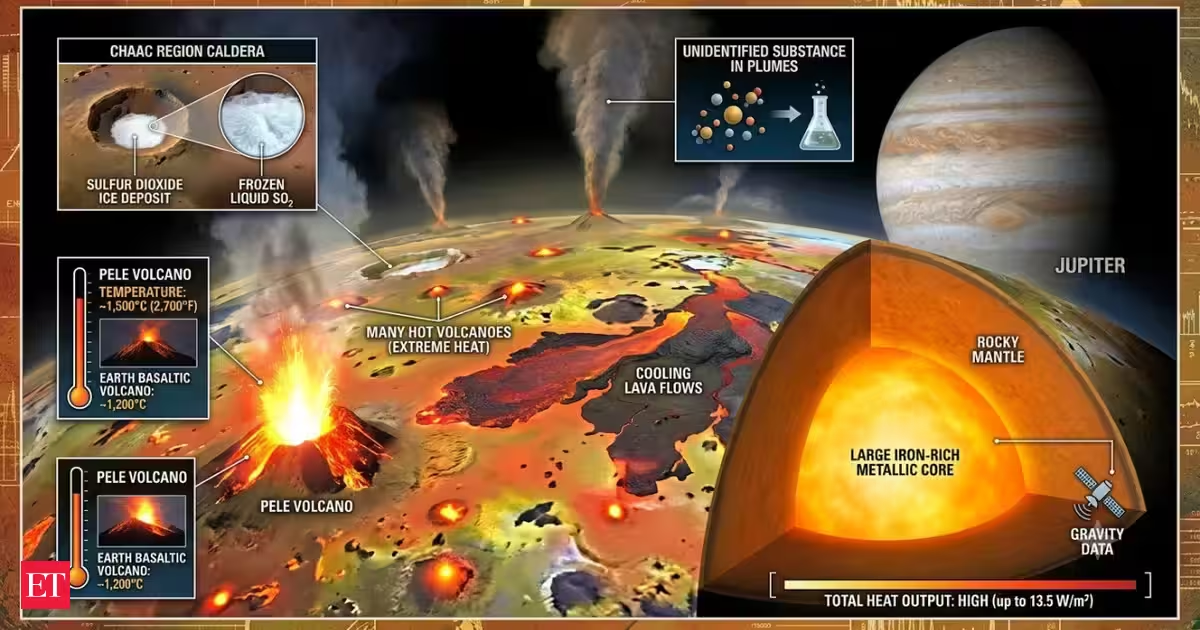
More than two decades after NASA's Galileo spacecraft flew close to Jupiter's moon Io, data from those encounters continue to reveal an extraordinary volcanic landscape.During three flybys in late 1999 and early 2000, Galileo's near-infrared mapping spectrometer detected intense heat and identified different materials across Io's surface. The instrument measured heat from lava while also showing where different substances were located.One of the most striking findings came from Pele, a volcano named after the Polynesian fire goddess. Temperatures inside Pele reached about 1,500 degrees Celsius, or more than 2,700 degrees Fahrenheit. That was far above temperatures found inside volcanoes active on Earth today.The close encounters also revealed more high-temperature areas than distant observations had shown, suggesting that smaller volcanoes on Io could also produce extremely hot lava.Galileo raised questions about Io's hottest volcanoesBefore Galileo's close encounters, scientists knew of two volcanoes with exceptionally high temperatures. The new observations raised an important question: Is extremely hot lava common across Io, or are many of its volcanoes more like Earth's basaltic volcanoes, which erupt at temperatures of about 1,200 degrees Celsius?You Might Also Like:Rosaly Lopes-Gautier, the instrument's science coordinator for Io at NASA's Jet Propulsion Laboratory, noted that similarly hot volcanic activity may have been common on Earth billions of years ago, as per a ScienceDaily report.A quiet volcano contained sulfur dioxideVolcanic heat was not the only unusual feature Galileo detected. In the Chaac region, the spacecraft observed a small, inactive volcano with a bright white floor covered in sulfur dioxide. The deposit was confined within the caldera walls, suggesting it could originally have been liquid material that rose from deeper layers.Io's atmosphere is extremely thin, almost like a vacuum, so liquid sulfur dioxide would normally boil away. JPL research scientist Bill Smythe said calculations showed that sufficiently large quantities could instead freeze into a layer of sulfur dioxide ice inside the caldera.An unidentified substance may have come from volcanic plumesGalileo's infrared instrument also detected an unusual light pattern in part of Io. Scientists initially considered whether the signal could come from an iron-containing mineral such as pyrite within silicate lava. If that were the case, they expected the signal to be stronger in areas with newer lava deposits.You Might Also Like:Higher-resolution observations during the flybys showed the opposite. The signal was weaker in dark volcanic regions. That suggested the unidentified compound probably was not reaching the surface through lava. Instead, scientists proposed that it could be ejected in volcanic plumes.Io may be releasing enormous amounts of heatGalileo's measurements also changed how scientists viewed Io's overall heat output. Earlier estimates focused on active volcanoes and other localized hot areas. That left out roughly nine-tenths of Io's surface, providing only a lower limit for the moon's total heat output.JPL planetary scientist Dennis Matson and four colleagues calculated an upper limit of about 13.5 watts per square meter, or roughly 1.3 watts per square foot. That was about five times the heat output from the ground in the Yellowstone hot springs area of Wyoming.Nighttime measurements from Galileo provided further evidence. Io's surface temperatures averaged about 90 to 95 Kelvin, or roughly -297 to -288 degrees Fahrenheit.You Might Also Like:The temperatures changed little with latitude or time of night, suggesting that most of the heat came from Io itself rather than absorbed sunlight.The researchers said Io's actual heat output could therefore be close to their upper-limit calculation. Producing that much heat would require much of the moon's surface to be covered with lava in different stages of cooling.Beneath Io's surface is a large iron coreIo is not entirely molten despite its extreme volcanic activity. The moon has a solid metallic core surrounded by a rocky mantle. Jupiter's gravitational influence, however, causes much greater deformation than the Moon's effect on Earth.Jupiter pulls on Io strongly enough to maintain an oval shape as the moon rotates. Io lacks the long-term strength to resist these forces and therefore behaves as though it were a fluid.During a May 1999 flyby, Galileo measured Io's polar gravity. The relationship between polar and equatorial gravity indicated that Io has a large metallic core made mostly of iron. The polar measurements confirmed an earlier conclusion based on observations of Io's equatorial gravity.Earth's metallic core generates its magnetic field, but it was not yet known whether Io's iron-rich core does the same.Galileo revealed a volcanic world unlike EarthGalileo's close encounters showed that Io's volcanic environment was more extreme and complex than distant observations had suggested.The spacecraft detected temperatures of about 1,500 degrees Celsius inside Pele, possible sulfur dioxide ice inside a caldera and an unidentified compound that may be carried by volcanic plumes. Its heat measurements also suggested that much of the moon could be covered with lava in different stages of cooling.The spacecraft's gravity measurements provided evidence of a large iron-rich core beneath the surface.You Might Also Like:
In 2000, NASA’s Galileo spacecraft mapped Jupiter's moon Io’s volcanoes at temperatures above 1,000°C. 26 years later, the data still reveal one of the solar system’s strangest volcanic worlds
Discover how NASA's Galileo spacecraft mapped Jupiter's moon Io, revealing volcanic activity that exceeds 1,000°C and uncovering one of the solar system’s most extraordinary geological landscapes.
805 words~4 min read