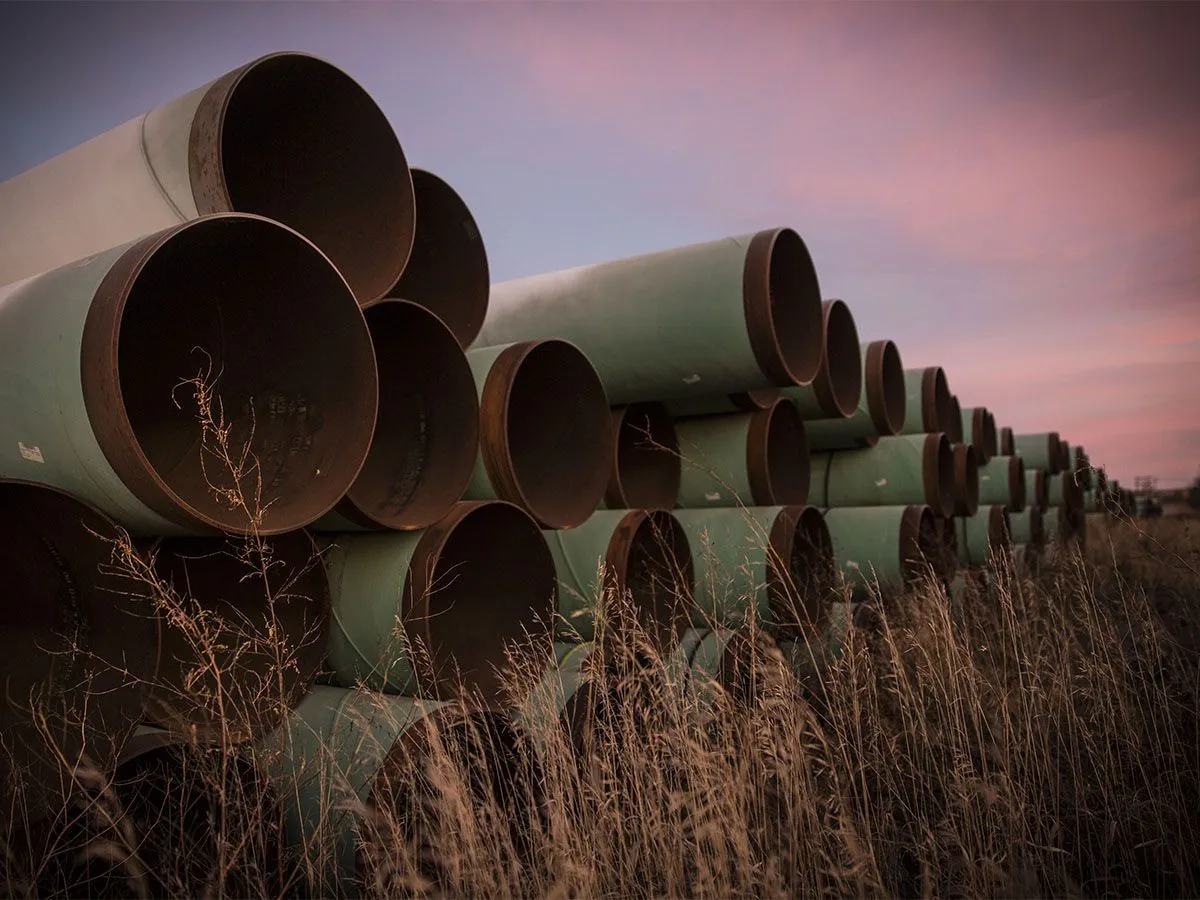
Skip to Content News Archives Economy Energy Oil & Gas Renewables Electric Vehicles Mining Commodities Agriculture Real Estate Mortgages Mortgage Rates Finance Banking Insurance Fintech Cryptocurrency Work Wealth Smart Money Wealth Management Investor Personal Finance Family Finance Retirement Taxes High Net Worth FP Comment Executive Women Puzzmo Newsletters Financial Times Business Essentials More Innovation Information Technology FP500 Podcasts Small Business Lives Told Tails Told Shopping Financial Post Store Obituaries Place a Notice Advertising Advertising With Us Advertising Solutions Postmedia Ad Manager Sponsorship Requests Classifieds Place a Classifieds ad Working Profile Settings My Subscriptions My Offers Newsletters Customer Service FAQ News Economy Energy Mining Real Estate Finance Work Wealth Investor FP Comment Executive Women Puzzmo Newsletters Financial Times Business Essentials HomeEnergyCanada imposing 50 per cent tariffs on oil and gas pipeline steel from the U.S.Ottawa’s strategy is to impose duties on American goods that Canadian companies can get from other sourcesLast updated 3 hours ago Miles of unused pipe, prepared for the proposed Keystone XL pipeline, sit in a lot on Oct. 14, 2014 outside Gascoyne, North Dakota. Andrew Burton/Getty ImagesCanada is not fighting a trade war with the United States by taxing or withholding energy, but it is putting a 50 percent tariff on some of the steel that oil and gas pipelines are built from.Subscribe now to read the latest news in your city and across Canada.Exclusive articles from Barbara Shecter, Joe O'Connor, Gabriel Friedman, and others.Daily content from Financial Times, the world's leading global business publication.Unlimited online access to read articles from Financial Post, National Post and 15 news sites across Canada with one account.National Post ePaper, an electronic replica of the print edition to view on any device, share and comment on.Daily puzzles, including the New York Times Crossword.Subscribe now to read the latest news in your city and across Canada.Exclusive articles from Barbara Shecter, Joe O'Connor, Gabriel Friedman and others.Daily content from Financial Times, the world's leading global business publication.Unlimited online access to read articles from Financial Post, National Post and 15 news sites across Canada with one account.National Post ePaper, an electronic replica of the print edition to view on any device, share and comment on.Daily puzzles, including the New York Times Crossword.Create an account or sign in to continue with your reading experience.Access articles from across Canada with one account.Share your thoughts and join the conversation in the comments.Enjoy additional articles per month.Get email updates from your favourite authors.Create an account or sign in to continue with your reading experience.Access articles from across Canada with one accountShare your thoughts and join the conversation in the commentsEnjoy additional articles per monthGet email updates from your favourite authorsSign In or Create an AccountorOttawa dropped the gloves Tuesday, releasing the full list of its countermeasures at a news conference, covering $27.6 billion in American imports. Steel and aluminum tariffs double to 50 per cent to match what Washington has already imposed, alongside duties on American dairy, appliances, agricultural equipment, pulp and paper and electronics.It’s part of Canada’s tit-for-tat response to tariffs the United States enforced over the weekend.Get the latest headlines, breaking news and columns.By signing up you consent to receive the above newsletter from Postmedia Network Inc.A welcome email is on its way. If you don't see it, please check your junk folder.The next issue of Top Stories will soon be in your inbox.We encountered an issue signing you up. Please try again“Those tariffs will have real consequences for Canadian workers, businesses and communities across our nation,” Finance Minister François-Philippe Champagne said of the American duties prompting the response.Canada is not imposing any duties on its oil and gas exports, which Ontario Premier Doug Ford had suggested. Champagne didn’t say whether the government would use the lever in the future, when asked by a reporter.But according to Ottawa’s list of new counter-tariffs on U.S. goods, set to come into effect on Sept. 8, line pipe for oil and gas pipelines are slapped with 50 per cent duties, along with the casing and drill pipe used in wells.Ironically, Canada needs steel to build proposed new pipelines to the West Coast – projects that are meant to diversify trade away from the United States by moving oil and liquefied natural gas to overseas markets.Still, Ottawa’s strategy is to impose duties on American goods that Canadian companies can get from other sources. Alberta isn’t buying much pipeline steel from its American neighbours. Only two percent comes from the United States, according to Statistics Canada.Canada bought $137.3 million worth of oil and gas line pipe from South Korea over the past year, according to the national agency. From the United States, only $8.1 million. Korea alone supplies close to 40 per cent of what Canada imports.Richard Masson, a long-time oilpatch observer and a former chief executive of the Alberta Petroleum Marketing Commission, said the tariffs don’t change much for oil pipelines right now, since nothing major is under construction near-term.The bigger exposure is a proposed natural gas line to a West Coast shipping terminal, which appears to be closer to moving ahead.“All of these things right now have a pretty big symbolism,” he said. The real question, he said, is whether Canadian steel and manufacturing can ramp up fast enough to take advantage of it.Masson pointed to the Sturgeon Refinery north of Edmonton as an example. The pipe spools used there came from Asia, not North America.“If it’s not going to come from North America, from the U.S., then, yeah, there are international suppliers,” he said. “Korea, in a big way.”Alberta’s pipeline builders now have to choose between American line pipe, now tariffed on the Canadian side, or sourcing farther afield at higher shipping costs, with the Strait of Hormuz still choked by the Iran conflict, pushing up diesel and freight prices worldwide.“Diesel is very expensive now,” Masson said. Buying from North America would be the cheaper option, he said, if a trade war weren’t standing in the way.Mark Parsons, chief economist at ATB Financial, said the same import pattern holds beyond pipe: national data shows 78 per cent of Canada’s imports in the tariffed categories came from countries other than the U.S. in 2025, including Mexico, China and South Korea.Substituting supply away from American sources could be a viable option, Parsons said, though it will be hard to know which categories are hit hardest until the details settle.“It’s hard to find things that are cost-free when you’re trying to put a tariff on,” Masson said. “Everything has an implication. It’s not going to be easy for us. That’s the bottom line.”A spokesperson for Calgary-based pipeliner Enbridge Inc. said the company is still working through the countermeasures. “We’re just learning about this ourselves and assessing what it means for our business.”The tariffs land as Alberta and Ottawa are trying to get more pipeline capacity built, not less, including a proposed West Coast pipeline that Carney and Premier Danielle Smith announced in July. Masson said that push predates this week’s escalation and isn’t going away because of it.“It is the whole reason why we’re trying to build it in the first place, which is to diversify our markets, because the U.S. is no longer a reliable partner,” Masson said.It could still end with more Canadian manufacturing and less dependence on any single supplier, he said, but getting there “will make things more complicated.”Nobody has a dollar figure yet for what any of this might mean for the costs of a new pipeline.“I have no idea, and I’m not sure many will have that yet,” Masson said.What he’s more certain of is what happens where nobody is watching. Companies delay big capital decisions when prices might drop once a trade dispute resolves, he said, and that hesitation costs more than the tariff itself.“If they think prices are going to go down six months from now when things are resolved, they won’t build now in anticipation of lower prices later,” he said. “Everything just seizes up. If you can’t invest, then you can’t hire people.”Masson said he doesn’t think the implementation date for Canada’s counter-tariffs Sept. 8 is necessarily fixed.“There’s always a chance,” he said. “Trump is going into the midterms in a very weak position.” Join the Conversation This website uses cookies to personalize your content (including ads), and allows us to analyze our traffic. Read more about cookies here. By continuing to use our site, you agree to our Terms of Use and Privacy Policy.
Canada imposing 50 per cent tariffs on oil and gas pipeline steel from the U.S.
Canada not fighting trade war with U.S. by taxing energy, but will put tariffs on some steel that oil and gas pipelines are built from.
1,404 words~6 min read