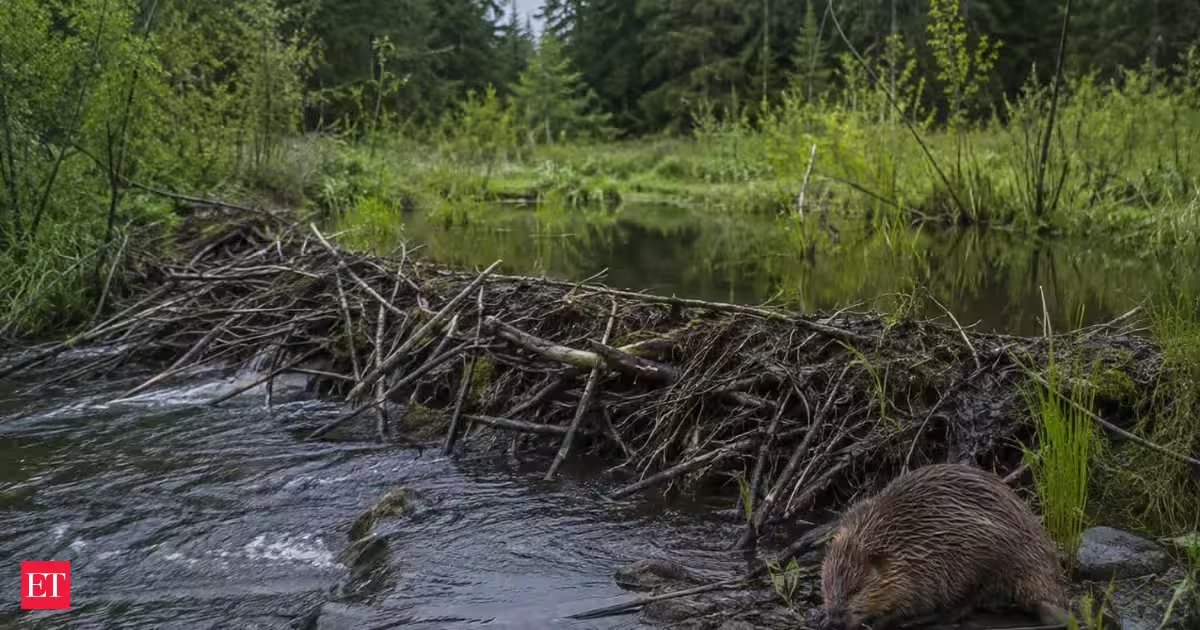
A wildlife biologist is loading a very large and ferocious rodent in a crate and driving it up a logging road where it gets dumped into a half-dry creek and is released from the crate. This is not some kind of stunt; it is a government policy. From Washington through Utah all the way to California, the wildlife departments are now actively trapping beavers, either tranquilizing them or placing radio tags on them and transporting them to streams that need restoration.The purpose is very straightforward: allow the beavers to do the restorative work that 100 years of trapping, agricultural work, and road construction have destroyed. As stated in a 2014 BioScience article titled “Using Beaver Dams to Restore Incised Stream Ecosystems,” by Pollock et al., beavers and their dams help to slow the flow of water and retain sediments, thus reversing the type of stream erosion that engineers have been attempting for decades and with millions of dollars to prevent using concrete and rebar. It seems like beavers happily carry out the restoration work for free.We nearly wiped out the one animal built to fix our riversPrior to the arrival of the European trappers, it is believed that there were about 200 million beavers building dams across North America's rivers. Through hunting and extermination campaigns, the numbers have now been reduced to about 10-15 million. This isn’t just a slight miscalculation. It’s the near-complete destruction of a species that turns out to be responsible for carrying out the rather dull duty of maintaining our waterways by replenishing underground water sources, connecting the rivers to the floodplain and creating wetlands, which serve as natural sponges.The receipts: what happens when beavers get to workThis isn't folklore. Streams with active beaver dams remained visibly greener during and after wildfires than streams without beavers in the area, due to the moistening effect of the water moved and stored in the soil by the beavers. It helped to keep the riparian vegetation alive even when everything else burnt down. In other words: beaver-dammed creeks acted as a natural firebreak. This is documented in Fairfax and Whittle’s 2020 study titled “Smokey the Beaver: beaver-dammed riparian corridors stay green during wildfire throughout the western United States,” published in the journal Ecological Applications.An eroded streambank photographed before habitat restoration work began. Image credits: Wikimedia CommonsIt's the same story with the erosion of the banks. Infested streams are the ones that have become "incised," with water confined within a channel so deep that it does not inundate the floodplain; they are very difficult and expensive to correct. Pollock's team suggested that beaver dams and their man-made counterparts, called beaver dam analogs, cause flows in the stream to slow down to the point where sediment begins to settle and build up the banks, which helps keep a stream from eroding.Not just water and soil, but there is one more interesting discovery related to beavers’ contribution to the environment. As reported in a 2016 Scientific Reports article titled “Ecosystem experiment reveals benefits of natural and simulated beaver dams to a threatened population of steelhead (Oncorhynchus mykiss),” by Bouwes et al., a watershed-scale experiment conducted in Oregon’s John Day Basin has revealed an increase in density, survival rate, and production of young steelheads, which are listed as endangered species, with no migration restrictions caused by installation of beaver dam analogs.How this is relevant to usBeaver reintroduction alone is not the solution to the West's water equation, nor is there a scientist who says otherwise. However, it is one of the few climate interventions that is low-tech, inexpensive, and self-maintaining. Some states, such as Utah, which developed a formal beaver management program in 2010, are now researching the streams or creeks that can be restored to support a beaver dam and creating artificial beaver dam analogs to provide a head start on the streams too extensively altered to maintain a dam of their own.The slightly clumsy bitThis is not new science. For years, wildlife managers have known how important it is for beavers to play a vital role in the watershed ecosystems. What has shifted is that the cost of fires and drought has become high enough for the policymakers to finally pay attention to the animal that environmentalists have been yelling about for decades.A beaver dam. Image credits: Wikimedia CommonsCalifornia's state-funded beaver program was not established until 2023, decades after programs were established in other states, such as Washington, Oregon and Utah.The meadows of the Sierra Nevada and Rocky Mountains from which drinking water for millions flows will still require some work. Beavers won't be a panacea. However, they just might be the closest thing the American West has seen to free labor for the past one hundred years.
Washington state biologists reintroduced beavers on tributaries, and within years their dams slowed stream flow and rebuilt banks that resist erosion
Washington state biologists are reintroducing beavers on tributaries to combat stream erosion and restore habitats. This low-cost, natural solution could benefit ecosystems and regions facing drought.
787 words~4 min read