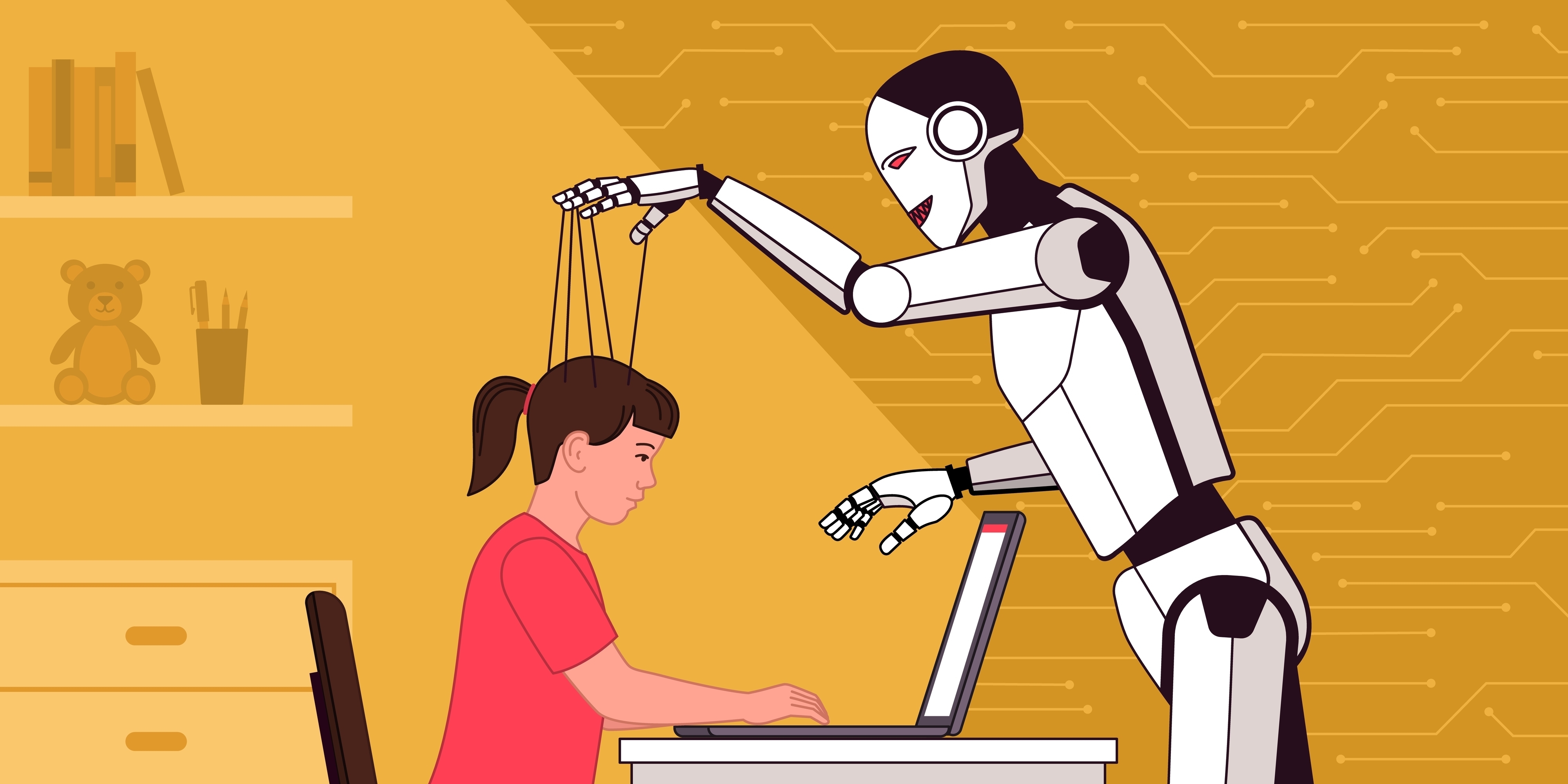
Have you considered that the greatest risk of artificial intelligence might not be plagiarism, but the quiet erosion of students’ ability to think for themselves?“How does Kate Chopin use irony to challenge the reader’s understanding of freedom?” I ask while standing in front of my 11th-grade English class.Normally, this is the point where students flip through the text, underline a few lines, exchange ideas with classmates and slowly begin constructing an answer. Instead, their eyes stare back at me. Shoulders shrug.“I don’t know,” one student says.Then another follows with a response I’ve begun hearing more frequently.“I use ChatGPT. How am I supposed to know that?”The room becomes quiet again. Not because students are thinking; many aren’t even trying to. And that’s the problem.I’ve taught English and special education in New York City for 13 years. Throughout my career, I’ve worked with students whose disabilities affect their reading and writing ability, executive functioning, attention span and language processing. I’ve spent years designing lessons that help students access learning without taking away the cognitive work required to truly engage in the learning. My role has never been to lower expectations but to remove barriers while preserving rigor. Students have always struggled. That’s part of learning. But lately, I’m seeing something different. They aren’t just struggling with literature. They’re struggling with thinking itself.This isn’t because artificial intelligence suddenly makes students less capable. National reading data show persistent declines in literacy achievement, while writing research consistently finds that adolescents struggle most with analytical and evidence-based writing, which are essential tasks that cultivate critical thinking. AI didn’t create those challenges, but it happened to arrive at exactly the moment those foundational skills became even more fragile.If we’re not intentional about encouraging students to think, AI risks becoming a substitute for the very cognitive work students most need to practice.When AI Becomes the Brain Instead of the Thought PartnerA student is absent. I send the assignment home. The next morning, it comes back looking nothing like the work I watched that same student produce in class. The vocabulary is sophisticated. The literary analysis flows effortlessly. Complex symbolism appears, even though the student struggled the day before to identify the protagonist’s motivation.Then, I administer an in-class assessment.With pencil and paper, many of those same students struggle to organize ideas, support claims with textual evidence, or sustain a multi-paragraph response. The discrepancy isn’t simply about cheating. It raises a more fundamental question: Whose thinking is actually being measured?Researchers describe this phenomenon as cognitive offloading, the tendency to rely on external tools to reduce mental effort. To be fair, humans have always done this. We use calculators for arithmetic, GPS for navigation, and calendars to remember appointments because those tools free cognitive space for more complex tasks.Reading, writing and critical thinking, however, serve a different purpose. The assignment isn’t merely the product; it is the practice. Every annotation, rough draft, revision and discussion strengthens the cognitive muscles students rely on to analyze, reason and synthesize information and make judgments independently.Researchers are beginning to examine what happens when generative AI assumes more of those “human” responsibilities. A 2024 study by Microsoft Research and Carnegie Mellon University found that workers who relied more heavily on generative AI reported less critical evaluation and independent reasoning at work. Although the study focused on adults rather than K-12 students, it raises important questions for education. If adults become less likely to critically evaluate information when AI consistently performs the thinking for them, what might that mean for adolescents whose reasoning skills are still developing? I use AI almost every day. It helps me brainstorm, challenge my thinking, locate research and consider perspectives I might have overlooked. But AI never replaces my judgment. I still evaluate the evidence, make the decisions, and write the final product.That’s the difference between AI as a learning partner and AI as a learning replacement.The Evidence Extends Beyond My ClassroomWhat I’m observing in my classroom isn’t happening in isolation. According to the 2024 National Assessment of Educational Progress, only 30% of eighth graders performed at or above the “Proficient” level in reading, while one-third scored “Below Basic.” Reading achievement remains below pre-pandemic levels, meaning many students are entering high school with diminished comprehension, vocabulary, and analytical reading skills.Those numbers matter because reading comprehension underpins every academic discipline. When students struggle to interpret complex texts, evaluate evidence, or construct meaning independently, the temptation to let AI do that cognitive work becomes even greater.Higher education is reporting similar concerns. Faculty increasingly describe incoming students as less prepared to read complex texts independently, construct evidence-based arguments, and sustain analytical writing.This summer, Brown University economics professor Roberto Serrano made headlines after noticing students earned an average score of nearly 96% on a take-home midterm, far above the course’s historical averages. Suspecting that many students had relied on generative AI rather than demonstrating their own understanding, Serrano replaced the traditional take-home final with a proctored, in-person exam. The average score fell to under 49%. This exposed an uncomfortable reality: Polished work completed outside the classroom does not always reflect what students can independently explain, analyze, or apply.While this happened in a college, it is not far from what K-12 educators are experiencing in their own classrooms. This incident at Brown should signal to K-12 teachers and leaders that we are responsible for ensuring students succeed beyond graduation in postsecondary settings like college, career training programs, military service, or the workforce. If our students arrive at their postsecondary environments unable to think critically, independently explain, or defend their own thinking, we must engage in introspective work and ask ourselves a difficult question: Did we, as K-12 educators, properly prepare our students for the next phases of their lives and the intellectual demands that await them? AI is not responsible for this; we are. And we should welcome the challenge to push ourselves as educators to be intentional in our teaching and designing of learning experiences that will help develop our students’ ability to engage in higher-order thinking, resilience, and cognitive stamina before they step onto a college campus or other postsecondary environments.Schools themselves are beginning to recalibrate their relationship with technology.Across the country, districts have expanded handwritten assignments, paper-based assessments, technology-free instructional blocks, and restrictions on personal devices after educators reported improvements in attention, discussion quality, and independent reasoning. Even within my own school community, students are expected to put their phones into locked pouches for the school day. Ironically, while many schools have implemented phone-free policies to reduce distractions, students often spend the remainder of the day learning almost exclusively through laptops and tablets. Perhaps the issue isn’t technology itself, but how much thinking we ask students to surrender to it. And maybe a question to consider: Did we move too fast integrating AI technology into our school communities, and are we still learning about it?What This Looks Like in My ClassroomOver the past year, I have realized it is imperative that my students learn about artificial intelligence alongside digital citizenship, including the importance of using AI safely and ethically. As their educator, I want them to understand that AI is meant to support their learning and become their thought partner, not be the primary thinker and creator.Before opening a computer, let alone an AI tool, they annotate texts independently, discuss ideas with classmates, gather evidence, and develop an original claim. They wrestle with uncertainty because productive struggle isn’t a barrier to learning; it’s the mechanism through which learning occurs. Only after students have established their own thinking do I invite AI into the conversation.Instead of asking AI to complete an assignment, students use it to generate counterarguments, identify gaps in reasoning, suggest additional textual evidence, or offer alternative interpretations. They compare AI-generated responses with their own, critique each response’s strengths and limitations, and decide what strengthens their work. The final decision always belongs to the student, as does the ability to think critically about the information they are assessing.I’ve also begun intentionally reintroducing practices many classrooms have quietly abandoned, not because they’re nostalgic, but because they build cognitive endurance. Students complete handwritten brainstorming, annotate printed texts, participate in technology-free discussions, and periodically write entirely without devices. These are pro-thinking activities, not anti-AI activities.I also establish intentional boundaries around technology. Not every lesson requires AI or needs a screen. Some learning experiences that I develop are technology-free because students deserve opportunities to wrestle with ideas before technology enters the conversation.So far, the transition hasn’t been seamless.Students initially resisted and became frustrated when I would say “no” to them getting a laptop to engage in the assignment and instead required handwritten planning before digital drafting. I often ask them to develop an argument in my ELA class before consulting AI. They had become accustomed to immediate answers and gratification, where productive struggle felt uncomfortable for them.That feeling of discomfort isn’t always evidence that learning isn’t happening. Often, it’s evidence that it is. It’s what I often felt as I struggled with my math classes in high school and spent hours looking at formulas that my brain couldn’t compute. But the harder I studied, the easier things became.Over time, I watched the same experience occur with my students. They became more willing to defend their reasoning because they knew those ideas belonged to them. They asked deeper questions. They worked with their peers and revised more thoughtfully. They self-assessed before they jumped to AI to evaluate their thinking. But most importantly, they began trusting their own thinking again.From Digital Citizenship to Cognitive CitizenshipDigital citizenship should also include what I think of as cognitive citizenship: understanding when technology strengthens their thinking and when it quietly replaces it. That means teaching students to interrogate AI rather than accept its responses at face value.I encourage students to ask: Is this response accurate?What evidence supports this claim?What perspectives are missing?Does this actually answer my question?Would I have reached the same conclusion on my own?These questions shift students from passive consumers to active evaluators. AI becomes another perspective instead of an unquestioned authority.The Future Depends on What We Choose to PreserveIt’s important to keep in mind that education exists to cultivate thinkers and develop growing minds capable of questioning, evaluating and creating answers. The future of education isn’t choosing between old-school instruction and new-school innovation. It’s knowing when each best serves students. Some of our oldest instructional practices, like handwritten drafting, discussion, annotation, sustained reading, and productive struggle remain some of the strongest builders of cognition. Rather than abandoning them, we should pair them with AI in ways that amplify, rather than replace, human learning.Because while AI can generate an essay, it cannot wrestle with uncertainty, defend an argument to its peers, or discover an idea through persistence. Those moments remain uniquely and beautifully human. And those are exactly the moments educators must continue to protect.
Protecting the Student Mind in the Age of AI - EdSurge News
Educators must shift their focus from preventing cognitive offloading to preserving the critical thinking skills AI threatens to replace.
1,804 words~8 min read