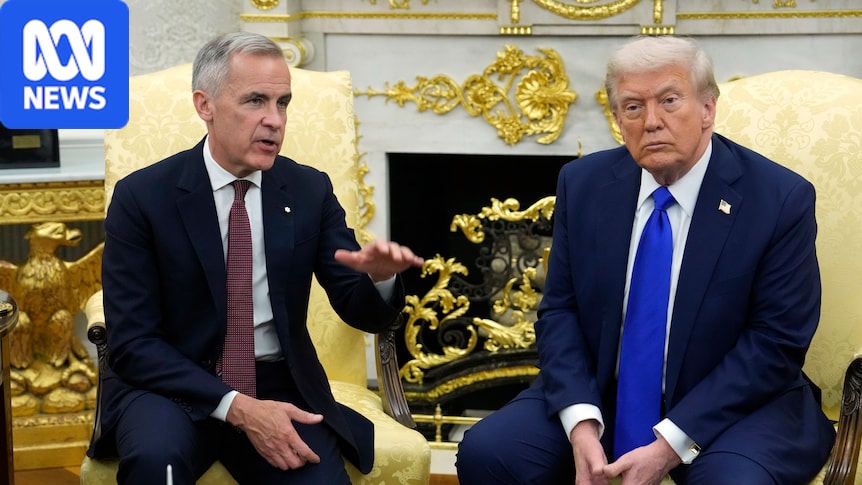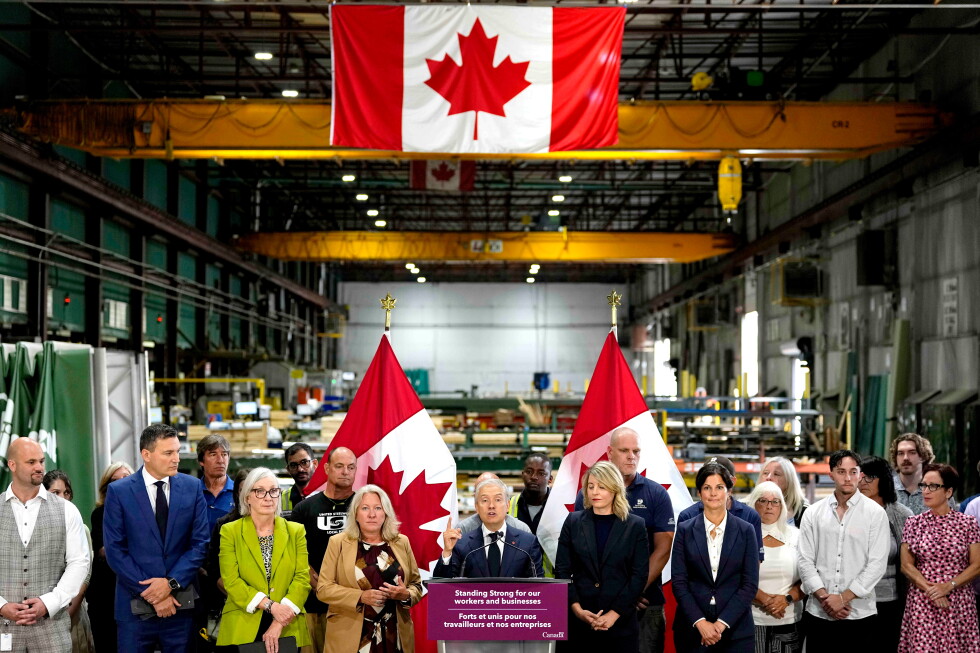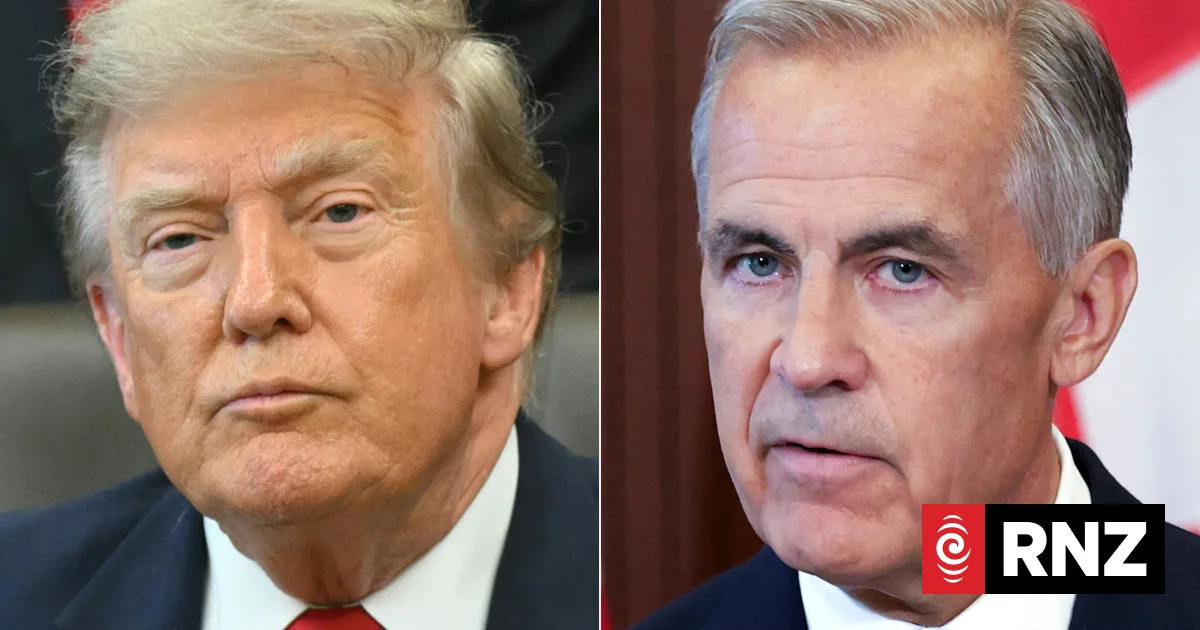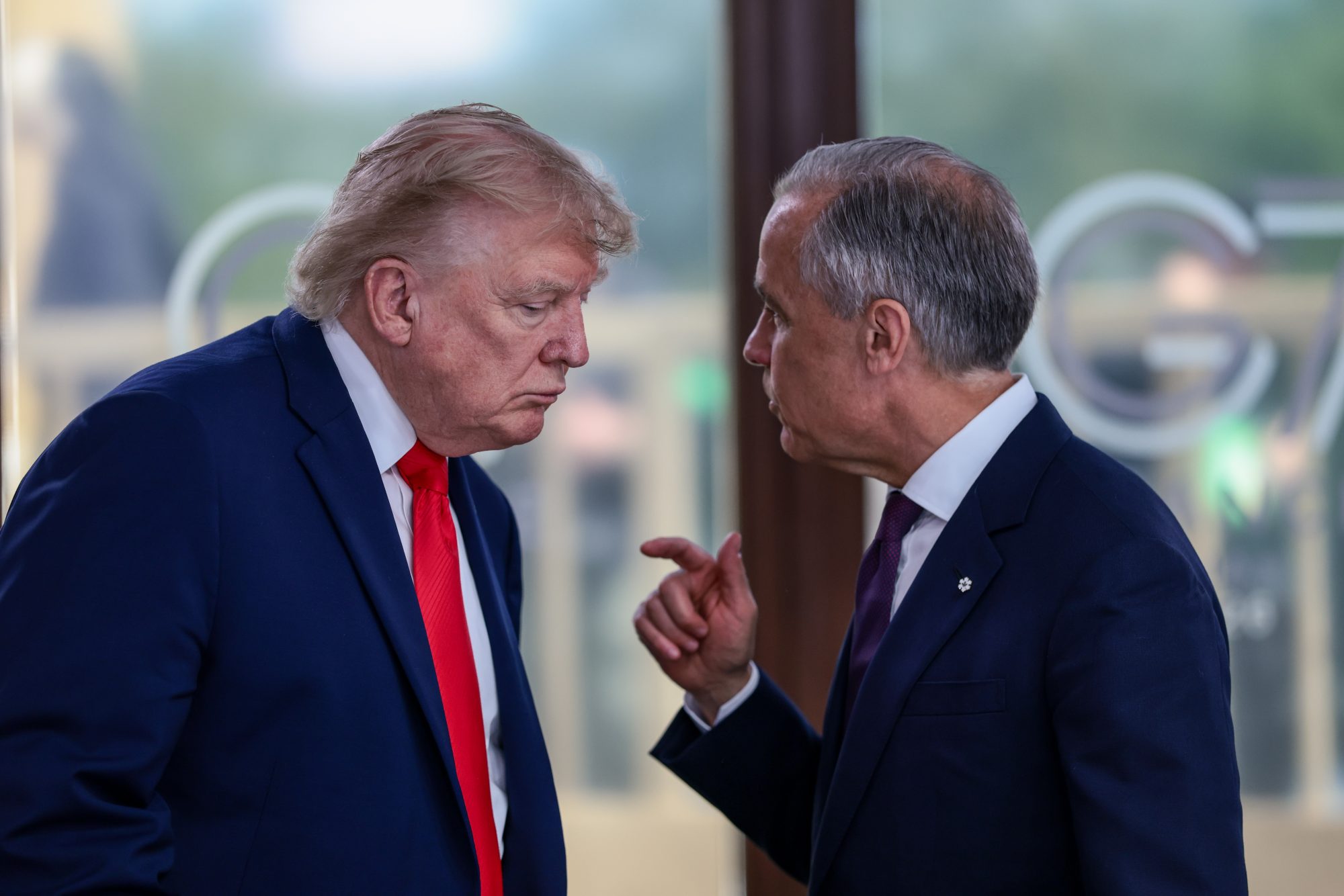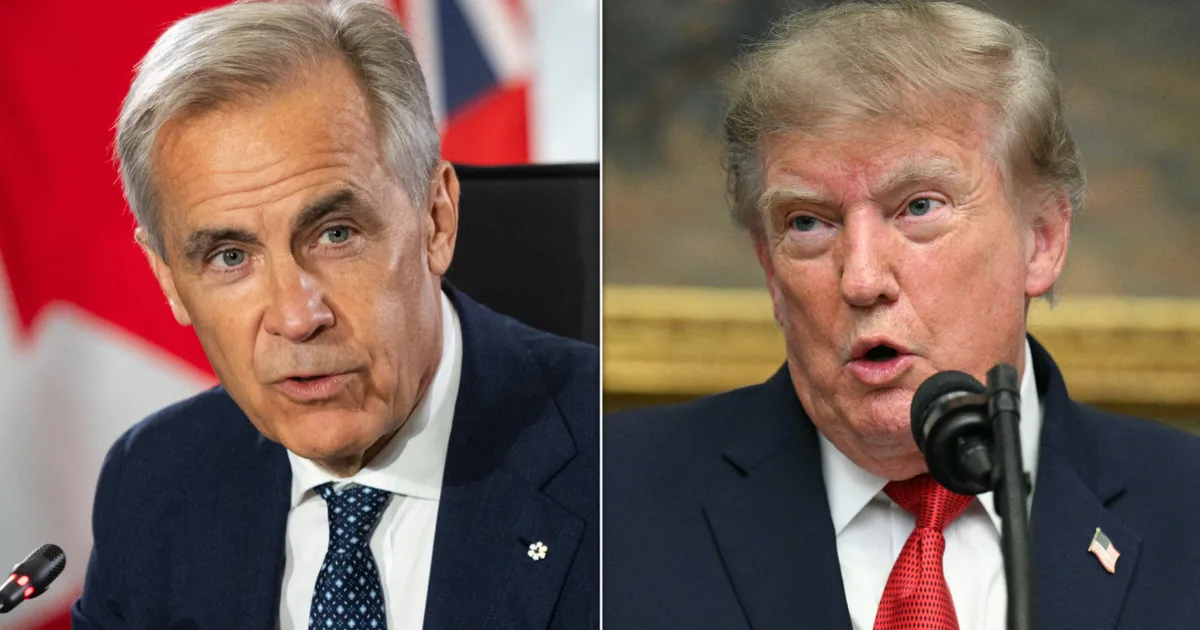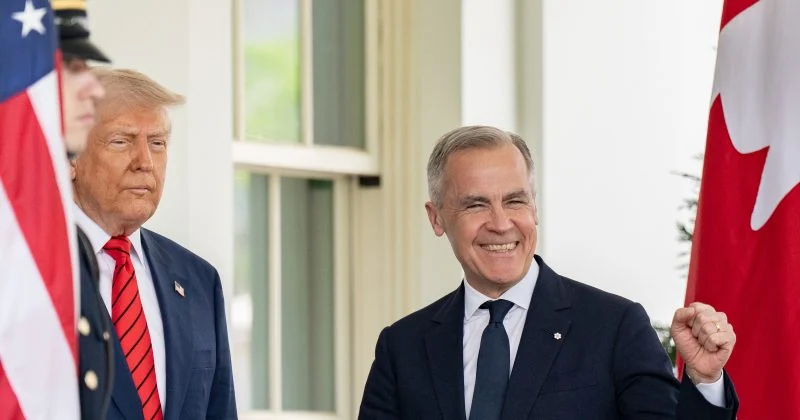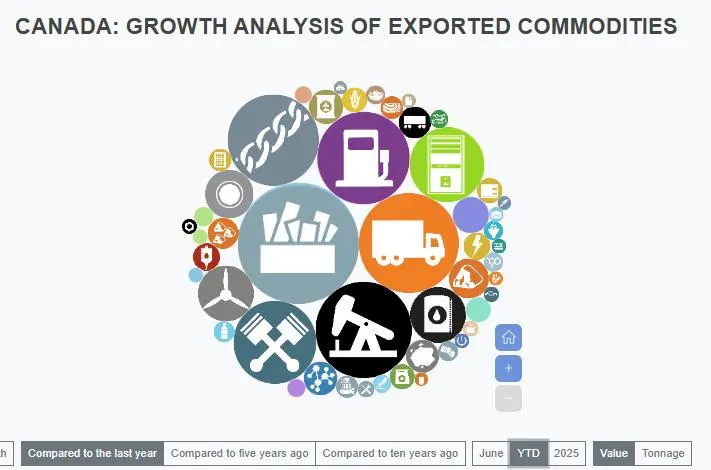
Some of the fastest-growing U.S. exports to Canada this year are gasoline, commercial vehicles, oil and motor vehicle parts.ustradenumbers.comI do not mean to minimize the impact the 50% tariffs that President Trump and Canadian Prime Minister Mark Carney have slung at each other in their schoolyard spat could have on some American and Canadian businesses, workers and consumers.But this isn’t a trade war like the one Trump kick-started with China during his first term. In that one, which is ongoing, Trump imposed tariffs on some $300 billion in U.S. imports beginning in the spring of 2018. Xi Jinping’s retaliation all but wiped out China’s status as the leading market for U.S. oil and soybean exports, among other products.In the skirmish with Canada, Trump is putting tariffs on $20 billion in goods. And threatening to change the name of Lake Ontario to Lake America after Ontario Premier Doug Ford suggested that Trump could kiss his, well, you-know-what.It is worth noting that the reciprocal tariffs from Carney are not scheduled to go into effect until Sept. 8. Let’s call it breathing room.Nevertheless, even though it’s not a trade war on the scale of the eight-year trade war with China, it’s still fraught with risk.Consider the bigger picture:The United States has been unable to end the Russian invasion of Ukraine that Trump inherited, hobbled by an inconsistent effort and squabbles with NATO partners. The war has affected grain and fertilizer exports from Ukraine as well as limiting markets willing to accept Russian oil after U.S. sanctions.MORE FOR YOUAhead of the midterms, Democrats want to connect those disruptions to the price of gas and food.Trump’s invasion of Iran is at an impasse, leading Treasury Secretary Scott Bessent on Monday to declare an economic D-Day – his words, not mine – against not only Iran but any country doing business with it. China, of course, gets most of its oil from Iran and immediately issued a warning, just weeks before Xi’s visit to Washington. The Strait of Hormuz has been essentially disrupted or shuttered for months, affecting oil exports from the region.With the House of Representatives and Senate in play, Democrats want to connect that to the price of food and gas.The bond market’s muted response last week to Bessent’s effort to stabilize the long-bond market may reflect investor skepticism about the administration’s ability to restore confidence.A sustainable peace in Gaza is on the ropes as Hamas and Israel are at odds on the terms of any agreement. One of the primary sticking points is whether Hamas will disarm.So, does Trump have a fairly full plate? Yes. Of course, all U.S. presidents tend to have a full plate even in the best of times, have tended to have had a full plate since the United States established its global leadership coming out of the Second World War with the creation of the United Nations, NATO, the Marshall Plan, the World Bank, the International Monetary Fund, the World Health Organization, which the United States no longer supports, and what became the World Trade Organization.Trump essentially neutered the WTO in his first term, choosing not to replace appellate judges, and President Joe Biden failed to fill the positions during his term.That makes the rules of international trade all but unenforceable.Enter a U.S. president uniquely willing to take big gambles. While big gambles can result in huge rewards they also come with big risks.His trade war with the world, announced on April 2, 2025, is but one example. The Supreme Court struck down the original policy. The administration has since pursued replacement tariffs that face additional legal challenges. All of this is to say that even though the United States and Canada are not really in a trade war, don’t assume it could not escalate to that.It is helpful to understand that Canada for decades was the United States’ No. 1 trade partner – and was as recently as 2022. Even when the overall rank was ceded first to China in 2015 and now Mexico, Canada remained the No. 1 market for U.S. exports. Even that changed in 2025, when Mexico for the first time ranked first for not only U.S. trade and U.S. imports but also U.S. exports. Canada’s overall trade fell for the third consecutive year, something that had not occurred in decades if ever. There are many factors to these changes but two stand out: the trade war with China and the U.S. becoming the world’s top global energy market. Through it all, Canada remains the nation’s second most important trade partner.It’s oversimplifying but consider the trading relationship between the two to be a three-legged stool. One leg is automotive. What NAFTA created and what USMCA has thus far kept intact is the world’s largest and most integrated supply chain. While there has undoubtedly been a shift southward to Mexico over time, all three countries remain critical to its success. Several top U.S. imports from Canada are tied to the automotive sector, including passenger vehicles, motor vehicle parts, commercial vehicles and motor vehicle engines.ustradenumbers.comFor both the United States and Canada, many of the top exports and imports are automotive-related. The discussion apparently fell apart over finding common ground in automotive trade.Trump has now threatened to extend the 50% tariff to automotive parts in January – after the November midterms – if the two sides don’t reach agreement. That could push the current skirmish into trade war territory.Canada dominates U.S. oil imports, with more than 60% year to date and more than 65% in the month of June.ustradenumbers.comOil is the most valuable U.S. import from Canada but natural gas and refined petroleum as well as electrical energy are also involved. Combined, they account for about one-third of the total value of all imports from Canada this year.ustradenumbers.comA second leg is oil and other energy sources. Canada is the dominant supplier of U.S. oil imports. Even with the rapid increase in oil from Venezuela – largely, a different grade of oil – Canada is supplying 61.29% of all U.S. oil imports this year, 65.82% in the month of June, according to the most recent Census Bureau data available.While the United States is the world’s largest energy producer, if Canada were to shut the pipeline spigot, that could also push the current skirmish into trade war territory. It would definitely be kicking out one of the legs on the three-legged stool.The third leg may be smaller than the other two, but Canada could still use it in a way that echoes China’s decision to halt purchases of U.S. soybeans. Potassic fertilizers, dominated by potash, are critical for U.S. farmers, including those in states that traditionally vote Republican.ustradenumbers.comIf Canada decided to cut off its exports of fertilizer to the United States, it would be felt most acutely in the Midwestern farm states that are traditional Republican strongholds. The United States gets more than 90% of its imports of potassium-based fertilizers from Canada. The United States produces little of its own. It is safe to assume that the United States would regard any heavy tariff on potash as a big step toward escalating the two men’s differences to trade-war status.That is why the current dispute should not be dismissed as a schoolyard spat, however personal it may appear. Automotive trade, energy and fertilizer are not side issues in the U.S.-Canada relationship. They are the three supports that have made the two economies among the most integrated in the world.The immediate tariffs may cover only a relatively small portion of the more than $700 billion in annual two-way trade between the United States and Canada. But tariffs on auto parts, restrictions on Canadian oil or disruptions in fertilizer supplies would reach far beyond the negotiating table—to assembly lines in Michigan and Ontario, gasoline prices across the Midwest and farm fields throughout the heartland.
This Isn’t A U.S.-Canada Trade War (Yet), It’s A Silly Schoolyard Spat
The U.S. and Canada are threatening each other with tariffs. Though smaller than the ongoing China trade war, this conflict is fraught with risk.
1,302 words~6 min read