Can South Africa do hard things? When I meet new diplomats who have just arrived in South Africa, they often say they are excited by the “opportunity and potential” of the country because of how we navigated the end of apartheid. I call it the “Mandela, rainbows and unicorns” vibe, and most of them ditch this as soon as they make contact with reality. Unfortunately, as the ANC will no doubt find in the forthcoming elections, the past is very much in the past and is no guarantee of delivering the goods now. That the unemployment rate is where it is would suggest that doing hard things is a struggle in South Africa. The inability to grasp the complexity and challenge of large-scale oil and gas exploration pre-Covid and make it an apex priority suggests that mega-investments (which rely on the state) are also not possible. Such investments may now be too late in the context of the closing climate transition window. Hard things can’t always wait. Stepping back, it is interesting to consider that South Africa not only has to deal with how hard underlying issues such as unemployment are to solve, but also new ones that compound on top, such as the transition of labour markets and workforces under new technological pressures, geopolitics or the race for new minerals. There has been some realisation of the need to tackle big problems, as seen in Operation Vulindlela and other government apex interventions, but there has never quite been a sense that the imperative is to move now, because even harder problems are coming down the track. The end of load-shedding is the exception that proves the rule, and we need to replicate this kind of intervention across a huge range of different areas, like the unemployment, manufacturing, logistics, skills, education and criminal justice crises. Criticism last week of the expansion of the business-government partnership to include even more things is in one sense correct — so much drama, on so many fronts — but misses the mark because so many hard things need to be accomplished to move the country forward. There has been some realisation of the need to tackle big problems, as seen in Operation Vulindlela and other government apex interventions, but there has never quite been a sense that the imperative is to move now, because even harder problems are coming down the track. The National Development Plan was an attempt to grasp complexity, but failed to follow up with the hard step of operationalisation and budget implementation, and hence fell flat, in effect becoming a statement of intent. The recent Industrial Development Plan fails for the same reasons — it is a high level statement of intent rather than a detailed set of plans that can take on the hard job of turning manufacturing and industrialisation around. That is why in its present iteration it will achieve nothing. The cabinet-approved Freight Logistics Roadmap adopted in December 2023 was interesting for its complexity, length and that it was written by respected experts and gained political approval and is now being implemented. It surveyed the whole logistics sector, the end point it should reach and how to get there, including the actions stakeholders (and especially the monopoly incumbent) would have to take. The recently released draft Electricity Transformation Roadmap is not quite in the same vein yet; it is about a tenth of the size of the freight logistics version. But it is very welcome for laying out the breadth and complexity of change required and recognising how hard it is to change an entire industry. Hopefully in the process of consultation the detail will rise to match the level of complexity, and the principles will survive to guide all stakeholders. It also answers the outstanding question of what the responsible department really thinks on reform. Up to now one has had to dig into budget speeches and conference presentations to get answers. Clear, crisp communications that everyone can understand are vital, especially so that structures like the National Energy Regulator of South Africa are mandated by a clear policy path when there are so many hard and difficult competing interests. How hard things are can be weaponised though, as in the case of Eskom’s unbundling. The impression that has been put about in the media that somehow no-one considered that all the hard problems, such as tax and creditor covenant consent solicitation, would need to be solved is hilarious. In fact we have seen creditors engage constructively and give consent about covenants often on Transnet’s debt in the past two years, for example. Such challenges need strong advice and strong leadership. Yes, they can fail if these are lacking, but they are not too hard to solve. The coming political transition is interesting, but it is normally framed in the wrong way. People think political continuity of the state (by which they normally mean the ANC leadership, which then becomes the leadership of the state) allows hard things to happen, and that change could derail change, or at best delay it. This is true to some degree, but is a narrow and simplistic framing. The more interesting question is who can actually take on the level of growing complexity and ever harder problems. The government of national unity has shown that in the existing coalition existing problems can be tackled, but new ones are problematic ― consider AI, skills and economic diplomacy.Where the electricity sector transformation plan ends up, and the start of talks on BEE reform, are a useful set of test cases to watch, as well as the parallels between Transnet progressing its structural change versus Eskom. In the never-ending quest for positive narrative and sentiment everyone misses the point that doing hard things looks good and gets brownie points. As much as it’s easy to pooh-pooh mega projects and large-scale investments, it’s precisely because they are hard that they give cool vibes. We need to start thinking about policy and planning and hard systemic change in the same way. • Attard Montalto leads on political economy, markets and the just energy transition at Krutham, a South African research-led consulting company.Business Day
PETER ATTARD MONTALTO | The struggle of doing the hard things
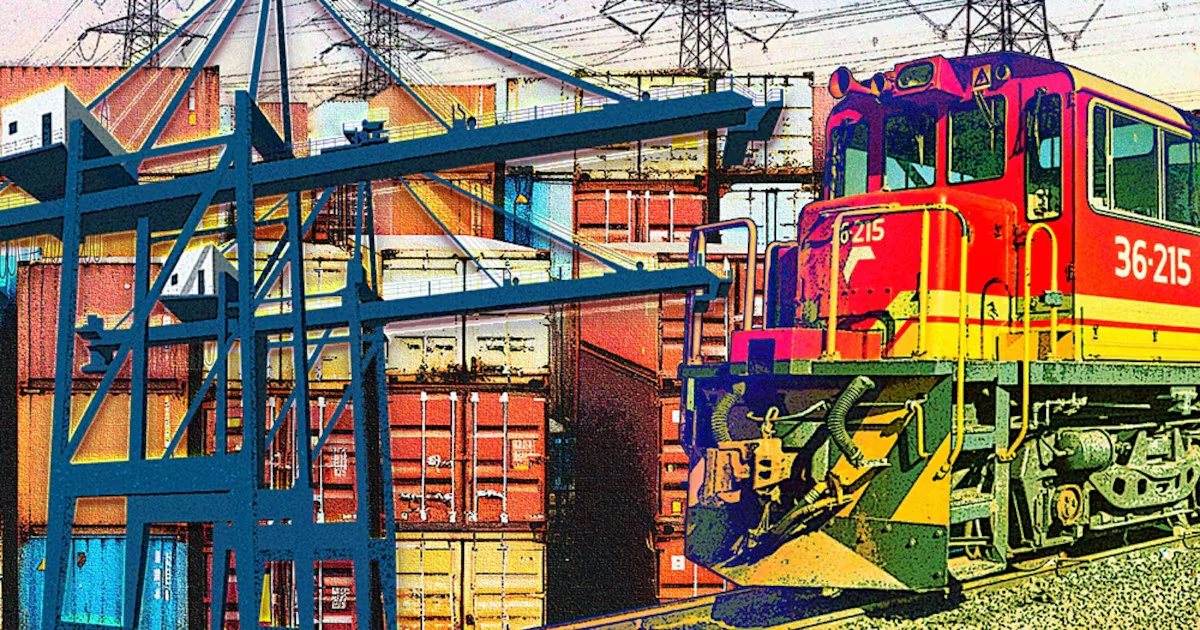
Confronting the challenge of turning plans into action amid mounting crises
1,028 words~5 min read