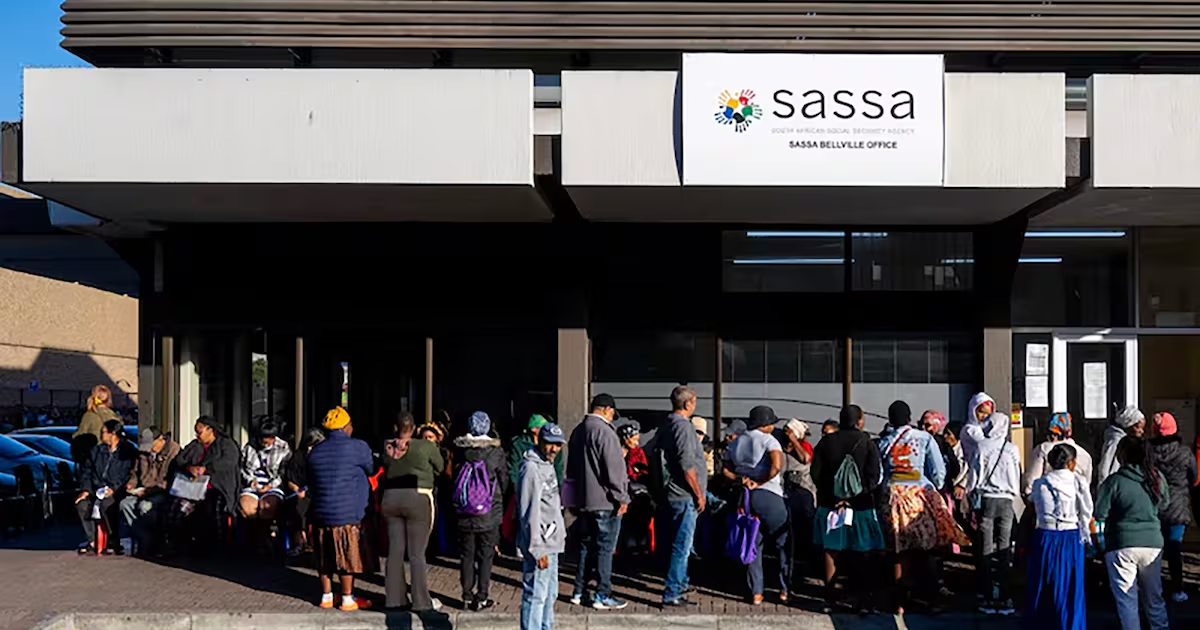
One of the most understated issues in public policy is who makes decisions within a household and how the exercise of that power can have differentiated impacts on the wellbeing of individual members of the household.In The Economics of Power and Poverty in the Home: Progress and Challenges in Measuring and Targeting Individual Well-Being within Households, economist Olivier Bargain, a research fellow at the UN University World Institute for Development Economics Research, discusses this issue.He argues that policies aimed at improving wellbeing require knowledge of which household members benefit from such policies. Policymakers shouldn’t assume that all family members benefit equally.Part of the problem is that available data is mostly collected at a household level, and this data ignores the complexity of behaviours within households and family decision-making processes, specifically regarding the use of resources.Even where data on individual and collective behaviour is collected through surveys and administrative records, “what is measured often represents only the tip of the iceberg”. This, says Bargain, limits the ability to measure wellbeing at an individual level.Take two issues about South Africa, a country with one of the highest unemployment rates in the world (above 33%) and a high number of people dependent on social grants (more than 40% of the population).Anecdotal evidence shows that unemployed people lose voice in household settings. When I was growing up in the 1970s, an unemployed person would be given all manner of pejorative nicknames, and his consumption heavily curtailed. He would often be called uqhwayilahle for example — one who pulls an ember from the hearth to light his roll of tobacco.Another example of complex household dynamics is about who receives a social grant within the family. In the late 2000s I sat through a focus group discussion in Umbumbulu, a largely rural community southwest of Durban. Some members of the group spoke about how the child grant had changed family dynamics.They quoted an example of a local girl who had now subverted the traditional family decision-making structure because she was the only one at home who brought in an income through social grants. Because she was now responsible for “bringing home a sack of mealie meal”, she had become the de facto head of the homestead, something that was a great shock to her father and neighbours. Both of her parents were unemployed but not yet old enough to qualify for an old age grant.Bargain makes the point that families “are not necessarily spaces of benevolent decision-making”, and that this heightens the need to collect individual-level data on time use, consumption and other dimensions.One example is the school-based meal programme, whose objective is to improve the wellbeing of children from poor families. This objective can be sabotaged if the family decides to reduce the dinner of a child who receives a school lunch by reallocating it to other children within the household.Government transfers aimed at improving the consumption of children and women can also be hijacked by men within a household.Bargain looks at several factors that explain intra-household decision-making. These include socio-demographic characteristics, including age and education differences between spouses. External factors, such as natural disasters and economic or social crises can also have gender-differentiated impacts. Then there are cultural norms that shape decision-making processes.Bargain concludes, though, that targeting the wellbeing of individuals within households effectively is difficult.• Sikhakhane, a former spokesperson for the finance minister, National Treasury and South African Reserve Bank, is editor of The Conversation Africa. He writes in his personal capacity.
JABULANI SIKHAKHANE | Data gaps obscure who truly benefits from SA’s social grants
Unemployment and cultural norms complicate the distribution of state benefits within families
579 words~3 min read