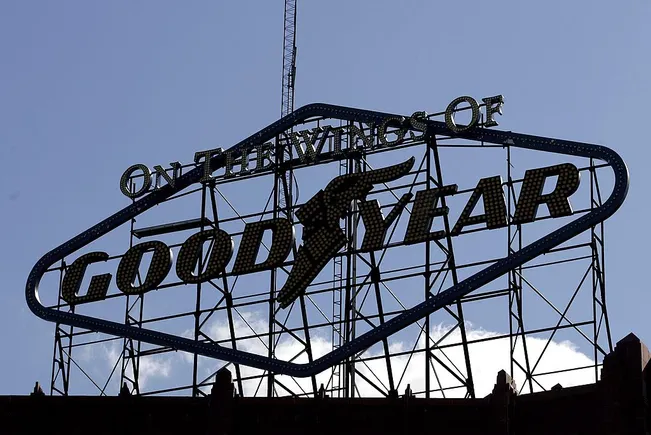
1200 Firestone Parkway, Akron, Ohio, is home to the former location of Firestone Tire & Rubber Co.'s Plant 1. Debris now lies moldering at the feet of an otherwise imposing clocktower. This spring, the city decided to save the clock bit of the complex."It's part of the identity of a city — a city that's been through hard times, wears its scars if not with pride, with meaning," said University of Akron professor David Giffels, co-author of the book "Wheels of Fortune: The Story of Rubber in Akron."Tire companies like Firestone, Goodyear, General, Goodrich, and Bridgestone were all here at one point. By 1950, half of all vehicle tires on planet Earth were made in Akron. But by 1982, tires had hit the skids."It was when proud Akron realized we're not the rubber capital anymore," Giffels said.It was the year they peeled the very last passenger car tire from a mold in Akron."The job loss had been massive," Giffels continued. "The city's finances plummeted. The city had to cut 600 jobs, had to eliminate 200 cars from the motor pool. Had to borrow $13 million to keep the recycled energy plant going, to keep the lights on. It was brutal."What does Akron’s story have to do with artificial intelligence and tax? This city is a case study of what happens when new technology clobbers jobs, clobbers income, which then clobbers tax revenue. More than 40 years ago, the new technology killing jobs was the steel-belted radial tire — a European innovation that lasts longer and saves gas. Yet Akron factories were customized for old-school tires, and company brass just kept wishing the longer-lasting tires would go away."In our book there's a Firestone executive who just says flatly, the radial tire is the reason that rubber left Akron," Giffels said.Could AI do to our near future what radial tires did to Akron? Tax policy experts now are planning for many scenarios, but some include an intense period of human layoffs as software increasingly does what one economist called "human-shaped" work."If labor displacement does become widespread, and the labor share in the longer term goes way down — the labor share of income — these would be really problematic for our current tax system," said Lee Lockwood, a University of Virginia economics professor.The way the U.S. collects taxes makes it especially vulnerable."Most rich country governments, including the U.S., rely very heavily on labor taxation for much of their revenue," Lockwood said.For the federal government, two-thirds of revenue comes from taxing labor — more than taxing corporations, more than taxing investments when they go up."The old tax system won't work without reform," said Joseph Stiglitz, a Nobel laureate and economics professor at Columbia University.While experts worry it'll take a crisis to overhaul an entrenched system, the solutions to a possible government revenue mess triggered by AI are varied and interesting. Should we consider taxing units of AI? Perhaps the government could take loads of AI company stock and reap the rewards when profits go up? What about a national sales tax? Or what about expanding on an existing tax policy?"We should force the corporations to pay their fair share," Stiglitz added.UVA's Lockwood co-authored a piece for Brookings that encourages policymakers to start weighing the alternatives. He's among the many who say a great place to start would be to fix the national debt, so the U.S. would have more leeway to respond to AI workplace disruption through government borrowing. Chances Republicans and Democrats would unite in this political environment? Well, now they can't say they never heard this coming.Additional production support by David Shin and Sophie Bellwoar.
What Akron's rubber bust can teach us about a possible AI tax crisis
In Akron, Ohio — once the tire capital of the world — the collapse of the rubber industry offers a stark preview of what AI-driven job losses could mean for government tax revenue.
604 words~3 min read