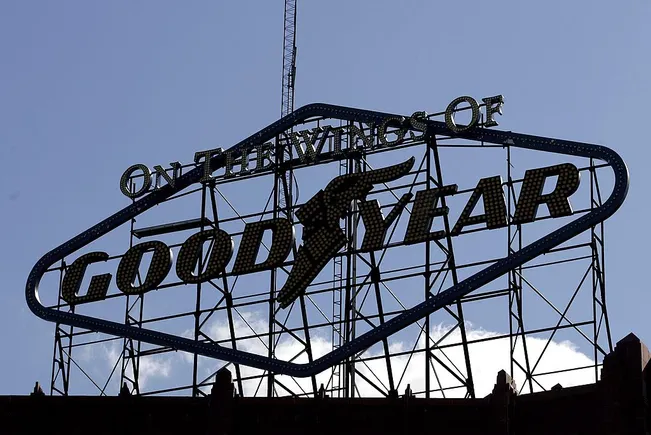
Downtown Akron’s history center holds a lot of mementos from the city’s time as the “rubber capital of the world,” including a slab that looks like a granite cornerstone but feels like a pre-historic seat cushion."This is how rubber arrived in Akron," explained Dave Lieberth, president of the Akron History Center, pointing to the slab. "It's just the raw rubber from the plantations — packaged in South America."Lieberth has spent decades documenting the flowering, collapse, and now rebirth of what was once the tire capital of the earth. The high point came in 1950, when half of all motor vehicle tires in the world were made in Akron.But 1982 brought what Lieberth calls the Big Blowout."There was a two-week period in the early '80s when Firestone laid off 11,000 men and women in the Akron area," he said.The dominant employers in Akron — Firestone, Goodrich, Goodyear, General Tire — were crushed by globalization and competition from non-union factories. A new technology out of Europe, the steel-belted radial tire, also played a role. The factories in Akron were customized to make another kind: balloon-like, bias-ply tires."There were a lot of reasons to believe the radial tire was superior," Lieberth said. Radials could go 40,000 miles instead of 20,000. Tires that don't get replaced as often were a hard sell to Akron tire makers, but consumers loved them.Leiberth once interviewed former B.F. Goodrich Company’s chairman, John Ong, who described his own company’s obstinance in the face of a changing market: "I had lived through and been part of the radial revolution in the '70s, and I had seen the lack of imagination on the part of my own company and our competitors in facing that threat.”By 1982, employment in the tire industry had fallen by two-thirds from its peak. With so many solid jobs gone, incomes collapsed and Akron tax revenues fell into the tank. Lieberth said that, combined with poor city leadership, the austerity lasted two decades."Downtown really looked like a ghost town at one point," he said.Governments raise money by mainly taxing labor, and when labor falls off, new tech could create new fiscal nightmares in the era of artificial intelligence."Two-thirds of federal revenue comes, in some sense, from wages and salary. If there's a shock to tax revenue from wages and salary, then that could be very disruptive to federal revenues," said Carter Price, an economist and mathematician at RAND. Last year, he co-authored a working paper on this issue, "Federal Revenue When AI Replaces Labor.""If AI does start disrupting the labor market, then there will be disruptions to federal revenue … and state and some city revenues as well,” Price said.While we don’t know when or how big AI job losses will be, Price is among those calling for hard conversations about whether our tax system needs an overhaul. Options include a Europeran-style value-added tax, or taxing units of AI, like we do gallons of gas. Joseph Stiglitz, a Nobel laureate and Columbia University economist, believes there’s a more straightforward answer. "We should force the corporations to pay their fair share, that will necessitate increasing the taxes on profits, and all of that will more than make up for the losses," he said.A first step to anything, economists say, is tending to the national debt. That way, the government isn't shackled as we enter an era of AI disruption. Additional production support by Daniel Shin and Sophie Bellwoar .
What Akron's tire collapse can teach us about the AI economy
In Akron, Ohio — once the tire capital of the world — the collapse of the rubber industry offers a stark preview of what AI-driven job losses could mean for government tax revenue.
571 words~3 min read