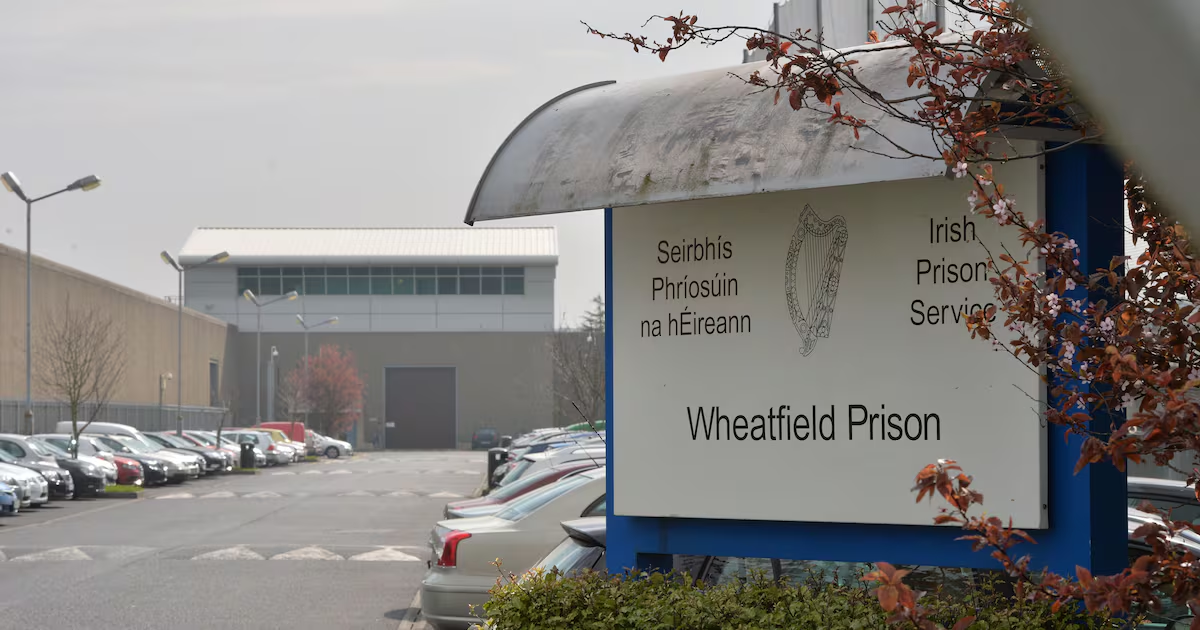
A doctor at Cork Prison has told an inquest into the death of a man found cold to the touch in his cell that the prison service should consider using technology which can remotely monitor the vital signs of certain inmates. Jamie Crowley (27) was pronounced dead in his cell on the morning of March 14th, 2024. His cellmate in the vulnerable persons unit (VPU) raised the alarm when he noticed Crowley was not breathing. Lividity had set in and he had been dead for some time. The native of Cork city, who variously lived in Mayfield and Mahon, had been remanded into custody at Cork Prison on March 8th, 2024.At his committal interview he informed a nurse that he was a drug user. He said he had a chaotic lifestyle and that his life revolved around drug taking. He told the nurse he had had a seizure the night before. He had also been sleeping in a tent. Crowley was placed on Librium for alcohol and drug withdrawals. He was subsequently seen by prison GP Dr Conor McGarry, who placed him on a comprehensive drug withdrawal regime. Crowley had tested positive for opiates, heroin, Valium and THC. However, in the early hours of March 13th an ambulance was called by prison staff amid concern for Crowley’s health. He was moved to hospital at 3.35am. Crowley was diagnosed with withdrawal seizures and treated in hospital. His condition stabilised and he was sent back to Cork Prison shortly before 7am.Crowley was returned to his original cell. He was then moved to the VPU for special observations. McGarry said Crowley was given all the necessary medication required in order to the avoid risk of seizures. He said that it was very unusual for someone to be moved to hospital for suspected withdrawal seizures several days into taking withdrawal medication. McGarry said it was his view that Crowley was accessing other illicit substances while in prison. He acknowledged that his views in relation to the death contrasted with those of Dr Margaret Bolster, who carried out the postmortem on Crowley.McGarry said prisoners in Ireland were taking “more novel psychoactive substances”.“There is a variety of new drugs appearing. [Reactions] can be mild or horrendous. Prisoners can be literally psychotic in a number of hours. Keep[ing] these out is a challenge, as is monitoring effects. Traditional [illegal] drugs are not as common as they used to be.”The doctor said dealing with drug withdrawal was literally “their bread and butter”. Many formerly homeless prisoners had taken drugs to make the day pass.He said it was hard to keep up with the substances being taken by inmates arising out of the “onslaught of [new substances] on the market. He said prisoners reported committing a crime in order to “get into prison”. He likened prison to an Airbnb and said that some inmates were looking for “three hots [meals] and a cot [place to sleep for the night].Crowley was being checked by prison officers through a hatch every 15 during the night that he died. The regular opening of a cell door at night was limited to “exceptional circumstances” such as treating a patient with terminal cancer.The doctor acknowledged the limitations to the set-up, which he stated occurred as a result of safety constraints. Tom Creed, SC, for the family of the deceased, put it to McGarry that an Inspector of Prisons investigation report on the case had recommended that the Irish Prison Service look into the potential of employing monitoring of vital-signs technology in prisons in Ireland. McGarry said remote monitoring was a “great idea” that “would make a lot of sense”. However, he said it would be quite complex in its organisation and would no doubt “cost an arm and a leg”.He said any remote system would have to be designed around issues such the potential for damage following an assault situation between prisoners. Dr McGarry said they currently replaced one or two televisions daily in Cork Prison as they are broken by inmates. He added that any technology employed would have to factor in such issues. The inquest will continue on Wednesday.
Prison service should consider technology to monitor vital signs of inmates, inquest hears
Jamie Crowley (27) was pronounced dead in his cell at Cork Prison in March 2024
687 words~3 min read