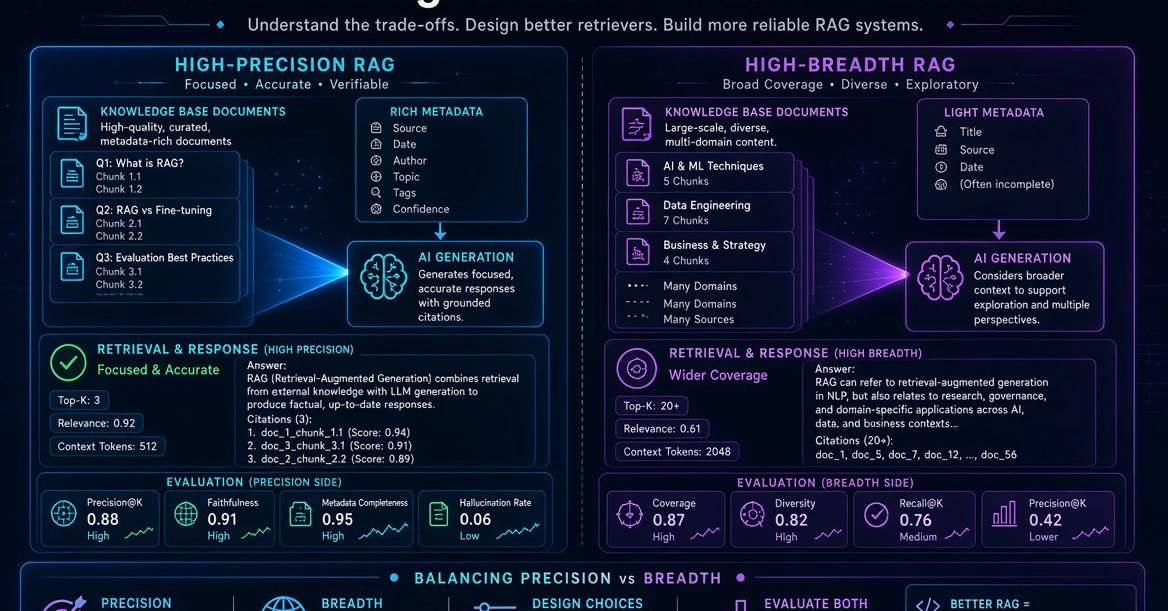
A retrieval-augmented generation system should be evaluated as a trade-off: research evidence shows that retrieval can improve precision and metadata completeness while reducing breadth. This tutorial explains how to turn that finding into a defensible knowledge-base evaluation plan.
Why This Is an Evaluation Tutorial, Not a Vendor Setup Guide
Retrieval-augmented generation, usually shortened to RAG, is often described as a straightforward recipe: retrieve relevant passages, add them to a language-model prompt, and expect more reliable answers. That description is incomplete. The available verified evidence does not support the claim that RAG improves every quality dimension, every task, or every model.
A June 2025 research paper, Reasoning with RAGged events: RAG-Enhanced Event Knowledge Base Construction and reasoning with proof-assistants, compares direct generation, knowledge-graph enhancement, and RAG for extracting structured historical events from narrative texts. Its case study uses the first ten chapters of Thucydides and evaluates multiple large language models, including GPT-4, Claude, and Llama 3.2.
The important lesson for teams planning a knowledge base is not that one architecture won universally. The paper finds that enhancement strategies optimize different performance dimensions. Direct generation favored coverage and historical breadth with Claude and GPT-4. RAG improved precision, coordinate accuracy, and metadata completeness, but reduced breadth. In other words, retrieval may help a system return more exact, better-supported details while also causing it to omit relevant events or facts that a broader approach might surface.