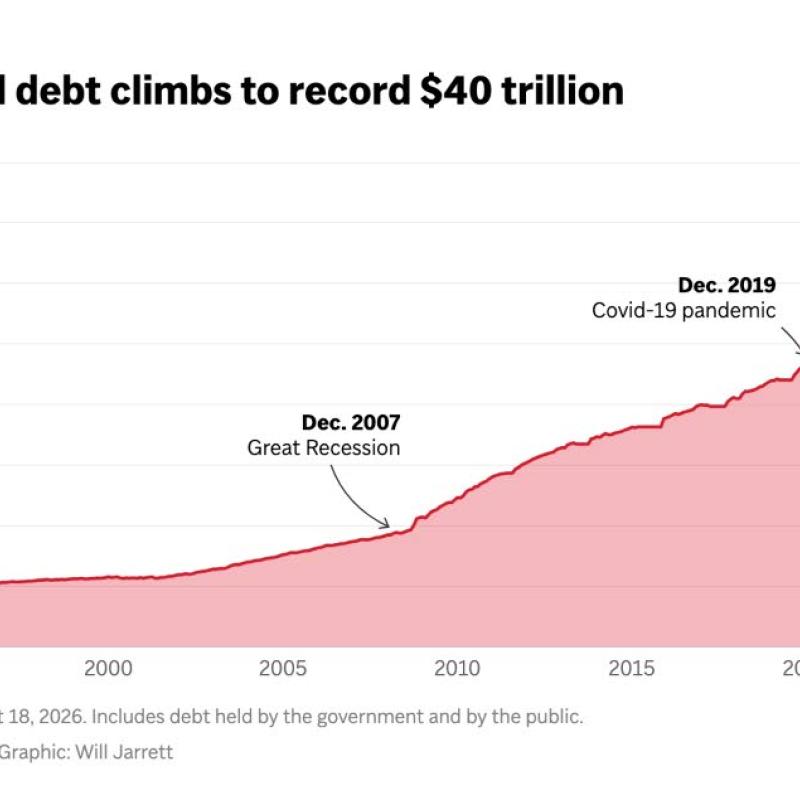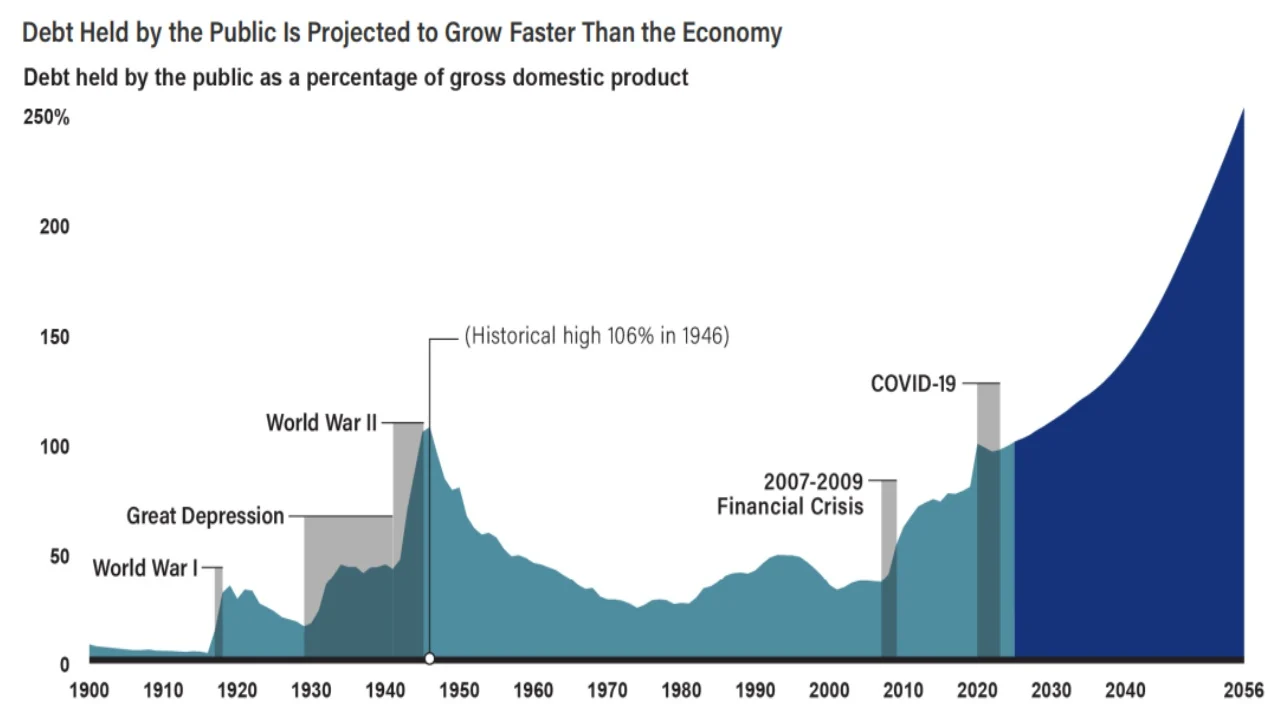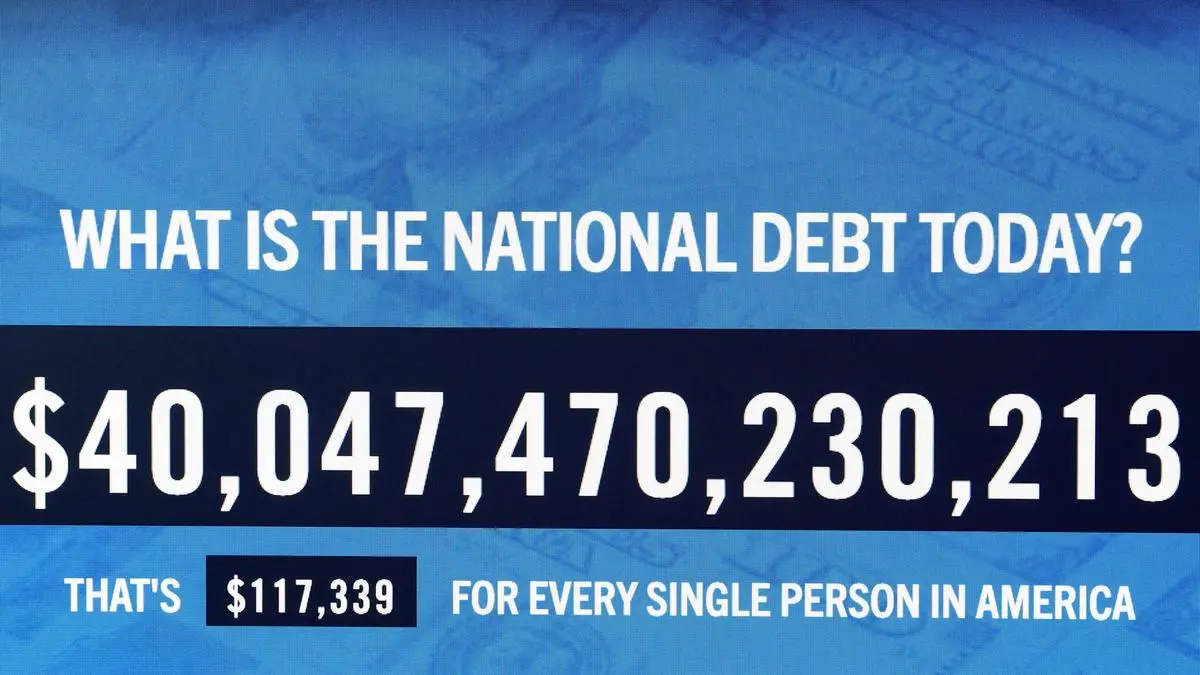
US national debt has passed a record US$40 trillion (£29.4 trillion). This milestone is a major warning sign. It reveals vulnerabilities that threaten the long-term economic stability of the US and the rest of the world.The speed of US debt accumulation is staggering. US national debt first reached $1 trillion in 1941 and, after rising to $20 trillion in 2017, has more than doubled over the past nine years. It is expected to increase by $2.1 trillion in the 2026 fiscal year alone.The primary source of high US national debt is Washington’s inability to control its persistent budget deficit. This stems in part from systemic political incentives. Addressing a deficit requires either cutting public spending, raising taxes or both. These are actions that tend to be punished by voters.The speed of US debt accumulation is staggering (Getty Images)Various structural factors also drive high US national debt. Mandatory spending on programmes such as social security and health insurance schemes like Medicare and Medicaid consume almost two-thirds of the federal budget. This spending is set to increase due to demographic ageing – the median age of Americans increased from 35.6 in 2001 to 39.4 in 2025.The cost of servicing national debt has itself also become a major driver of US federal budget deficits. Annual net interest payments the US government pays on its outstanding loans currently stand at around $1.2 trillion, eclipsing national defence spending. Servicing debt is now the second-largest item in the US federal budget, behind only social security, and is expected to cost more than $16.2 trillion over the next decade.A key reason why this status quo persists is the global importance of the US dollar. The US dollar has long served as the world’s primary reserve currency, and is the most widely used currency for international trade.This creates high global demand for US Treasury bonds, the financial instruments the US government issues to investors to pay for its national spending.That demand allows the US government to pay lower interest rates on these bonds, generally keeping its borrowing costs low. For years, this has provided Washington with little immediate pressure to change its trajectory.Economic risksHowever, the current trajectory poses several risks to the US and global economy. First, US Treasury bonds are considered safe assets by global investors, so often pull money away from other areas of the economy – a process economists call “crowding out”.This is particularly true if the yield – the effective interest rate the US government pays – on them is relatively high. On August 21, the yield on the US government’s 30-year bond was trading at 5.34%, its highest level in two decades. The US Treasury is now buying back its own bonds in an attempt to stabilise the yield.At the same time, the cost of servicing high levels of debt diminishes the US government’s flexibility to spend on areas of the economy where funding is most needed, including infrastructure, innovation and defence. Rising net interest costs, which currently represent around 14-15% of total federal outlays, are actively squeezing the federal budget.Second, a large fiscal deficit can be inflationary. This hampers price stability in the US economy and can lead the country’s central bank, the Federal Reserve, to increase interest rates. When passed on to firms and households, higher interest rates harm economic activity.Third, projections suggest the debt ceiling of US$41.1 trillion established by US Congress in 2025 is likely to be breached by mid-2027. This sets up a high-stakes legislative battle. A prolonged political showdown over whether to raise this ceiling could lead to the US government being unable to meet its financial obligations.Fourth, a lack of fiscal discipline is contributing to a slow-moving global shift away from the US dollar. The share of US dollars in global foreign exchange reserves currently stands at nearly 57%, a decline compared to 2001 when it was around 70%.Central banks worldwide are diversifying into non-traditional reserve assets, including the Chinese yuan, South Korean won, Norwegian krone and the Canadian, Australian and Singapore dollar. They are also pivoting towards gold, with central banks buying an average of 1,000 tonnes a year over the past four years – double the average of the previous decade.And fifth, due to the size and global significance of the US economy, there could be adverse spillovers of inflation and higher interest rates to other economies if US national debt continues to increase.This is because other countries will respond to the higher yield on US treasuries, caused in part by a larger supply of these bonds as US national debt rises, by offering higher returns themselves to prevent capital from leaving their economies and their currency from dropping.About the authorMuhammad Ali Nasir is a Professor of Economics, University of Leeds. This article was first published by The Conversation and is republished under a Creative Commons licence. Read the original article .Ultimately, the US needs structural fiscal adjustment. Its tax rates need to increase from their current level of around 27% of GDP to at least the OECD average of 34%. Donald Trump’s One Big Beautiful Bill Act, which is expected to cost more than $4 trillion over the next decade and add new tax cuts, also needs to be reconsidered.And finally, the US needs a bipartisan consensus on fiscal prudence to put its public finances in order. As the first US secretary of the treasury, Alexander Hamilton, said in his first report on public finances in 1790: “In countries in which the national debt is properly funded and an object of established confidence, it answers most of the purposes of money”.
America’s 40 trillion dollar debt crisis threatens global economic stability
US national debt has passed a record US$40 trillion. This milestone is a major warning sign
928 words~4 min read