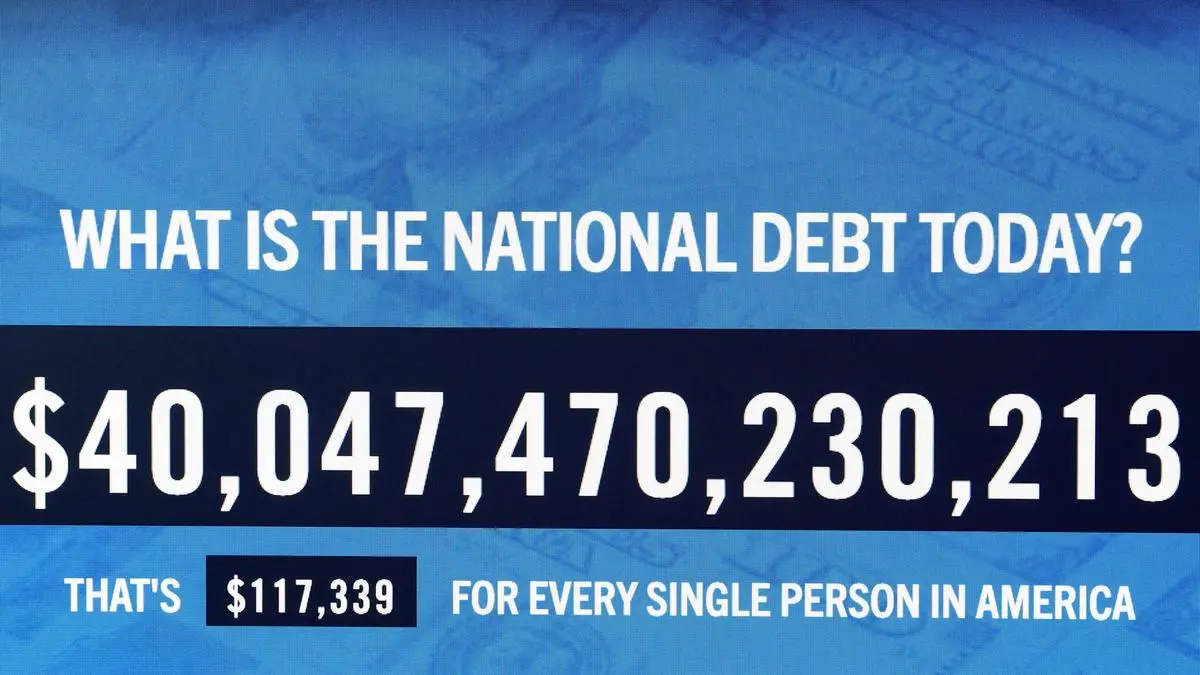
The country’s national debt is now over $40 trillion for the first time in history, leading economists to warn that the United States is staring down a fiscal reckoning.The Treasury Department reported on Wednesday that the debt crossed the $40 trillion mark the day before. Concerningly, the government has been running budget deficits for years, and for the first five months of fiscal 2026, the federal budget deficit totaled just about $1 trillion, according to the Congressional Budget Office.
“This bleak milestone serves as yet another reminder that it’s past time to confront a fundamental mismatch,” said Bipartisan Policy Center President and CEO Margaret Spellings. “Our federal programs spend much more than the government takes in, and the biggest-ticket items in the federal budget are all running on autopilot.“Federal debt is already raising the cost of living and choking out other spending and investment, threatening our economy and Americans’ long-term prosperity,” she added.While the national debt has exploded in recent years, it hasn’t been a frequent topic of discussion on the campaign trail, even though the matter is an important one.“It’s not just that this is a large number in absolute terms — it’s also that there are very tangible economic effects that we’re facing now, and that we will face more of in the future,” David Ditch, a policy analyst at the Cato Institute, told the Washington Examiner.Despite the growing debt, there has been very little momentum in Congress toward addressing the matter. For instance, the House failed to pass a measure earlier this year that would propose amending the Constitution to require the federal government to have a balanced budget.Last October, CBO estimated that the federal budget deficit for fiscal 2025 was $1.8 trillion as interest payments crossed $1 trillion for the first time.The 2025 federal deficit is high by historical standards and is the result of a long-running mismatch between spending and revenues that threatens the federal government’s fiscal health. At $1.8 trillion, the deficit is roughly 6% of GDP — a ratio that, before 2023, had never been seen in peacetime, other than during the 2008 financial crisis and the onset of the COVID-19 pandemic.Interest payments have soared, a concerning trend that has worsened in recent years. Net interest on the public debt was $1.03 trillion in 2025, up from $949 billion in fiscal 2024.Some analysts, such as the director of the nonpartisan CBO, have warned that the government faces economic risks if it does not address the long-term mismatch between spending and revenues.Affordability and cost-of-living challenges are the biggest issues for voters heading into the midterm elections. Inflation has been above the Fed’s 2% target for several years now, and the cumulative effects of that have caused consumer sentiment to sour.Ditch said there is a direct tie-in with the debt and the inflation that consumers are feeling.“The federal government went on a $7.5 trillion spending spree between 2020 and 2022, which put tremendous upward pressure on inflation, helping to kick off the current cycle of elevated inflation,” he said.Popular entitlement programs like Social Security and Medicare are also facing major fiscal cliffs.The Social Security retirement trust fund will be exhausted in 2032, earlier than previously anticipated, the program’s trustees projected in June — meaning that senior citizens would face a cut in their benefits at that time unless Congress acts.Workers can claim Social Security retirement beginning at age 62. Benefits increase the longer workers wait to claim them, but they cap out at a retirement age of 70.The trustees predicted that the Old Age and Survivors Insurance trust fund would only be enough to pay 78% of scheduled benefits in the fourth quarter of 2032.The OASI trust fund, combined with the disability insurance trust fund, is projected to be able to pay out benefits until 2034, after which there will only be enough to pay out 83% of benefits, the trustees project.Ditch said the country’s fiscal trajectory and national debt threaten U.S. growth and well-being.“Americans take economic growth and opportunity and prosperity as a core part of our national identity, and if we lose that, to me, I think we lose a very important part of what it means to be the United States of America,” he said.EDITORIAL: SOCIAL SECURITY INSOLVENCY IS HEREFormer Rep. Carolyn Bourdeaux (D-GA), who is now executive director of Concord Action, said the latest $40 trillion milestone should serve as a “wake up call.”“But neither Congress nor the President have a credible plan to stop it from growing,” she said. “Every day that goes by makes the problem worse and more difficult to solve. At $40 trillion, the national debt now equals nearly $117,000 for every person in America.”