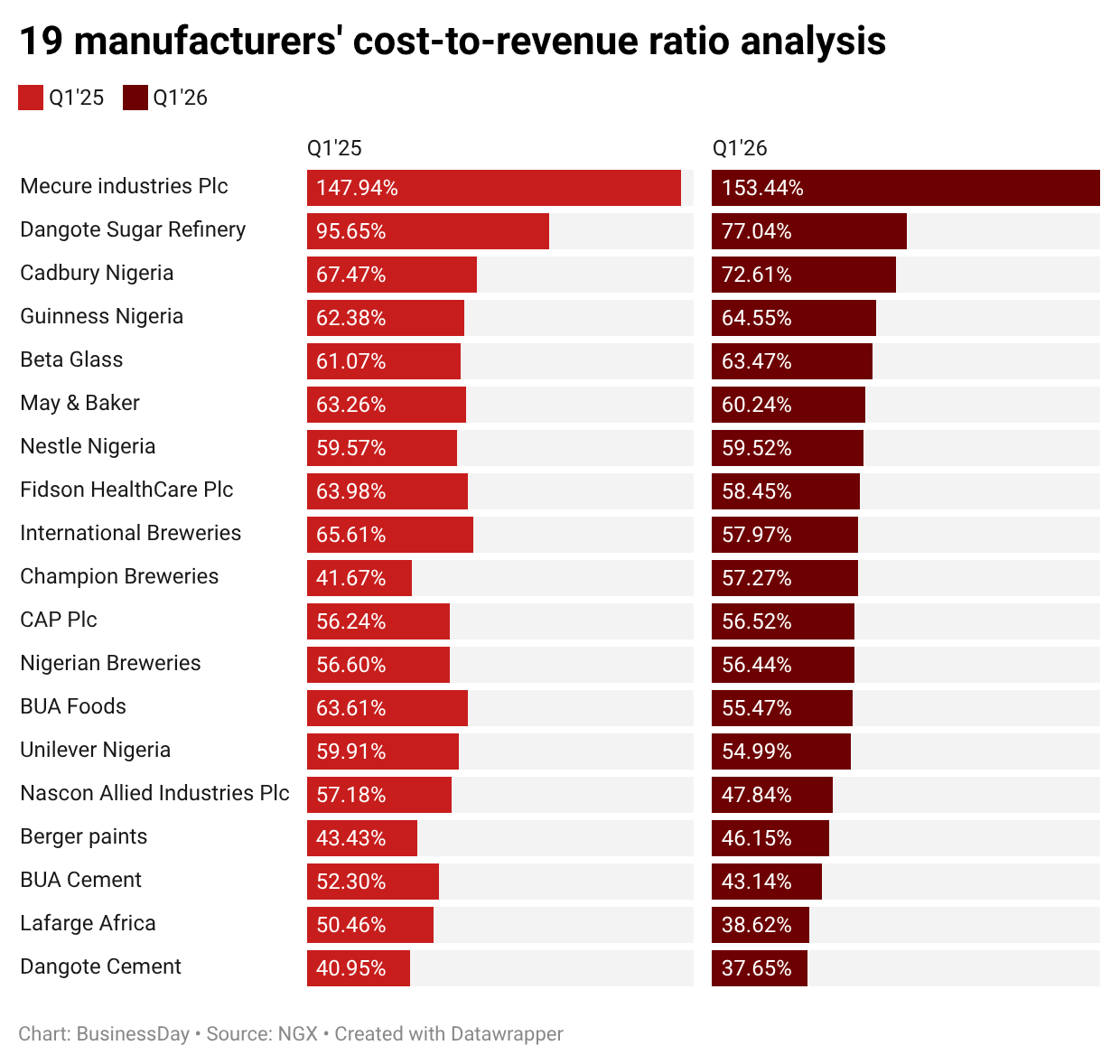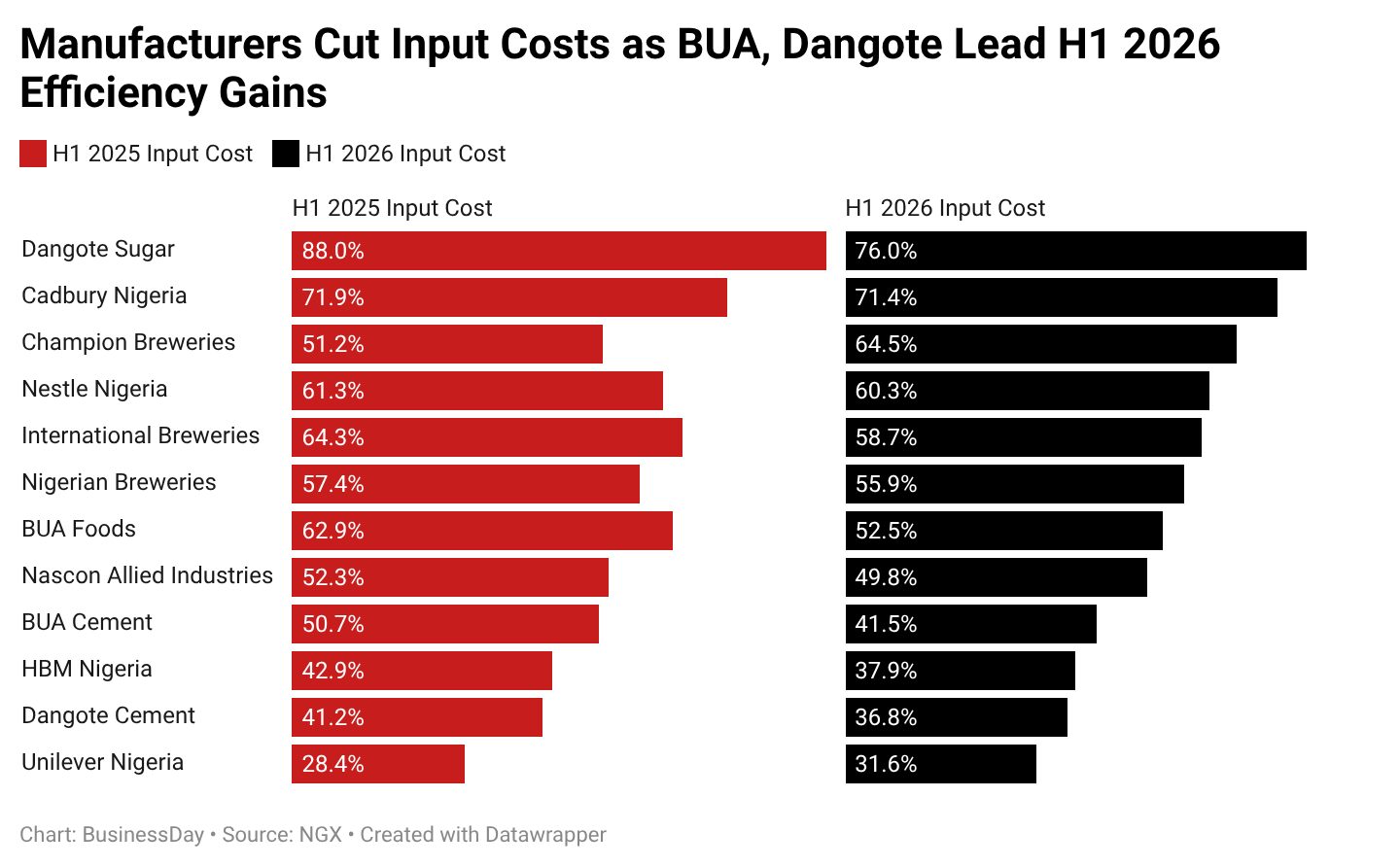
Nigeria’s major listed manufacturers significantly reduced the share of revenue absorbed by production costs in the first half of 2026, pointing to an emerging improvement in cost efficiency as inflationary pressures began to moderate and exchange-rate conditions became more predictable.
An analysis of financial statements from 12 major companies across consumer goods, food, beverages and cement shows that their aggregate cost of sales fell to N3.38 trillion in H1 2026, from N3.45 trillion in H1 2025, even as combined revenue rose to N7.19 trillion from N6.44 trillion.
The result was a sharp decline in the aggregate input-cost ratio — measured as cost of sales as a share of revenue from 53.62 percent in H1 2025 to 47.07 percent in H1 2026, representing a 6.55 percentage-point improvement.
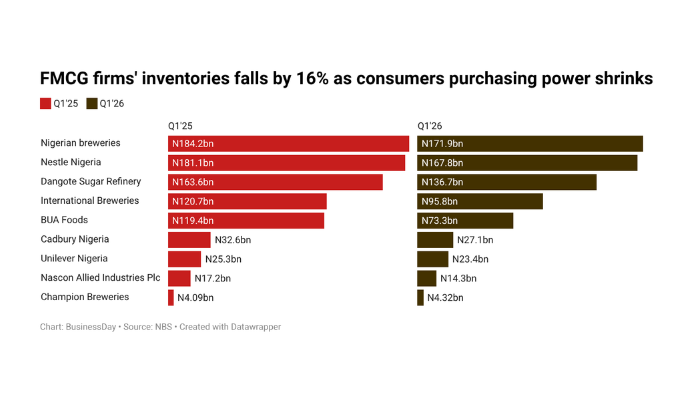
The movement is significant because it suggests that manufacturers were able to convert a larger proportion of each naira of sales into gross value before operating expenses, finance costs and taxes, despite continuing pressure from energy, logistics, imported materials and weak consumer purchasing power.
The improvement also coincides with a broader moderation in Nigeria’s inflation environment. Headline inflation fell to 15.43 percent in July 2026 from 15.91 percent in June, while month-on-month inflation slowed to 1.57 percent from 1.66 percent.