Nigeria’s largest consumer goods companies are making fewer bets on what Nigerians will buy.
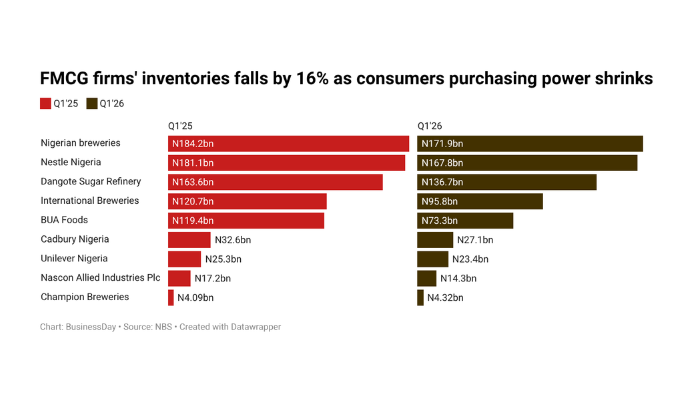
Faced with households still struggling with high cost of living, listed manufacturers’ unsold inventories fall by 16 percent in the first quarter of 2026, signalling that they are producing more cautiously and buying fewer raw materials as consumer demand remains fragile.
BusinessDay’s analysis of nine listed consumer goods and brewing companies shows combined inventories declined to N714.6 billion in Q1 2026 from N848.2 billion a year earlier, while raw material holdings plunged by 33.8 percent, reflecting a cautious approach to manufacturing despite resilient profitability.
The inventory drawdown comes even as aggregate revenue edged higher to N1.65 trillion from N1.64 trillion, while combined profit jumped 32.5 percent to N297.2 billion from N224.4 billion, suggesting companies are becoming more efficient rather than simply producing more.
The trend reflects a sector still navigating Nigeria’s difficult consumer environment, where inflation has eased from 2024 peaks, but purchasing power remains weak, forcing manufacturers to prioritise cash preservation, lean inventories, and faster stock turnover over volume expansion.