The combined finance costs of 12 leading fast-moving consumer goods companies listed on the Nigerian Exchange declined by 23.02 per cent to N67.66bn in the first quarter of 2026, from N87.90bn in the corresponding period of 2025, signalling stronger profitability, lower debt burdens and increased reliance on equity financing.
An analysis of the companies’ unaudited financial statements showed that finance costs decreased by N20.23bn year-on-year as many firms returned to profitability and accelerated debt repayment after weathering the impact of foreign exchange volatility and elevated borrowing costs in 2025.
Finance cost is the total cost a company incurs for borrowing money or financing its operations. It is reported in the income statement and reduces a company’s profit.
The PUNCH spoke to industry analysts who attributed the improvement to stronger earnings, deleveraging, and increased access to equity financing following the rally in the Nigerian capital market, which reduced dependence on expensive bank borrowings.
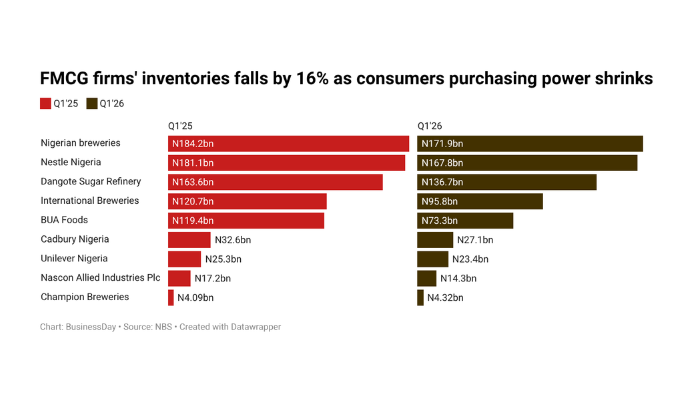
The biggest contributor to the decline came from Dangote Sugar Refinery, although it still recorded the highest finance cost in the sector at N28.45bn, down 4.73 per cent from N29.86bn. Nestlé Nigeria followed, with finance costs falling 27.88 per cent to N16.92bn from N23.47bn, while Nigerian Breweries posted one of the sharpest reductions, cutting finance costs by 46.09 per cent to N8.28bn from N15.36bn.