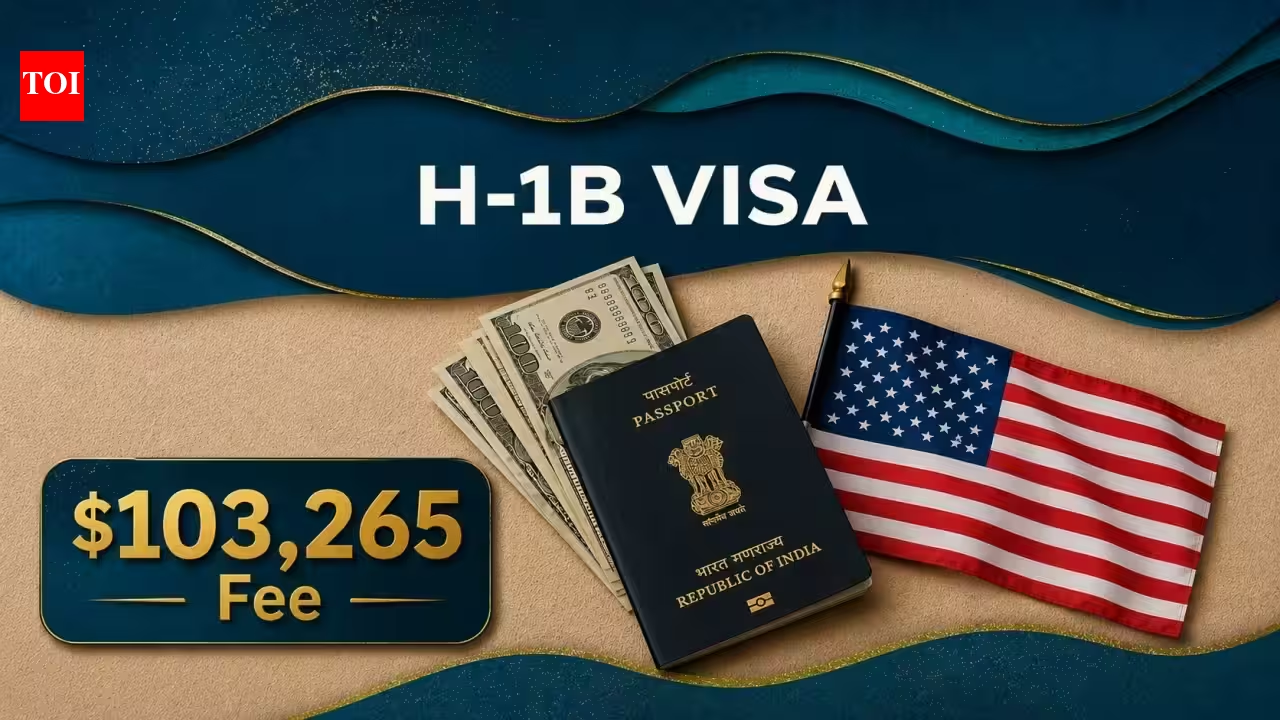
For Indian students and families looking at the United States for higher education and work, the financial and immigration barriers are rising at both ends of the journey. The annual cost of attending more than a dozen US colleges has crossed $100,000, while the Trump administration has proposed a separate $103,265 fee on cap-subject H-1B petitions.India remains the largest source of international students in the US, with 363,019 students recorded in the 2024-25 academic year. However, applications from India to US colleges fell 14% by February 2026, according to Common App data.The college amount is the sticker price, which includes tuition, fees, accommodation, meals, books, transport and other expenses. The H-1B charge is still only a proposal and is not in force yet. Together, the developments show how expensive and uncertain the US education-to-employment pathway has become.Also Read| America sold the world a dream — and kept millions chasing itCollege costs cross the $100,000 markFor the 2026-27 academic year, 16 US institutions have a yearly sticker price of more than $100,000, according to data provided to CNBC by The Princeton Review for its upcoming “The Best 392 Colleges” list.The institutions include Duke University, Georgetown University, New York University and the University of Chicago. Brown University, Northwestern University and Pepperdine University are among those with annual costs above $99,000.The total includes more than tuition. Families must also account for housing, food, books, transportation and other personal expenses.“We just keep going up and it just never stops,” Jeff Selingo, author of “Dream School”, told CNBC.“We have been moving toward this six-figure price tag for a long time, and now we are here — and for a lot of people that feels significant,” he said.The rising sticker prices are putting pressure on smaller private and liberal arts colleges. Selingo said some families are now questioning whether these institutions justify their cost, leading students to consider larger public universities and community colleges.“The cost of college is sobering — no doubt about that,” said Robert Franek, editor in chief at The Princeton Review. “And with some schools’ sticker prices crossing the $100,000 mark, paying for college seems all the more daunting.”Also Read| Is a foreign degree still worth it? Indian students rethink as costs soar, visas tightenThe sticker price is not the final priceThe published cost does not always reflect what families pay. Private colleges increasingly use scholarships and grants to reduce the final bill.The average tuition discount for first-time, full-time students at private colleges reached 57% for the 2025-26 academic year, according to the National Association of College and University Business Officers.“This means that for every dollar of undergraduate tuition and fees that these institutions could have charged, they awarded roughly 57 cents in grant aid to first-time undergraduates,” the organisation said.The Princeton Review found that among the 16 institutions with six-figure annual price tags, the average scholarship grant for first-year students with financial need ranged from $42,000 to $79,000 for 2026-27.“The data tell a clear story: Don’t rule out a private college due to its sticker price, because odds are very good that you will receive a grant from that school,” Kara Freeman, president and CEO of NACUBO, said in a statement.But students must first be admitted and qualify for financial aid. Scholarships may also depend on family income, academic performance and an institution’s own policies. The headline price remains a major factor in how families compare colleges.Students are moving towards cheaper pathwaysThe high cost of four-year degrees is changing student choices. The latest increases in US undergraduate enrolment are being driven by community colleges and public four-year institutions, according to the National Student Clearinghouse Research Center.The Lumina Foundation-Gallup State of Higher Education 2026 report also points to growing interest in shorter programmes.Among US adults without a college degree, 58% said they had considered pursuing a degree or credential in the previous two years. Nearly one in four was considering an associate degree or certificate.The report found that shorter programmes attract students because they can offer a quicker route to employment, access to local jobs and the ability to work while studying.Also Read| US loses ground as study destination amid weak safety, visa perceptions: SurveyCareer prospects remain the strongest reason for pursuing higher education. Expected job opportunities were cited by 67% of currently enrolled adults, 63% of those who had stopped studying and 57% of adults who had never enrolled.Employers also continue to value degrees and credentials. About 74% said the importance of a college degree or credential for getting a good job at their organisation would remain unchanged or increase over the next five years.At the same time, 76% of employers said they preferred bachelor’s degree holders for jobs that did not require a degree, while 78% preferred associate degree holders.Indian students remain the largest international groupIndia remains the leading source of international students in the US.The Open Doors 2025 report, sponsored by the US Department of State and implemented by the Institute of International Education, recorded 363,019 students from India in the 2024-25 academic year, a 10% increase from 331,602 in 2023-24. The figure includes students enrolled at US institutions and those on Optional Practical Training, or OPT.The Open Doors India country fact sheet shows that the 2024-25 total included 177,892 graduate students, 40,135 undergraduate students and 143,740 students on OPT.However, recent indicators suggest that future Indian enrolment may weaken.Common App’s February 2026 report found that the number of Indian applicants to US colleges fell 14% by February 1 compared with the same point in the 2024-25 application cycle. International applicants overall declined 9%.The data covers first-year college applicants and does not represent completed enrolments. Still, it offers an early indication that fewer Indian students are applying to US colleges.A separate Fall 2025 Snapshot by the Institute of International Education and higher education associations found that total international student numbers at participating US institutions fell 1% in the 2025-26 academic year. New international enrolments fell 17%, while graduate enrolments declined 12%. The report did not provide a country-specific decline for India.This creates a contrast: Indian students still form the largest international student group in the US, but fewer prospective students appear to be applying. Rising college costs, tougher visa scrutiny and uncertainty around post-study employment may be making families reconsider the US before they commit to an expensive degree.Affordability affects whether students enrolThe Lumina-Gallup report found that financial aid influences both where students study and whether they study at all.Among people who applied to college and completed the FAFSA for the 2025-26 academic year, 72% said the aid offered affected where they enrolled. Nearly two-thirds, or 64%, said it influenced whether they enrolled.Students also ranked proximity to home, cost of attendance and financial aid among the main reasons for choosing an institution.Only 25% of adults without a college degree believe that all or most people in the US have access to quality, affordable education after high school. That figure has fallen by 10 percentage points since 2023.The finding highlights the gap between the perceived value of higher education and its affordability. Seventy-three per cent of adults without a degree said a two- or four-year degree is at least as important for career success as it was 20 years ago.Student debt delays life decisionsThe cost does not end when students leave college. More than eight in 10 borrowers worry about their ability to afford student loan payments, including 78% of those with less than $10,000 in debt.Around 52% of college graduates with outstanding loans said their debt had delayed at least one major life decision. The most common delays include saving for retirement and returning to school for additional training.Even smaller debts can have an impact. About 32% of graduates who borrowed less than $10,000 said they had postponed one or more major milestones because of their loans.The likelihood and number of delayed decisions increase as the loan amount rises.The H-1B route is becoming more expensiveFor international students, the financial challenge continues after graduation. The Trump administration has proposed a $103,265 fee on employers filing cap-subject H-1B petitions.The proposed charge would apply to petitions under the annual H-1B cap, including the regular 65,000 visas and the additional 20,000 places reserved for applicants with qualifying US master’s degrees.This means the proposal could affect foreign students already in the US who are selected in the H-1B lottery and seek to move from student status to work status. It would not automatically apply to every H-1B holder, and cap-exempt petitions would not be covered.The fee would be paid by the employer, but its effect could extend to workers. Companies may become more cautious about sponsoring international graduates if hiring them involves a six-figure additional cost.The proposed fee is separate from other H-1B charges and from the earlier entry-related fee announced for certain workers applying from outside the US. It will require a federal rule-making process, including public comments, government review and a final decision before it can take effect.A costly and uncertain pathwayThe US continues to offer access to leading universities and a large job market. But the route from education to employment now comes with several financial risks.Families may face a six-figure annual college sticker price, even if scholarships reduce the final bill. Students may need loans to cover the remaining cost. After graduation, they may face uncertainty over whether an employer will sponsor them for an H-1B visa and absorb the proposed fee.The Lumina-Gallup report captures this tension. Americans continue to believe that higher education improves career opportunities, but many no longer believe quality, affordable education is within reach.For Indian students, the decision is no longer only about getting admission to a US college. It also involves calculating the net cost after aid, the risk of student debt, the value of the chosen programme, the possibility of securing a work visa and the effect of changing US immigration rules.The US remains a major destination for Indian students. But with college costs rising, applications falling and the H-1B route facing a possible six-figure employer charge, starting a new life in America is becoming a more expensive and uncertain decision.
Studying in America is anything but a dream now - The Economic Times
The US education-to-employment route is becoming costlier for Indian students. Annual costs at 16 colleges have crossed $100,000, while a proposed $103,265 H-1B employer fee could complicate post-study hiring. Meanwhile, Indian first-year applications to US colleges have fallen 14%.
1,675 words~8 min read