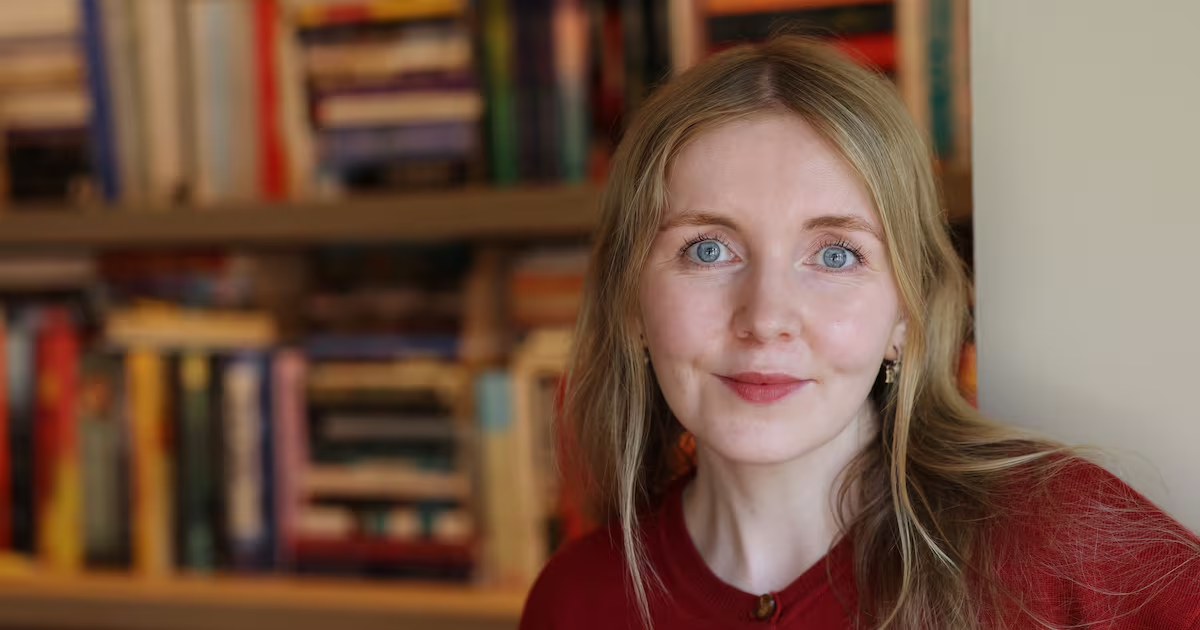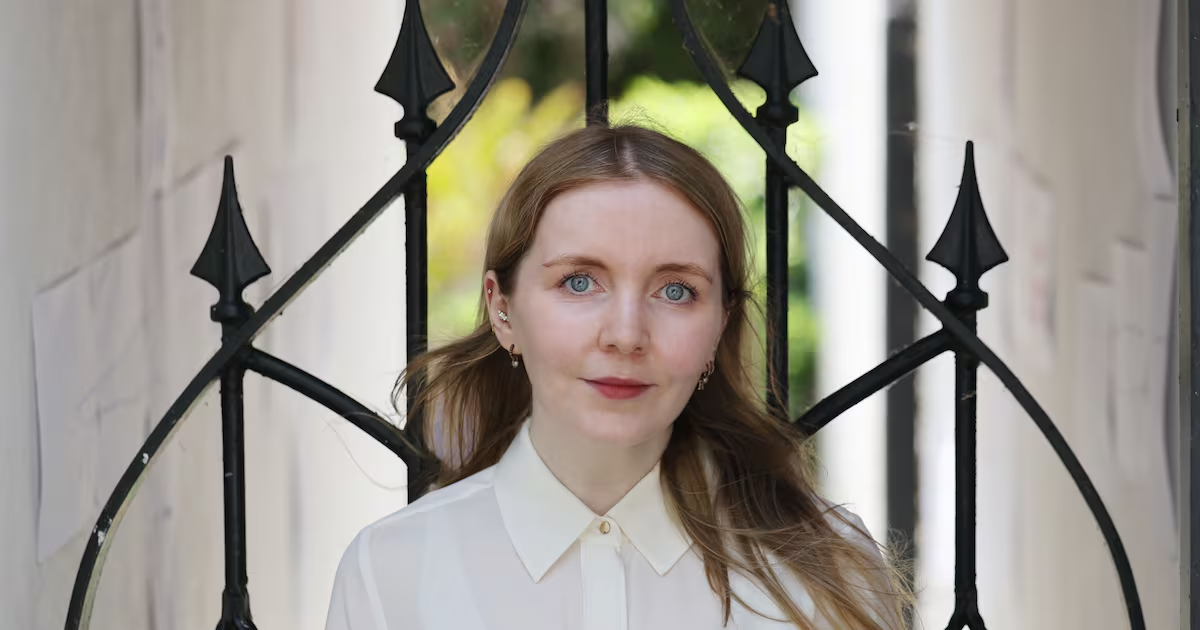
Should I get Botox? Is it vain to love make-up? How much of my identity is really me, and how much has been imposed on me? These days, decisions about our personal aesthetics can easily become messy dilemmas. If you’re looking for didactic answers to such questions, Roisin Kiberd’s new essay collection, The Most Normal Woman: Essays on Appearances, isn’t where you’ll find them. Instead, you’ll discover a thoughtful, often humorous, rigorous yet open-minded dissection of beauty and identity in the current age.“I call it a book about appearances – that’s the common thread between all of the themes,” says Kiberd, a 37-year-old Dublin-born journalist and writer who bears a vigorous intellectual energy matched by an earnest self-awareness. “It began as a book more overtly about the beauty industry. But the more I wrote, the more it opened out into being about how we show up in the world more generally, and the psychology of it.”Kiberd is an astute observer of human behaviour, even seeking to dress so she can blend in and people-watch. She lives a somewhat nomadic life with her partner, writer Rob Doyle, so whether in Dublin, Galway (where she lectures in creative writing at the University of Galway), London or Berlin, she positions herself at a slight remove in order to witness. Once, during an interview with the late author Edna O’Brien, she was comforted to hear the doyenne of Irish fiction tell her this was normal, as “a writer is always a little bit outside of life”.When we meet, Kiberd is wearing a cream blouse with a high neck and long, ruffled sleeves, and either dark trousers or a skirt. I realise afterwards I can’t remember, which only serves to prove her point that she dresses to “pass through like a spy undercover”. On her wrist she has a delicate gold bracelet with the word “Pisces” on it. “I am a double Pisces,” she says, adding with a grin, “And I don’t even know if I believe in astrology ...” Still, as her book shows, sometimes we take on facets of our identity even if we don’t quite know why.Kiberd admits to some fear about publishing a book on beauty, worrying that people will see it as solipsistic in a time of “creeping fascism”. But while beauty can be a glittery distraction, it can never be disentangled from politics or societal trends, as proven by everything from tradwives’ pursuit of homespun perfection to the pillowy and aesthetically enhanced “Mar-a-Lago face” beloved of some Donald Trump supporters.In her first essay collection published in 2021, The Disconnect: A Personal Journey Through the Internet, Kiberd stepped into the waters of tech to examine its grimy undertow. The Most Normal Woman was more fun to write, she says, yet explores a theme that’s just as thorny. “[Beauty is] a very weighty subject in an odd way, unexpectedly, because it is so woven into culture and woven into our lives and our worlds. And at its worst, it can become wildly oppressive and very cruel and biased and remorseless, frankly, and manipulative. But then on the other hand, it can also be art,” she says. She wanted to pause and reflect in the book, rather than uphold or condemn.It’s arguable that no woman grows up being unaware of her appearance, so perhaps Kiberd has always been preparing for this book.Roisin Kiberd: 'As long as I’ve been alive, I’ve thought so much about identity. I’ve kind of given up on having a fixed identity, if I’m honest.' Photograph: Alan Betson “As long as I’ve been alive, I’ve thought so much about identity. I’ve kind of given up on having a fixed identity, if I’m honest,” she says with a gentle shrug. “I’ve always been really drawn to the literary idea of an unstable narrator or a shapeshifting narrator. So the book became this interrogation of ‘how do we create identity for ourselves?’ as well. One thing I was keen to write about was the idea of the ‘fantasy self’.”Kiberd writes about her fantasy self floating in her peripheral vision during a trip to the department store Selfridges in London. “It does sound a bit insane. But at the same time, isn’t that just being sold to us every single day? ‘Become someone else. Become someone different to who you are now. Imagine your life once you buy this dress,’” she says. “I was driven to write this book because I could sense that this thing just lives in my head rent free. Beauty, appearances – it’s like this parasite that inhabits my brain. For all my better instincts, it’s still there.”The first chapter in the book details her adventures with Botox. Not only is Botox manufactured by Allergan (owned by pharmaceutical company AbbVie) in Co Mayo, but the salon software company Phorest found in a survey that 62 per cent of Irish people either had used an anti-wrinkle injectable like Botox or were interested in doing so. “I’m letting it wear off right now,” she says, scrunching up her forehead. “I’ve not really seen that much of a difference, but maybe it’s still slightly active. I’m like, ‘Is this worth the money?’ I think ultimately it’s all about our feelings. I don’t think anyone else cares.”She would never condemn Botox or aesthetic interventions. “I don’t think moralising writing has anywhere to go, anyway,” she says. “If you come in having made your mind up exactly, and you’re just going to shout at the reader until they agree with you, there’s no journey.”‘It rewires your brain, and you never fully go back to normal. But then culture is not normal either’— Roisin KiberdFor many people, beauty will always be entwined with questions about what it really means to covet a lipstick, or desire to smooth out wrinkles. Kiberd doesn’t believe this inner conflict will disappear. “I think we have to embrace the complexity of it, and we have to seize any chance we can to broaden out that moment between picking [an item] up and carrying it to the cash register. Embrace the weirdness, the complexity, all of the emotions,” she encourages.[ Roisin Kiberd: I‘ve glimpsed the future of the internet. It’s a niche, useless, happy placeOpens in new window ]Her publishers, Tramp Press, nudged her to be as brave as she wanted in The Most Normal Woman. “They were like: ‘You can get weirder if you want,’” she says. That weirdness turned into a shot of fiction: vignettes written from the viewpoint of an alien visiting Earth, who becomes baffled by humans’ pursuit of beauty. (At one point, Kiberd writes that she herself feels like an alien in this world.) In the chapters in between, she fuses reportage and memoir. She visits a bodybuilding competition, goes to AbbVie’s base in Co Mayo, attends a Drag Race convention and even pops into a dog show.Being an essayist can entail getting very personal about your experiences, but Kiberd would rather write honestly than not. “I think the reader can smell it when you’re not [honest],” she posits. She was nervous of writing about her partner and his experiences with ketamine use in Berlin in one chapter, but got his sign-off. (She mentions that he will be writing about it himself, as will their friend Lias Saoudi of the band Fat White Family, in his book Tears of the Patriarch, out next year).[ Emer McLysaght: I’ve changed my mind about BotoxOpens in new window ]But it was perhaps trickier when it came to writing about “what the hell comes after eating disorder recovery”, something Kiberd has personal experience of. She first developed an eating disorder aged 11, and began recovery more than a decade ago. “I’d be curious to know what other people’s experiences are like. Mine has been that it just never goes away. It rewires your brain, and you never fully go back to normal. But then culture is not normal either,” she says. “It’s a pure grey area, and grey areas are my favourite thing to write about. If I feel ambivalent or a little uncertain about something, it usually means it’s a good thing for me to write about.”Roisin Kiberd: 'I have that drive in me to turn anything into an obsession.' Photograph: Alan Betson She harbours a desire to live a parallel life where she studies psychology, because she finds eating disorders and addictions an “impenetrable mystery”. “When I think of them, I think about the Cenobites from the movie Hellraiser. They are creatures of pain. If you are sufficiently vulnerable, they come in and they take hold of you,” she says.“I’m treading carefully with writing about all of it. But it was really important to me to write about this weird grey area experience that I’ve been having for years. Where I want to be well, I want to learn to make nice food and cook, I want to eat good food, I want to exercise, I want to be healthy – all the things that a recovery should involve. “But by engaging with those worlds, whether it’s online or even just going to yoga studios, I always feel like I’m on the brink of a relapse. Algorithms don’t help. But even without the algorithms ... I have that drive in me to turn anything into an obsession.”She writes in the book about a period in Berlin – around the same time her boyfriend’s ketamine use was increasing – when excessive exercise impacted on her sense of self and identity. “It interested me to write about it. I think I’m a little bit better since I wrote that essay, but [the behaviour] still comes back,” she says. “It’s responsive to pressure, to mood, to everything. It’s like you have to doublethink your life.”She turns to yoga in particular due to a feeling of being “wildly uncomfortable being alive”. “There are days when I wake up and I’m just too alive for myself. I’m just like, ‘The world is too bright today and I can’t handle it. And what am I going to do? Oh God!’” she says. “But if I do yoga, I don’t get that.” However, yoga’s grounding effect led her to wonder if these feelings indicated she was neurodivergent.So towards its end, the book takes a swerve in a new direction as she writes about her ongoing journey in pursuing an autism diagnosis. It’s somewhat of a necessary spoiler to say that this element of her story dwells in the grey, too. “I don’t want to be appropriating someone’s experience when I’m not fully diagnosed,” she says cautiously. “I have to say though that since I went through that process, I am benefiting from it, and that seems to confirm to me that it’s real.”[ Shapechangers: Essays from Irish women quietly challenging how literary history is writtenOpens in new window ]How so? “I’m able to manage my emotions and my sensory experience of the world better than I ever did before,” she explains, by using simple tools like an eye mask and earplugs as calming mechanisms. She’s also learned to take time to herself after socialising, something she used to judge herself for but now embraces.By the end of The Most Normal Woman, Kiberd has brought us on a personal and cultural journey through identity and appearance, resisting moralistic lessons but nonetheless showing us that life – hers, ours – is all about shifts and changes. There’s been a fresh shift in her identity since: after two essay collections, she’s focusing on writing fiction. She’s “writing like a maniac” on both short and longform pieces. “I’m happiest when I’m working,” says Kiberd. Happiest when working, thinking, and teasing out the trickiest issues of our time.The Most Normal Woman: Essays on Appearances by Roisin Kiberd is published by Tramp Press on August 27th
Roisin Kiberd: ‘Beauty is a very weighty subject ... it can be cruel and manipulative but it can also be art’
The journalist and writer’s new essay collection dissects the concepts of beauty and identity in the present age
1,966 words~9 min read