The Most Normal Woman: Essays on Appearances Author: Roisin KiberdISBN-13: 978-1915290229Publisher: Tramp PressGuideline Price: €16; 272ppAt the 2015 Golden Globes, host Tina Fey considered the effort Steve Carell had put into his transformative, prosthetic-laden role as millionaire wrestling enthusiast and murderer John du Pont. “It took Steve Carell two hours to prepare for his role in Foxcatcher, including hair and make-up,” Fey said. “For comparison, it took me three hours to prepare for my role tonight as a human woman.”This has become a daily catchphrase in my life, one my partner now knows well. I’ll need 90 minutes to turn myself into a human woman. I’m off to spend two hours and €200 to have extra hair attached to my head just to look like an acceptable human woman. My partner usually just nods bemusedly. None of these are standards he has ever imposed on me – I arrived in the relationship with them already fully formed, after a lifetime of learning. I’ve also spent a lifetime learning about sexism, feminism and misogyny, and am acutely aware that these beauty rules are patriarchal, oppressive and ever-changing, specifically designed to keep women feeling inadequate. And yet the possibility of unlearning the rules remains elusive, and so these two educations sit uneasily beside each other, going nowhere.It’s this tension that Róisín Kiberd explores in The Most Normal Woman, her sharp, funny and necessarily unsettling examination of the work involved in becoming an acceptable woman. Kiberd, who has previously written about the intersection of technology and identity in The Disconnect, is interested in beauty standards, and her work evokes writers like Jia Tolentino, whose essay collection Trick Mirror and writing about ‘Instagram face’ (frequently described as an ethnically ambiguous sexy baby tiger) also explore media, beauty, tech, and selfhood. Unsurprisingly, The Most Normal Woman is astute in exploring how technology has heightened and normalised increasingly extreme beauty standards, but Kiberd is even more interested in rules: who makes them, how we learn them, why we obey them even when we recognise their absurdity - and what happens when the person policing us most relentlessly is ourselves. Importantly, Kiberd never places herself outside of that dilemma. She’s obeying the rules and wondering why, just like the rest of us.The title is important - beauty is problematic; perfection is impossible; but the desire to be normal? Innocent enough, no? Normal sounds neutral, achievable, a natural resting state - but the closer Kiberd looks at the category of the ‘normal woman’, the stranger the creature becomes.In between incisive essays on Botox, blondness, perfume, shopping, disordered eating and the gender performances of bodybuilding competitions and drag shows, an alien narrator makes the construction of “normal” a literal challenge. This extraterrestrial visitor attempts to perfect its human suit, requesting eyebrows “approved by social consensus”, giraffe eyelashes, puffer fish lips. The alien ponders to the mothership that the human suit needs more improving. “I just think it lacks flair.” Add another phrase to my daily vocab.These sections are funny, and the sci-fi frame sets the stage for the often Cronenbergian explorations of contemporary beauty. By removing familiarity from the daily rituals of acceptable womanhood, Kiberd reveals them as body horror; we inject toxins into our faces, wear alligator corpses as handbags, starve flesh, tear ourselves apart and attempt to rebuild ourselves in pursuit of an average that doesn’t actually exist.The alien motif highlights a recurring theme of depersonalisation, estrangement from the self. Kiberd writes repeatedly about observing herself, a form of self-surveillance familiar to most women, who are programmed early to live inside a body while simultaneously hovering somewhere above it, monitoring its acceptability, looking for opportunities to discipline it, improve it - or, to use modern corporate-tech lingo, “optimise”.Kiberd is talented at linking the intimate and political: Botox and perfume to militarism, yoga and blondness to fascism, beautiful objects to histories of brutality. This intellectual range is what makes The Most Normal Woman such an exhilarating readThe idea of depersonalisation and numbness, the idea of making oneself physically and emotionally blank, builds slowly throughout the collection to something political, existential, and unsettling. Essays on Botox and “Mar-a-Lago face” (the conspicuous, expensive aesthetic embraced by women in Donald Trump’s orbit), both examine the creation of faces without evidence of age, stress, anger, emotion – a tool of femininity, Kiberd argues, but also of fascism. But numbness isn’t just a beauty standard or political tool, it’s also a necessary coping mechanism. Kiberd browses beauty subReddits on a phone delivering relentless news of genocide, climate catastrophe and seemingly endless threats of global destruction. She buys handbags and perfumes as an Irish millennial whose promised entry point to adulthood – housing – remains unaffordable. If we cannot control our lives and the external world, we can at least try to control our bodies.[ The Life Swap by Jeananne Craig: Even the most minor characters get a satisfying arc as they face their flawsOpens in new window ]The Berlin-based essay, A Thin Place, is particularly powerful on this theme. Against a background of political and housing instability, Kiberd’s relationship with yoga becomes obsessive while her partner disappears into a ketamine addiction – different forms of a shared desire for escape, control, oblivion. The desire to dissociate from reality is linked to Germany’s relationship with its own history, in ways that are fascinating and layered.Kiberd is talented at linking the intimate and political: Botox and perfume to militarism, yoga and blondness to fascism, beautiful objects to histories of brutality. This intellectual range is what makes The Most Normal Woman such an exhilarating read. At times those connections could be pushed deeper, and observations often come at the expense of immersion. Ireland and Berlin are explained and analysed rather than felt; the joy of queer spaces and the oblivion of raves described but never quite evoked. I wished for more about Ireland’s relationship with fake tan and Celtic Tiger beauty standards so Ross O’Carroll Kelly didn’t remain our primary anthropologist. But Kiberd is a witty, intelligent and fiercely perceptive guide to the increasingly grotesque work of having a self in public.The book’s final essay adds an unexpected and fascinating dimension to Kiberd’s explorations, retroactively reorganising her fascination with normality, rules, self-surveillance and performance. It’s a clever structural decision, adding depth and resonance to the book’s central question: if being “normal” requires so much work, so many learned behaviours, so many enforced rules, how normal can any of it really be?Roe McDermott is a columnist for The Irish Times
The Most Normal Woman: Essays on Appearances – a sharp, funny and unsettling
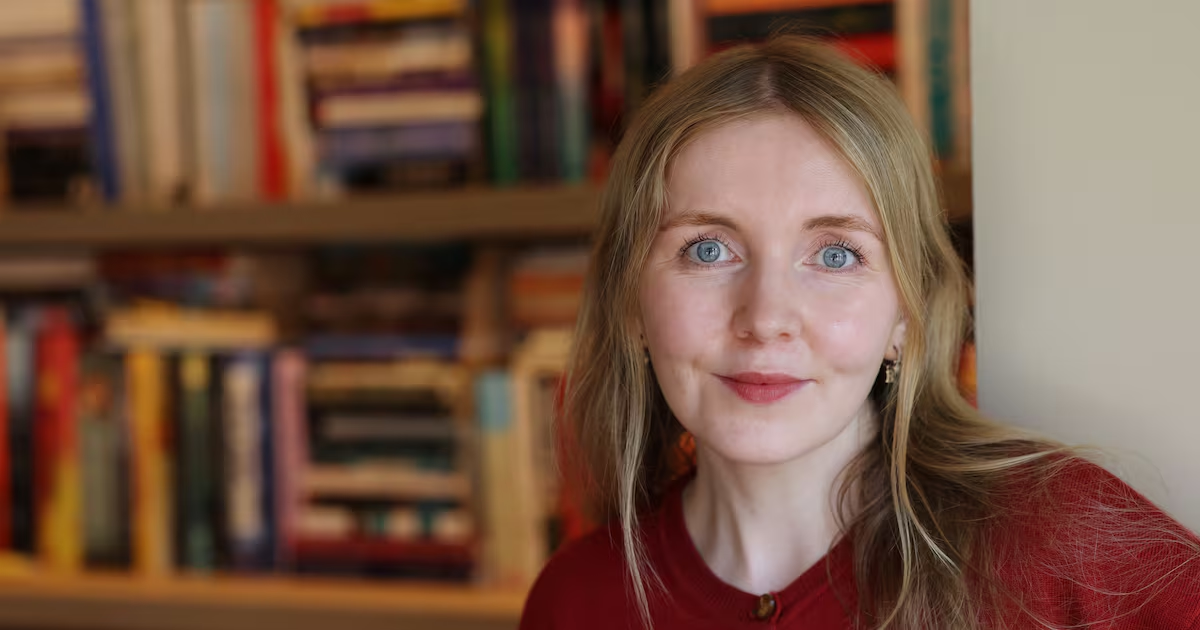
The author is a witty, intelligent and perceptive guide to the increasingly grotesque work of having a self in public
1,083 words~5 min read