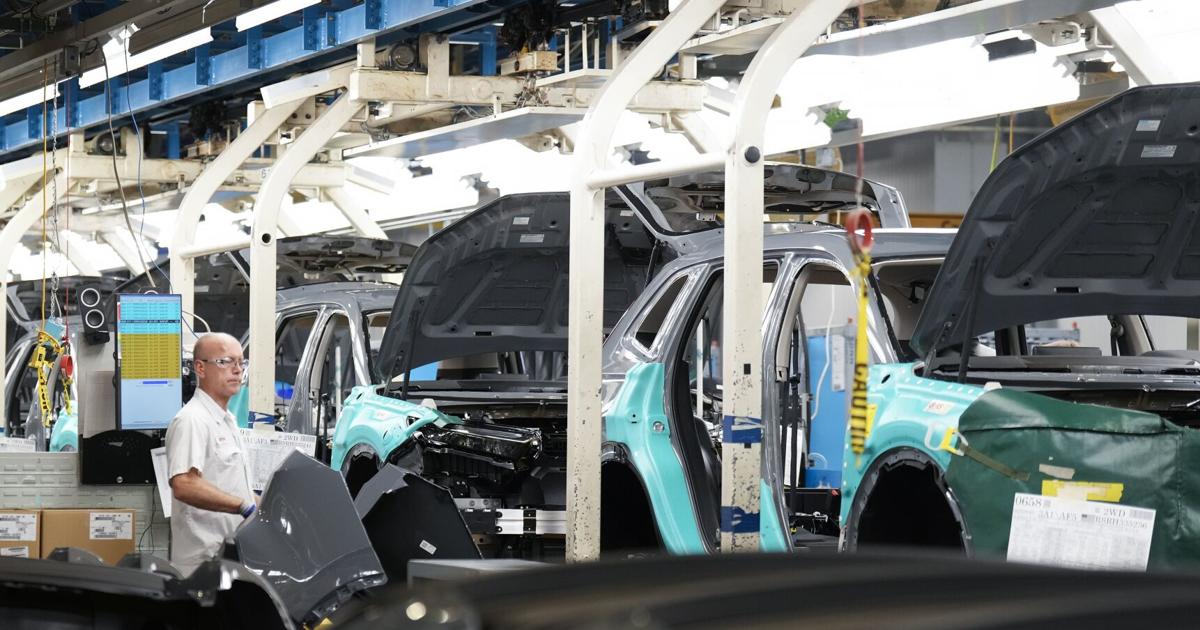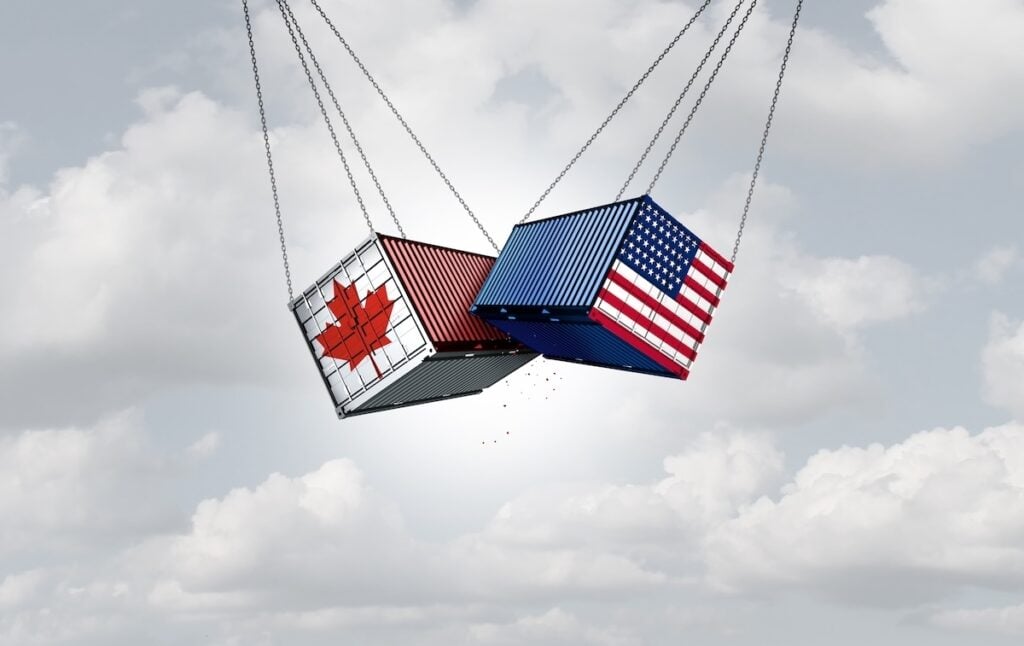
Skip to Content News Archives Economy Energy Oil & Gas Renewables Electric Vehicles Mining Commodities Agriculture Real Estate Mortgages Mortgage Rates Finance Banking Insurance Fintech Cryptocurrency Work Wealth Smart Money Wealth Management Investor Personal Finance Family Finance Retirement Taxes High Net Worth FP Comment Executive Women Puzzmo Newsletters Financial Times Business Essentials More Innovation Information Technology FP500 Podcasts Small Business Lives Told Tails Told Shopping Financial Post Store Obituaries Place a Notice Advertising Advertising With Us Advertising Solutions Postmedia Ad Manager Sponsorship Requests Classifieds Place a Classifieds ad Working Profile Settings My Subscriptions My Offers Newsletters Customer Service FAQ News Economy Energy Mining Real Estate Finance Work Wealth Investor FP Comment Executive Women Puzzmo Newsletters Financial Times Business Essentials HomeTransportationAutosTrump’s 50% auto tariff threat rattles Southwestern Ontario manufacturersIndustry experts warn the threatened tariffs could devastate Canada’s auto sector while also disrupting U.S. productionLast updated 44 minutes ago Ben Whitney, the president of Abuma, a high-tech manufacturing facility in London, Ont., says the company has started talking to high school students to encourage an interest in skilled labour. Photo by Mike Hensen/The London Free PressSouthwestern Ontario manufacturers reacted with surprise and disbelief Monday to U.S. President Donald Trump’s threat to slap 50-per-cent tariffs on Canadian vehicles and auto parts, with one calling it “a nuclear option” that could decimate the region’s auto parts industry while also inflicting pain south of the border.Subscribe now to read the latest news in your city and across Canada.Exclusive articles from Barbara Shecter, Joe O'Connor, Gabriel Friedman, and others.Daily content from Financial Times, the world's leading global business publication.Unlimited online access to read articles from Financial Post, National Post and 15 news sites across Canada with one account.National Post ePaper, an electronic replica of the print edition to view on any device, share and comment on.Daily puzzles, including the New York Times Crossword.Subscribe now to read the latest news in your city and across Canada.Exclusive articles from Barbara Shecter, Joe O'Connor, Gabriel Friedman and others.Daily content from Financial Times, the world's leading global business publication.Unlimited online access to read articles from Financial Post, National Post and 15 news sites across Canada with one account.National Post ePaper, an electronic replica of the print edition to view on any device, share and comment on.Daily puzzles, including the New York Times Crossword.Create an account or sign in to continue with your reading experience.Access articles from across Canada with one account.Share your thoughts and join the conversation in the comments.Enjoy additional articles per month.Get email updates from your favourite authors.Create an account or sign in to continue with your reading experience.Access articles from across Canada with one accountShare your thoughts and join the conversation in the commentsEnjoy additional articles per monthGet email updates from your favourite authorsSign In or Create an AccountorTrump said he planned to impose the new tariffs starting Jan. 1, a move that comes after trade negotiations between the U.S. and Canada broke down Friday, resulting in 50-per-cent levies now being applied on about $28-billion worth of Canadian goods, on top of sector-specific tariffs already applied to autos, steel and aluminum.“On January First, 2027, Tariffs on all Cars, Trucks, both large and small, Automotive Parts, and Steel, will be increased to 50%,” Trump wrote on Truth Social. “Build in the U.S. and there are ZERO TARIFFS. Canada will be treated like a State no longer!Get the latest headlines, breaking news and columns.By signing up you consent to receive the above newsletter from Postmedia Network Inc.A welcome email is on its way. If you don't see it, please check your junk folder.The next issue of Top Stories will soon be in your inbox.We encountered an issue signing you up. Please try again“On Trade, and in other ways, also, they are among the worst Nations in the World to deal with.”For his part, Prime Minister Mark Carney has said Canada will retaliate with dollar-for-dollar tariffs of its own beginning Sept. 8.Industry watchers said Monday the potential new tariffs would be devastating for Ontario’s auto belt, a key economic driver for the province that extends from Guelph, Cambridge and Woodstock in the east to Windsor in the west and includes four auto plants and dozens of parts makers along the Highway 401 corridor.“That’s like a nuclear bomb kind of effect that would be bad for everyone,” said Ben Whitney, owner of Armo Tool Ltd. in London, a manufacturer of machinery used to make parts for the automotive, defence and food and beverage sectors, among others.“There is no auto parts industry in Canada with that, but this would be extremely difficult for the entire automotive industry. This is a 50 per cent tariff in a sector that’s making six or seven (per cent) in profit margins, so something’s going to give.”Flavio Volpe, president of Canada’s Automotive Parts Manufacturers’ Association, echoed that assessment, saying U.S. automakers would also suffer from such a move.“The ‘importer of record’ pays the tariffs. A threatened U.S. tariff on Canadian auto parts will be paid by U.S. auto assembly,” he wrote on X, formerly Twitter.“Without those specific parts, auto assembly throughout the U.S. would halt.”Dave Johnson, general manager at London-based Ursa Manufacturing ULC, said the levies are so high it would take time to determine exactly how they would affect his company, which makes stampings and light assemblies for companies including General Motors Co. and Toyota Boshoku Corp.“But if that is the case, quite potentially, all automotive in North America would stop moving,” he said.“Whether it will occur or not is one thing, but it has the potential to bring the entire automotive industry to a halt . . . so let’s hope this is more bluster and bluff because it seems like a total shot in the dark that (Trump) is taking. The automotive companies, I would imagine, will have some sort of response to that.”Currently, the Canadian auto sector faces a 25 per cent tariff on vehicles exported to the U.S., but that amount can be reduced based on the percentage of U.S. content in a vehicle.It wasn’t immediately clear Monday whether the U.S. government would continue to apply that exemption to parts produced south of the border.But even if it did, it would still represent an effective tariff rate of 25 per cent for automakers in Canada, said Greig Mordue, an associate professor at McMaster University’s Booth School of Engineering Practice and Technology.Mordue, who questioned whether Trump “understands what he’s done,” given how intertwined the auto sector is, didn’t mince words when describing the potential impact of tariffs at that level on Canada’s industry.“Frankly, an effective rate of 25 percent expedites the demise of the Canadian automotive manufacturing industry,” he said.Mordue noted the move would put Japanese automakers Honda Motor Co., Ltd. and Toyota Motor Corporation, which so far have absorbed the cost of tariffs, in a difficult position. Unlike Ford Motor Co., General Motors Co. and Stellantis NV, Mordue said neither Honda nor Toyota has idle capacity to shift some production to the U.S.And while the Japanese companies may have been willing to continue with a wait-and-see approach at current tariff levels, pending the results of the November midterm elections or a new administration in 2029, the potential new tariff levels change the equation, with Mordue pegging the financial hit for both manufacturers at about $10 billion.“They would look at that and say, ‘We can’t put any new product or commit to new models at that level,’” he said.“They like building cars in Canada. They’ve made a commitment to Canada, and they think that commitment is a long-term one to Canada . . . but they can’t look at their global operations and say Canada is going to absorb half of their profitability globally.”With files from the Financial Post’s Gabriel Friedman Join the Conversation This website uses cookies to personalize your content (including ads), and allows us to analyze our traffic. Read more about cookies here. By continuing to use our site, you agree to our Terms of Use and Privacy Policy.
Trump’s 50% auto tariff threat rattles Southwestern Ontario manufacturers
Industry experts warn the threatened tariffs could devastate Canada’s auto sector while also disrupting U.S. production.
1,329 words~6 min read