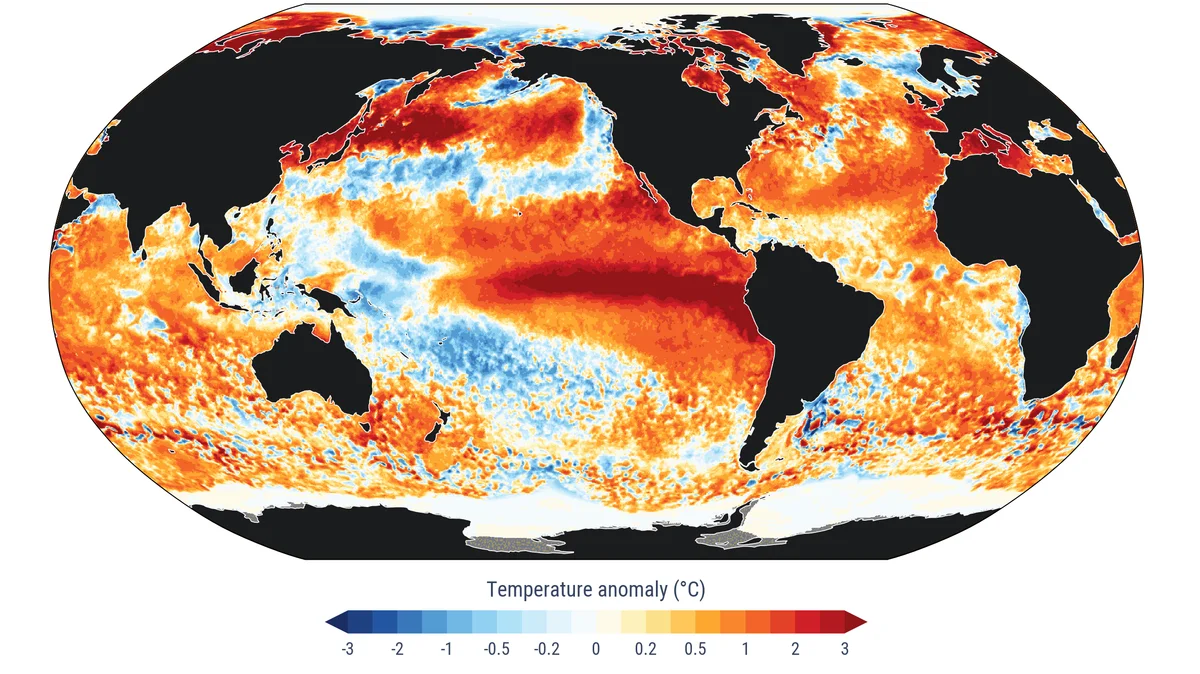
August 24, 20262 min read Add Us On GoogleAdd SciAmEarth’s oceans just hit their hottest temperature ever—it’s only going to get worseThe world’s oceans hit 21.10 degrees Celsius last Saturday, breaking a record set in 2024By Jackie Flynn Mogensen edited by Claire CameronSea surface temperature anomaly for August 22, 2026, compared to a 1991-2020 reference period ERA5/C3S/ECMWFJoin Our Community of Science Lovers!Average ocean temperatures hit a record 21.10 degrees Celsius (69.98 degrees Fahrenheit) on August 22, according to the European Union’s Copernicus Climate Change Service (C3S).That’s not as hot as a warm bath, but it is the hottest the world’s oceans have been since C3S started keeping records in 1979.“As a climate scientist, this is not surprising to me all,” says Zachary Labe, a climate scientist at Climate Central, a climate research nonprofit. “It’s consistent with decades of research showing how our climate is changing as the planet warms. And without reductions in the burning of fossil fuels, this warming will only continue.”On supporting science journalismIf you're enjoying this article, consider supporting our award-winning journalism by subscribing. By purchasing a subscription you are helping to ensure the future of impactful stories about the discoveries and ideas shaping our world today.The previous high, with a temperature of 21.09 degrees C (69.96 degrees F), occurred in March 2024, C3S said.Daily average sea surface temperature (°C) for 2024 (yellow), 2025 (orange) and 2026 (red). The 1991–2020 daily average appears as a dashed grey line.ERA5/C3S/ECMWFThe new high also reflects the fact that we are heading into an exceptionally strong El Niño year. This cyclic climate pattern is marked by unusually hot Pacific Ocean temperatures, which can affect the entire planet’s weather.“This record is another clear signal of an ocean under growing stress,” said Samantha Burgess, strategic lead for climate at the European Center for Medium-Range Weather Forecasts (ECMWF), in a statement.Hotter ocean temperatures can worsen sea-level rise, disrupt weather patterns and pose dangers to sea life such as coral reefs, Labe says. “These changes can affect nearly every part of society, including the economy, coastal infrastructure and global security.”The new record is unlikely to last long, he adds. “This won’t be the last time we say this, and unfortunately, it’s very possible we could break this record again in the coming months,” Labe says.It’s Time to Stand Up for ScienceIf you enjoyed this article, I’d like to ask for your support. Scientific American has served as an advocate for science and industry for 180 years, and right now may be the most critical moment in that two-century history.SciAm always educates and delights me, and inspires a sense of awe for our vast, beautiful universe. I hope it does that for you, too.If you subscribe to Scientific American, you help ensure that our coverage is centered on meaningful research and discovery; that we have the resources to report on the decisions that threaten labs across the U.S.; and that we support both budding and working scientists at a time when the value of science itself too often goes unrecognized.In return, you get essential news, captivating podcasts, brilliant infographics, can't-miss newsletters, must-watch videos, challenging games, and the science world's best writing and reporting. You can even gift someone a subscription.There has never been a more important time for us to stand up and show why science matters. I hope you’ll support us in that mission.
Earth’s oceans just hit their hottest temperature ever recorded
The world’s oceans hit 21.10 degrees Celsius last Saturday, breaking a record set in 2024
559 words~3 min read