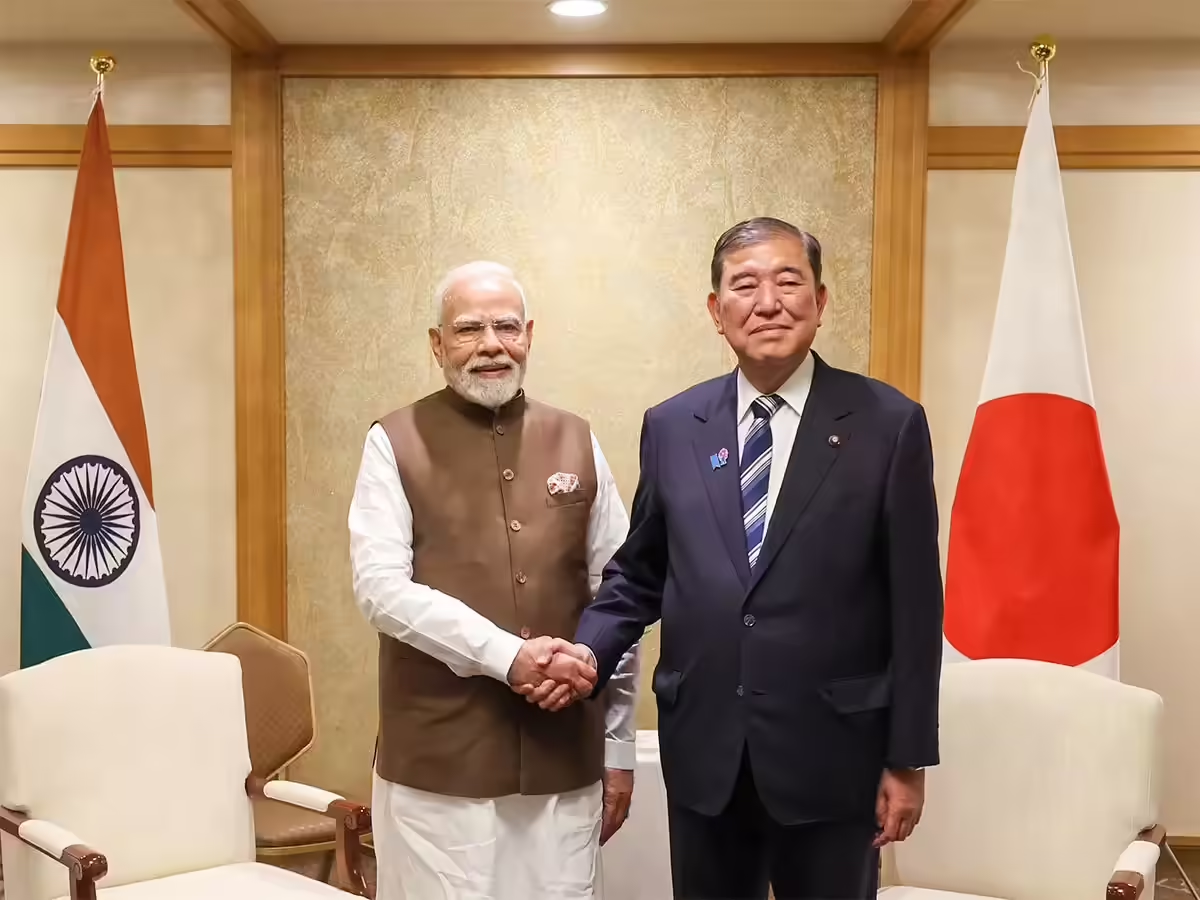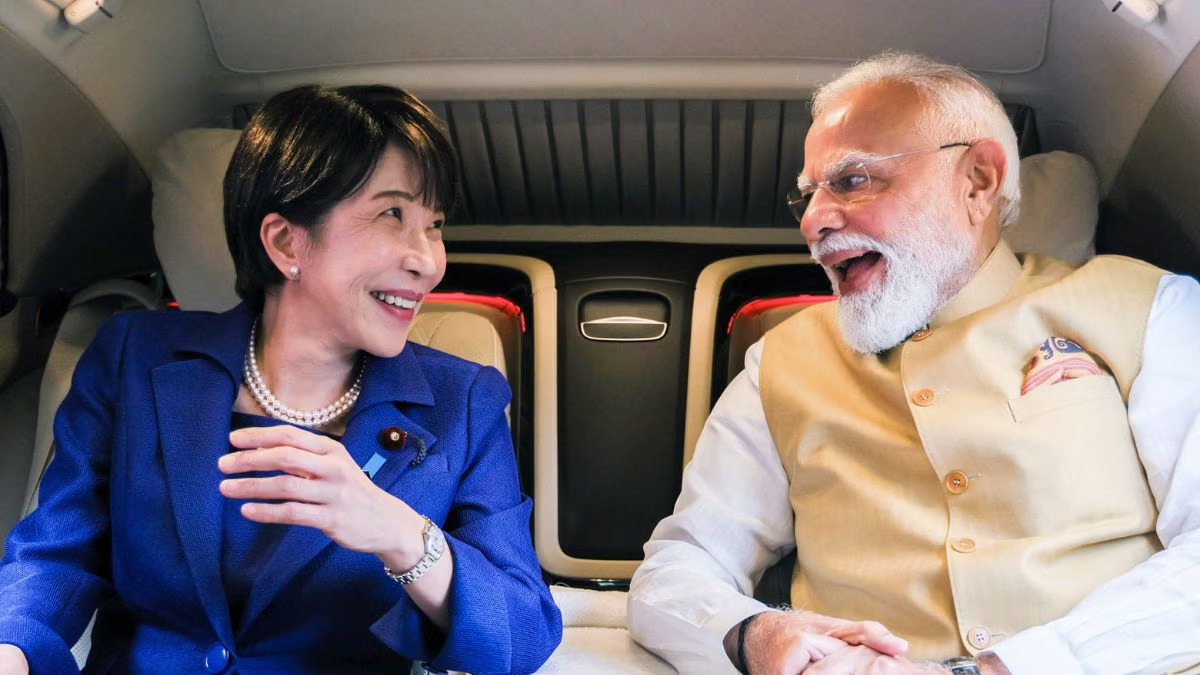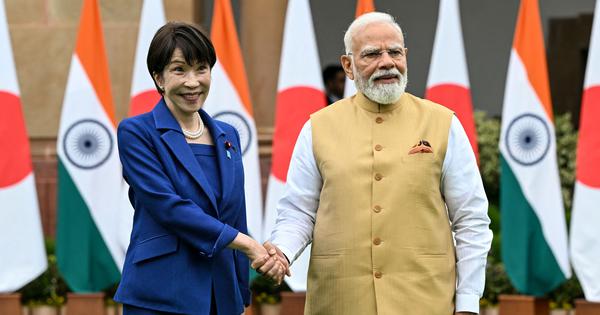
Japanese Prime Minister Sanae Takaichi’s three-day visit to New Delhi in July 2026 for the India-Japan summit appears to have elevated relations between the two Asian countries into a fresh phase of strategic expansion. Ties had already undergone a remarkable transformation over the past decade, evolving from a largely economic and development partnership into one of Asia’s most consequential strategic relationships.At its core, the logic of India-Japan convergence rests on a growing recognition that both countries have a stake in preserving a stable balance of power in the Indo-Pacific amid China’s expanding influence, safeguarding critical sea lanes, and strengthening economic resilience through diversified supply chains and trusted technology partnerships.This convergence has produced tangible cooperation through defense dialogues, maritime exercises, and collaboration in areas such as semiconductors, critical technologies, and economic security. The defense understandings reached during the Takaichi visit, including progress on defense equipment and technology cooperation, reflect a growing focus on developing each other’s defense industries alongside strengthening military cooperation.As Japan moves beyond the constraints of its post-war security framework toward a more proactive strategic posture, its partnership with India is often framed as a natural and necessary pillar of the Indo-Pacific regional order. From the articulation of the “Free and Open Indo-Pacific” vision to sustained efforts for the consolidation of minilateral platforms such as the Quad, a grouping that includes Australia and the US in addition to India and Japan, the normative and strategic convergence between New Delhi and Tokyo is widely acknowledged.The conventional view is that India and Japan will emerge as the central democratic pillars of the Indo-Pacific, with the expectation that their relationship will deepen in areas such as economic security, maritime capacity-building, and critical technologies.Yet, this very consensus risks obscuring a more fundamental question – if the logic is so compelling, why has India-Japan cooperation not translated into deeper strategic integration? Understanding the answer involves examining a set of structural constraints that continue to limit the operationalisation of their strategic convergence.Structural LimitsThe most immediate of these is what may be described as the geography trap. Despite the conceptual foundations of the “Indo-Pacific,” hard geography continues to tether both countries to their primary theatres. India’s strategic bandwidth is anchored in the continental challenge along its northern borders and its maritime responsibilities in the Indian Ocean Region.Japan, by contrast, is embedded in the security dynamics of the Western Pacific, with acute concerns in its near seas, including the East China Sea and the Taiwan Strait. Hence, defense-related operational reach, whether in terms of logistics, basing, or sustained deployment, remains limited by distance, capacity, and political constraints. While both have made incremental progress through logistics agreements and joint exercises, these do not fundamentally alter the fact that each country’s military posture is optimized for its immediate periphery.Yet geography, while visible, is not the most binding constraint. More consequential are perhaps the differences in strategic culture and risk thresholds that shape how India and Japan respond to regional crises. Japan’s security posture is deeply rooted in its alliance with the US, which provides both assurance and obligation. Tokyo’s evolving defense policies, reflected in its recent national security strategies, indicate a willingness to take on greater security responsibilities, but always within the framework of US-led alliance coordination and deterrence signaling.India, by contrast, continues to privilege multipronged partnerships. New Delhi’s approach is deliberately flexible, issue-based, and intentional about entanglement in conflicts beyond its immediate interests. This divergence produces different thresholds for risk-taking. In a crisis involving China, for instance, Japan is more likely to act in concert with the US, while India is likely to calibrate its response based on a narrower definition of national interest. The result is a partnership that converges in principle but could diverge in practice when escalation risks rise.Closely linked to this is the question of theatre prioritisation and the nature of threat hierarchies. Both India and Japan identify China as the central challenge to regional stability, but the nature of that challenge differs significantly across geographies.For Japan, the threat is immediate, maritime, and carries a credible risk of military confrontation. Chinese activities in the East China Sea and the prospect of a contingency in the Taiwan Strait create a sense of urgency that shapes Tokyo’s defense planning. For India, the challenge is more diffuse, spanning a contested land border, expanding Chinese presence in the Indian Ocean, and broader concerns about regional influence. This results in both countries responding to the same systemic pressure, but in different theatres and through distinct operational priorities. Each country, thus, remains reluctant to overextend beyond its respective primary theatres, limiting the scope for genuine strategic cooperation.The ambition-capacity mismatchA further constraint lies in the institutional thinness of the relationship, particularly in the security domain. India and Japan have built an impressive architecture of dialogues, agreements, and consultative mechanisms over the past decade. However, these have yet to evolve into the kind of operational coordination seen in other non-alliance partnerships such as Japan–Australia or India-France.Compared to these relationships, India-Japan cooperation remains centred on consultation and exercises, and even though military exercises have become more frequent and complex, the focus is more on signaling than on developing interoperable capabilities. In times of crisis, when the capacity to act collectively depends not just on political will but also on pre-existing systems for coordination and execution, the lack of institutional depth becomes especially important. In this regard, India–Japan ties remain a step removed from deeper integration.A persistent gap between expectations and capabilities compounds these constraints. Japan’s growing interest in the Indian Ocean reflects a recognition of the region’s strategic importance, but its ability to sustain a significant presence there is limited. Although India plays an increasingly important security role in the Indian Ocean, its capacity to support sustained operations beyond its immediate maritime neighborhood remains constrained by geography, logistics, and capacity.Similarly, expectations that India might play a more active role in East Asian contingencies run up against both political caution and operational limitations. The result is a pattern of symbolic alignment, joint statements, shared visions, and coordinated diplomacy, that is not always matched by material capabilities. This gap does not negate the value of the partnership, but it does constrain its strategic impact.Questions of economic security add another layer of complexity. Both India and Japan have sought to reduce vulnerabilities arising from their respective dependencies on China, particularly in critical sectors such as supply chains and technology. However, their economic relationships with China differ in scale and structure. Japan remains deeply integrated into Chinese manufacturing networks, while India’s engagement is more uneven but still significant in key sectors. This limits the extent to which either nation will engage in economic strategic competition.As a result, initiatives aimed at strengthening resilience — whether through supply-chain diversification, trusted technology partnerships, or critical mineral cooperation—have tended to be incremental rather than transformative. Economic interdependence, in this sense, constrains the scope for coordinated measures as these would impose significant commercial costs or provoke direct economic retaliation from China.Durable frameworkTaken together, these factors suggest that the limits of India–Japan strategic cooperation are not merely contingent, but also structural. Geography constrains operational reach, but it is the deeper asymmetries, including threat perceptions, institutional capacity, and economic vulnerabilities, that define the scope of the partnership. The Indo-Pacific, as a strategic construct, has brought India and Japan closer together. Yet translating that convergence into a coherent and effective strategic framework remains an unfinished project.To overcome these limitations, Tokyo and New Delhi will have to assume a more adaptable, networked approach to collaboration. This would entail deeper institutionalisation in specific areas where incremental gains can cumulatively enhance operational synergy, such as maritime security.Over time, regular information-sharing, coordinated maritime surveillance, and greater familiarity between their naval forces can reduce uncertainty and improve coordination when common interests are at stake. Such steps may appear modest individually, but collectively they can make coordination during periods of crisis faster, more predictable, and more effective. Finally, regular strategic dialogues focused on specific contingencies, such as disruptions in the Indian Ocean, a Taiwan Strait crisis, or major maritime incidents in Southeast Asia, could help narrow differences in threat perception and clarify expectations during periods of instability.Similar scenario-based consultations have become an important feature of partnerships such as Japan-Australia and Australia-India, helping participants develop a shared understanding of potential crises. Such mechanisms remain underdeveloped in the India–Japan context, in part because both countries continue to prioritize different theatres and face different immediate security challenges.The 2026 India-Japan summit has undoubtedly injected fresh momentum into the bilateral relationship, particularly in areas such as economic security, critical technologies and defense-industrial cooperation. Whether this momentum translates into deeper strategic integration, however, will ultimately depend less on the announcement of new initiatives than on the ability of both countries to navigate these structural constraints with strategic clarity.In that sense, the partnership’s potential lies in developing more effective mechanisms for coordination across areas where interests genuinely converge. Geography, threat perceptions, and institutional realities are likely to continue imposing limits on the relationship.The real test, therefore, is not whether India and Japan can eliminate these constraints, but whether they can build a more durable framework for cooperation that works despite them attempting to link the disparate security and economic dynamics of the Indian Ocean and the Western Pacific. In that regard, the two countries could aim to strengthen regional resilience through deeper maritime cooperation, economic security, critical technologies, and capacity-building initiatives that help preserve a favorable balance in the Indo-Pacific. The partnership’s long-term value lies less in overcoming its structural constraints than in managing them effectively to support a stable regional order.Pratnashree Basu is an Associate Fellow (Indo-Pacific) with the Strategic Studies Programme at Observer Research Foundation, focusing on Japan's role in the region and maritime geopolitics.
Why has India-Japan cooperation not translated into deeper strategic integration?
Geography constrains operational reach, but deeper asymmetries, like threat perceptions, and economic vulnerabilities, define the scope of the partnership.
1,632 words~7 min read