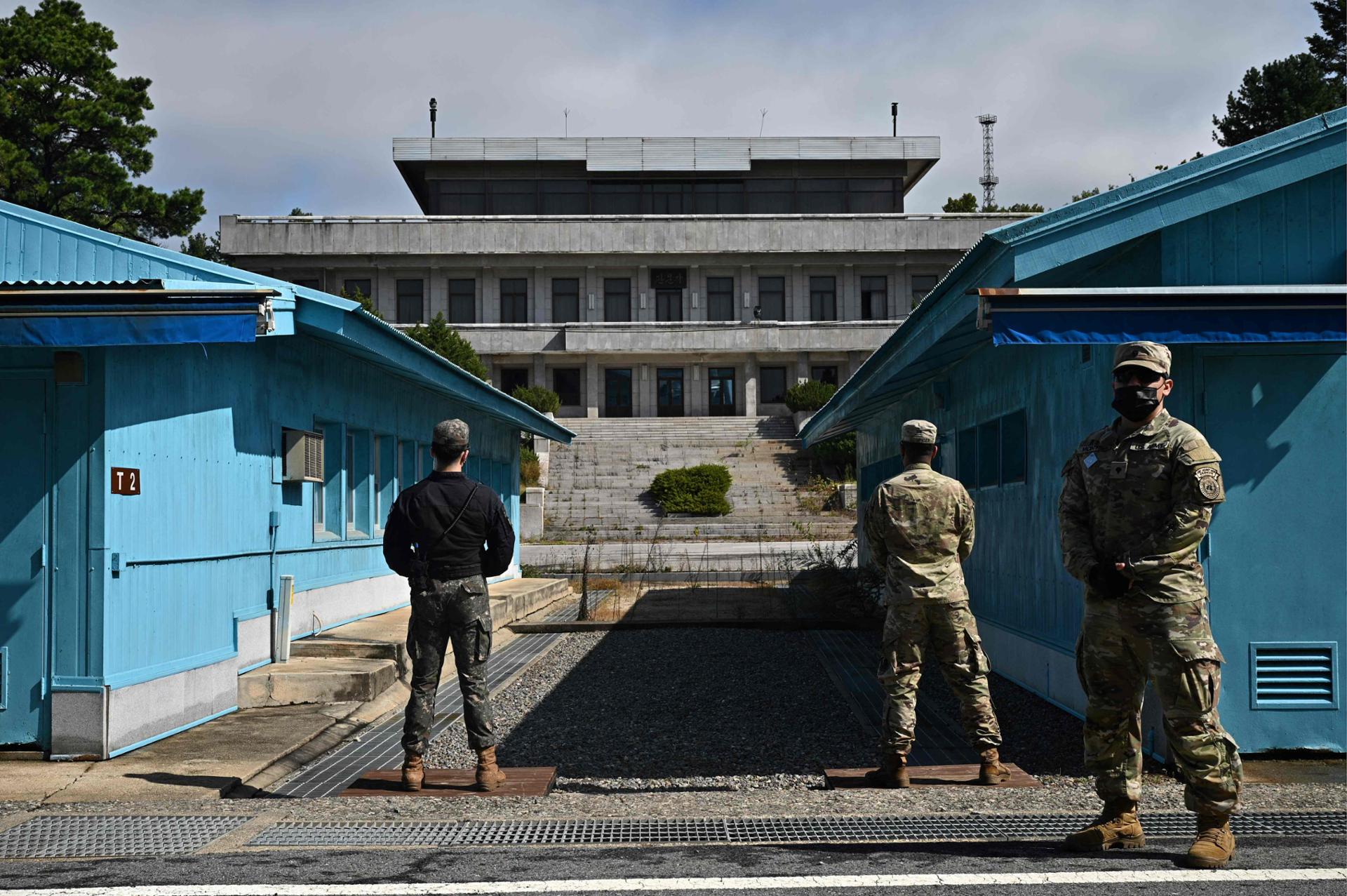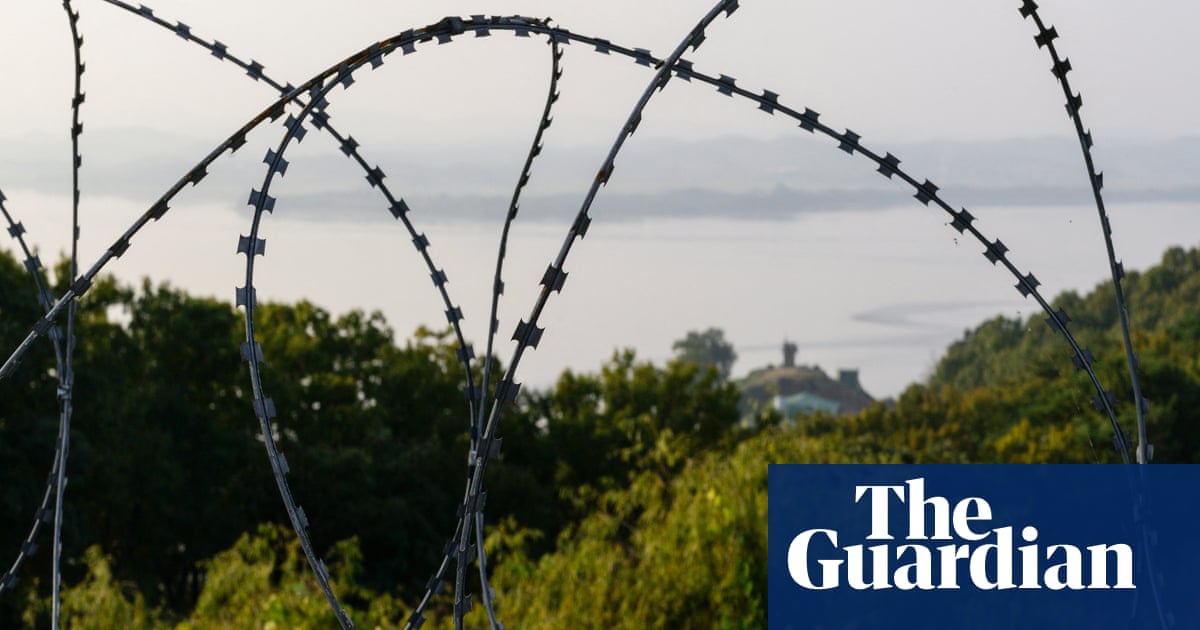
Lee Kyong-hee Ten years ago, I had an opportunity to travel along the Demilitarized Zone — more precisely, along its southern limit line — all the way from Goseong, Gangwon Province, at the eastern end to Gyodong Island in Ganghwa County, Incheon. I was part of a field-trip team of writers, photographers and editorial staff for a magazine aimed at English-speaking readers overseas. We visited places of major historical and humanitarian interest and frontline observatories along the way.I still vividly remember the eerie silence hanging over the deserted land beyond the barbed-wire fences. The young soldiers standing guard, their faces strikingly boyish, seemed to accept the quiet but tense confrontation as part of everyday life. Military roads cutting through rugged mountain terrain exposed the brutal reality of a division born of a bloody internecine war.True to the great ironies of its name, the DMZ is a land of paradoxes. Roughly 250 kilometers long and 4 kilometers wide, it was created as a buffer from which opposing forces were to withdraw. Yet the areas immediately beyond its boundaries have become among the most heavily fortified places on earth.The familiar image of the DMZ as a pristine “haven for wildlife,” untouched by humans for more than seven decades, is also too simple. Restricted human access has allowed remarkable biodiversity to flourish, but the zone is hardly free of human disturbance. Vegetation has been cleared or burned to preserve lines of sight, and defoliants including Agent Orange were used on the southern side in the late 1960s.The 1953 Korean Armistice Agreement — which halted three years of hostilities, established the Military Demarcation Line along the final line of contact between the opposing forces, crossing the 38th parallel — required each side to withdraw 2 kilometers to create the DMZ. Entry was to be tightly restricted, with no more than 1,000 people from either side permitted at any one time for civil administration and relief as “civil police.” Over the decades, however, military facilities and defensive work proliferated in and around this supposedly demilitarized space.North Korea, after declaring inter-Korean relations to be those between “two hostile states,” has accelerated work inside the DMZ, including fencing, land clearing, mine laying and road repairs. Some fences have reportedly been built within 100 meters of the MDL, while mine-related clearing has approached even closer. The United Nations Command says such defensive construction does not violate the armistice as long as it remains north of the MDL. That may be a defensible legal interpretation, but South Koreans have ample reason to worry about the broader security implications.Those concerns are heightened by North Korea’s effort to reinforce frontline firepower. South Korea’s Defense Ministry says Pyongyang is moving to deploy new 240 mm and 600 mm multiple rocket launchers, self-propelled artillery and tactical missiles to border areas. The 600 mm system, known as the KN-25, is described as capable of carrying tactical nuclear warheads. In June, Kim Jong-un oversaw tests of an upgraded 240 mm launcher, tactical ballistic missile warheads and extended-range shells for a 155 mm self-propelled howitzer.Kim, having abandoned the North’s long-standing goal of unification with the South, has warned that even a “0.001-millimeter” violation of what Pyongyang regards as its territory would be considered a war provocation. North Korea’s 2022 nuclear doctrine adds another layer of danger: It provides for an automatic and immediate nuclear strike under a prearranged plan if an enemy attack endangers the leadership’s nuclear command-and-control system. In such an atmosphere, even a small military incident carries a risk of miscalculation and escalation.With North Korea transforming its side of the DMZ into a fortified state border, while direct inter-Korean military communication has largely stalled, an accidental clash along the MDL could spiral rapidly.This increasingly sensitive situation calls for a strategic approach aimed at peaceful coexistence between the two Koreas. As a practical first step, the South might consider designating its side of the DMZ an “MDL Peace Zone,” as proposed by Cho Yong-geun, a retired Army brigadier general and former director of North Korea policy at the Ministry of National Defense, at a recent seminar jointly hosted by Kyungnam University’s Institute for Far Eastern Studies and the Korea-Japan Peace Forum.As a realistic security measure to protect lives, property, economic activity and strategic assets in border areas, Cho also called for Seoul to revive provisions banning hostile acts across border areas from the now-defunct 2018 inter-Korean military agreement.It is another unwanted irony that relations between North Korea and the United States may prove crucial to the future of this redefined border. Pyongyang still uses established communication mechanisms with the United Nations Command even as most direct military channels with Seoul have fallen silent.President Donald Trump, for all the controversy surrounding his approach, may again become an important variable. He has sought to revive dialogue with Kim and scaled back joint US-South Korea military exercises in that effort. Whether another round of personal diplomacy can produce anything more durable than their earlier summits remains deeply uncertain. Yet on a peninsula defined by paradox, even uncertainty can leave an opening for diplomacy — if it is matched by prudence, realism and a sustained commitment to peace.- - -Lee Kyong-heeLee Kyong-hee is a former editor-in-chief of The Korea Herald. The views expressed here are the writer's own. — Ed.
[Lee Kyong-hee] Rethinking the DMZ: A no man’s land of paradoxes
Ten years ago, I had an opportunity to travel along the Demilitarized Zone — more precisely, along its southern limit line — all the way from Goseong, Gangwon P
882 words~4 min read