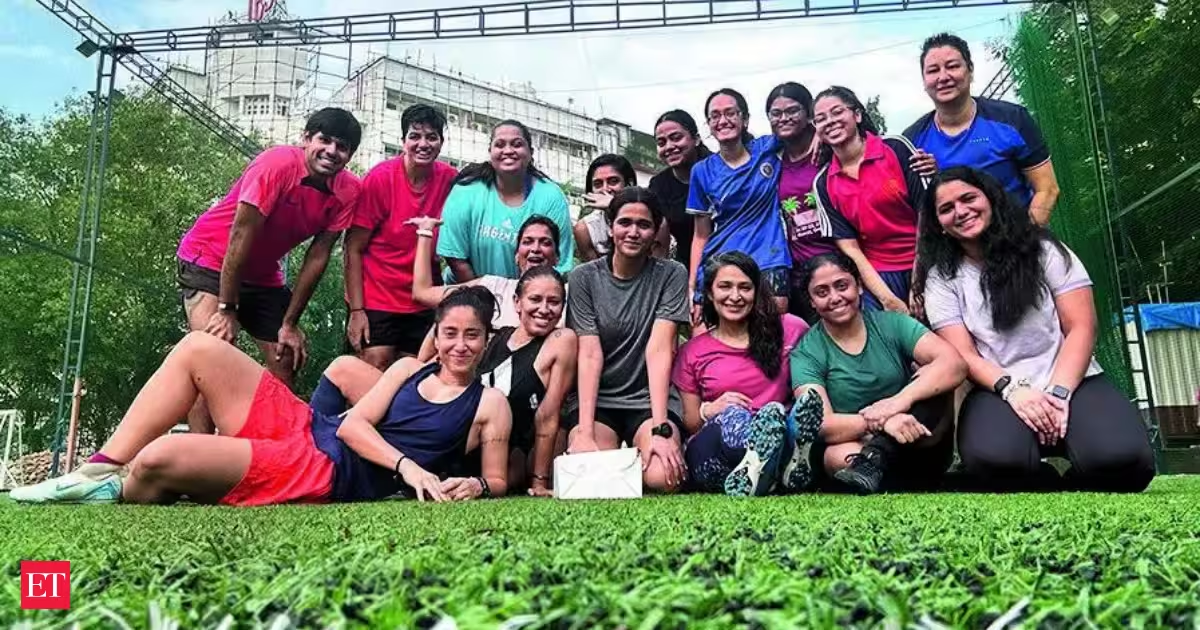
It was in 2013 that Surabhi Yadav started thinking about leisure. That year, at 21, after her mother Basanti passed away, Yadav realised that the mother she knew and the per - son her inner circle was talking about were two different people. To know her better, she asked people how they remembered her. And another Basanti emerged—funny, goofy, some - one who laughed and joked. “The exploration of her leisure was the portal to my mother’s personhood. The moments when she was laughing, swim - ming, joking, or doing whatever she enjoyed, were glimpses of her interior life,” says Yadav.In 2019, it led to “Women At Leisure”, an Instagram-based visual documentation project capturing women when they aren’t working, caring, mothering. What began as a personal investigation into grief and memory has grown into India’s first and largest such digital archive with over 66,000 followers documenting women and girls’ leisure. “Leisure for women in India is, to a large extent, stolen, com - promised, or conditional,” says Yadav. “It is either something you steal from public visibility, or it is conditional on how productive you have been like, ‘Finish this work, then rest.’” She adds, “Productivity can be a byproduct of leisure, but it is not its essence. Leisure should be a break from optimising yourself.Easier said than done. Mumbai based consultant Amrita Chhabria, 42, knows her ideal leisure: reading or bed rotting. But she battles the guilt. “Every time I do nothing, my very loud vocal inner critic says I am not a productive member of society and hence I do not deserve leisure.” Marketing head Sapna Prabhakaran, 48, finds doing something easier to schedule than doing nothing. “The simpler activities that amount to leisure like sitting around, sipping your morning coffee at a relaxed pace, doing nothing are infinitely more difficult.”Turns out, doing nothing can be surprisingly hard work.GIRLS FOR GIRLS, KOCHITOGETHER WE RESTAround the world, women do three times more cooking, cleaning and caring for family members than men. According to the International Labour Organisation, women perform 76.2% of total hours of unpaid care work globally, more than three times men’s share. In Asia and the Pacific, that goes up to 80%. Finding pockets of rest be - comes tough.That is why women are ready to schedule leisure. Across cities, a crop of women-only communities is gathering around sports, hobbies, food, travel and meeting other women.Also read | In their 60s, they found love. What they kept separate was their moneyNavami Uma Soman started Girls for Girls in Kochi in December 2025 to solve the problem of adult friendships. Today, the community has more than 3,000 women across cities in Kerala and in Bengaluru. Women join for many reasons: some are new to the city, others work from home, some want to explore beyond their existing circle. “There is a growing realisation that fun is not something you have to earn after finishing everything else,” says Soman. “Among the women we interact with, there is more willing - ness to say: I want to have a weekend that is actually for me.”Swetha Subbiah & Tanvie HansIn Mumbai, 21-year-old Aayushi Satish Pathak started The Hobby Hoarders Girls Club for women tired of café meetups. “People get so busy in their jobs and normal lives that they don’t get time for hobbies,” says Pathak. “Joining a community like this lets you do that.” The scheduled activity, in other words, protects lei - sure. Pathak calls these groups the contemporary version of the kitty party. The difference is that the kitty usually involves the same circle of friends, while her generation is turning up to meet strangers and likeminded people.HAVE A BALLFor Bengaluru-based PR professional Nasreen Patel, these communities work only when they solve a real problem. For her, Sisters in Sweat did that by helping find women to play sports with and stay active. “When a community is built around a clear, shared purpose, the awkward small talk disappears,” she says.Sisters in Sweat began in Bengaluru in 2017 when cofounders Swetha Subbiah and footballer Tanvie Hans organised a football session for 15 friends. It grew from a WhatsApp group into a community of about 20,000 members in seven cities, offering everything from football and badminton to pickleball, running, dance and yoga. Subbiah says the group mirrors women’s aspirations of “reclaiming their time and identity”. She adds, “Women feel extremely guilty about doing something for them. Today, that is changing. They are eager to reclaim their own identity. Wellness happens to be at the forefront of things women want to reclaim for themselves.”Ketaki Chowkhani, assistant professor of sociology, Manipal Academy of Higher Education, says women’s lei - sure is often considered secondary, even frivolous, beside education, employment and childcare. But demanding it can be radical. “If you demand leisure, you are demanding pleasure, you are demanding fun. That means you are demanding that the household burden is not on you,” she says.THE HOBBY HOARDERS GIRLS CLUB, MUMBAIWomen often make even pleasure productive: reading is enriching, exercise is healthy, rest is necessary to return rejuvenated, notes Delhi-based psychiatrist Dr Rachna Khanna Singh. “The biggest shift may be internal. We need to stop asking whether we have earned our leisure. Rest does not have to be earned. Pleasure does not have to be justified. Friendship does not need a professional purpose,” she says. “Sometimes the most restorative thing we can do is allow one experience to be enough.”Also read | In the age of dating apps, basic decency is apparently a green flagThese communities work for women because they stay focused on rest. For Bengaluru-based Pooja Prakash (name changed), joining a sporting club was a way back to her love for sports. She didn’t continue with the same group but kept playing. “Earlier, there was an illusion that these activities were leisure, something you did if you had the time. Now there’s been a shift in perspective. These activities are what I look forward to, so I plan everything else around them.”TIME TO EXHALEIn 2006, Elizabeth Gilbert’s Eat Pray Love introduced us to dolce far niente, the sweetness of doing nothing. But Chowkhani says there’s nothing wrong with productive lei - sure either. “Rest means different things for different people.” It ’s something Jharna Sattanathan found when she started her Chennai based club Mahjong by J in September 2025. Missing her social life in Mumbai, she learnt mahjong and then started teaching it. She says, “Women are willing to spend on leisure when it has a sense of purpose attached to it. A paid class or a curated experience can make taking time out feel more worth - while—and perhaps less indulgent.” In her club, women spend two hours learning a new skill and socialising. She calls it an “evolution of socialisation”W.E., GOAIn Goa, loneliness prompted Insia Lacewalla to start WE (Women Empowered) in 2023. It began with a few women trying a class, going on an outing, or simply having conversations they weren’t having elsewhere. Over the years, the group has become a support system and a safe space. “Now women are keeping time for themselves and treating it as non-negotiable. I see this in small but telling ways: women blocking a recurring slot on their calendar for a WE event or choosing to spend a free evening with someone from the community instead of catching up on chores. It’s a quiet but deliberate reclaiming of time.”Soman says, “These communities are about women actively creating the kind of social lives they want instead of waiting for friendships and community to happen organically.” Lacewalla adds, “Fitness groups, mahjong circles, travel collectives, communities like WE—they may look different on the surface, but they are answering the same underlying need: for women to define friendship and belonging on their own terms.”Women don’t mind paying for them. Girls for Girls has a Rs 299 annual membership, Sattanathan charges Rs 12,000 for eight classes, while others charge per experience. Sisters in Sweat has got investment from Rain matter, and its core business of organising sports and activities is already profitable.Also read | Problem of plenty: Car buying in India gets both easier and harderWhile paying for leisure doesn’t make it less real, Chowkhani says, “You don’t want companies to monetise leisure. It has to be in that liminal space. It has to be free. Otherwise, it negates its own purpose.” So Yadav prefers to keep her page independent despite interest from brands.WHO GETS TO REST?Women’s leisure requires space. Women’s fight for public spaces has long been a battle. Campaigns like Why Loiter?, Blank Noise, Girls at Dhabas and Pinjra Tod have challenged the idea that women need a legitimate reason—work, college, shop - ping, commuting to be out. Hanging around, apparently, is not enough.MAHJONG BY J, CHENNAIBengaluru-based artist Indu Antony decided to give women somewhere to do exactly that. Five years ago, she started Namma Katte near Banaswadi railway station in an old motor garage, a male-coded corner where men would drink and hang around. “You see men loitering and chilling on the road very often. But you don’t see women do it,” she says. “Why are women not resting? Why is it not part of the public memory of people?”So she opened the shutter. Put in a swing. And women sat. Women come to talk, stitch, read, just be. Some bring vegetables to cut. Older women lie down and nap. On Wednesdays, 10-20 women turn up for chai and a “gossip session”. Antony says she will never take the space down.While leisure economy is booming in cities, class, caste, caregiving, money and disability decide who can take that pottery class, go hiking, spend an afternoon at a café—or simply take an hour off. As Yadav says, one woman’s free time is sometimes made possible by another woman’s labour. She cites how domestic work is outsourced to women from lower-income and disadvantaged caste groups. “Structurally, we haven’t changed much in recognising women’s labour. And we haven’t paid attention to unka aaram.”Still, she adds that what these com - munities do is create the social infra - structure for leisure—making space for friendship, pleasure and me time.But fair access is the larger conversation. Chowkhani says leisure should be framed as a right: “Normalise it as part of life like work or chores.”In the end, girls just wanna have fun. And they shouldn’t have to explain why.
Girls just wanna have fun: The rise of women-only communities
Women in India are actively reclaiming leisure time through various initiatives. New communities are forming around hobbies, sports, and social connections. These groups provide a much-needed space for women to prioritise personal time. Many women now schedule leisure as a non-negotiable part of their lives. This reflects a growing desire for self-care and identity beyond traditional roles.
1,729 words~8 min read