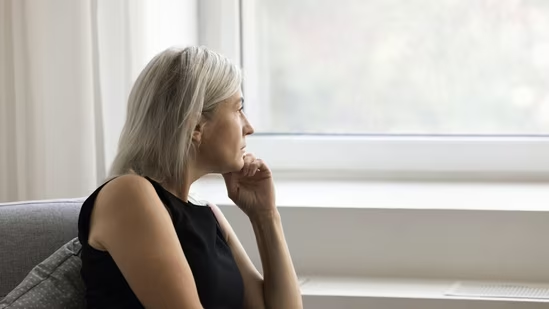
Every era of life has found its place in India’s wellness industry, except one.Women (Shutterstock)We know how to speak to the 20-something discovering fitness. We know how to speak to new mothers. We know how to sell beauty, weight loss, and fertility, and we've even seen brands directly targeting Gen Alpha. But there is a consumer, the wellness industry in India still does not know how to speak clearly.She is often in her 50s or 60s, has spent decades running homes, careers, families and health decisions, and is now entering a life stage where her own body, priorities and ambitions are changing.For years, she has been the health manager of the Indian household. She remembers everyone’s medicines, checks on parents, books doctor appointments, adjusts food for the family and carries the emotional labour of care.But when it comes to her own strength, energy, sleep, bones, mood, nutrition or long-term wellbeing, the wellness industry becomes strangely quiet.This silence is not because her needs are small. It is because we have not yet treated her as a consumer worth designing for.In our conversations, the 50+ women we meet are not looking to be spoken to as ‘old’. They are curious, active, ambitious and deeply invested in living better.One of them is a 63-year-old qualified pharmacist with over four decades in the health care and pharmaceutical industry. She has climbed Mount Kilimanjaro with her family, runs, treks and speaks about her 60s as a decade she wants to use fully, not quietly surrender.Her story is powerful because it challenges an assumption. Women over 50 are not a senior audience waiting to be cared for. Many of them are asking sharper questions than younger consumers. What should I do to protect my bones? Why is my energy different? How do I maintain muscle? What should I know about brain health, heart health, liver health, sleep, mood and nutrition now? How do I stay independent for longer?These are not small questions. They are questions about the quality of life.India’s ageing story is no longer a distant future. According to UNFPA’s India Ageing Report, the country’s population aged 60 and above is expected to rise sharply in the coming decades, and women at 60 have a higher life expectancy than men. In simple terms, many Indian women will spend 20, 25 or even 30 years beyond 50.That should change how we think about wellness.The years after 50 cannot be treated as a small footnote after the so-called prime years of life. For many women, this is when children are older, careers are evolving, caregiving roles are shifting, and there is a renewed desire to invest in oneself. It is also when health needs become more specific and more personal.Yet India’s wellness conversation has not kept pace with this reality.For women, especially, health is often discussed through the reproductive years. Menstruation, fertility, pregnancy and motherhood receive far more attention. But what happens after that?Menopause is one example of this gap.In the content we create for women over 50, menopause comes up often, but not always in the obvious ways. Many women do not begin the conversation by saying, “I am menopausal.” They say their knees hurt more. They say they feel tired in a way that sleep does not fix. They say their mood feels unfamiliar. They say they forget words, lose focus, feel heavier in the body or less like themselves. And very often, the first explanation they give themselves is, “Age ho gaya hai.”That phrase hides too much of what is really happening after 50.Of course, not every symptom is menopause. Not every change is a deficiency. And no brand should pretend to have simple answers to complex health transitions. But women deserve better information around what can change after 50, including bones, muscles, metabolism, mood, cognition, sleep and nutrient absorption.In recent years, menopause and perimenopause have finally started entering mainstream wellness conversations. That is a welcome shift. But the conversation still needs to become wider and better. It cannot stop at hot flashes. It cannot reduce women to symptoms. And it cannot make midlife sound like the beginning of decline.The 50+ woman should not be seen only as someone’s mother, wife, grandmother or caregiver. She is also a consumer with her own health goals, anxieties, spending power and ambition for the years ahead.For brands, this requires a shift in imagination. Show her with energy. Speak to her with intelligence. Build for her with specificity. Stop assuming she is not digitally active, not curious, not willing to learn or not ready to invest in herself. She is already doing all of those things. The industry is simply catching up.This is the lens brands need to build from. The aim is not to make ageing sound like a problem. The aim is to make it better understood.India’s 50+ women are entering a stage of life that can be active, independent, expressive and deeply meaningful. They are asking better questions about their health, their strength, their routines and their future.The wellness industry now has a choice. It can continue speaking to them through old stereotypes, or it can build a more intelligent, respectful and useful conversation around this life stage.The 50+ woman is one of the most important wellness consumers of the next decade. And if we listen closely, she may also become one of the most powerful voices shaping what wellness in India looks like next.(The views expressed are personal)Every era of life has found its place in India’s wellness industry, except one.We know how to speak to the 20-something discovering fitness. We know how to speak to new mothers. We know how to sell beauty, weight loss, and fertility, and we've even seen brands directly targeting Gen Alpha.But there is a consumer, the wellness industry in India still does not know how to speak clearly.She is often in her 50s or 60s, has spent decades running homes, careers, families and health decisions, and is now entering a life stage where her own body, priorities and ambitions are changing.For years, she has been the health manager of the Indian household. She remembers everyone’s medicines, checks on parents, books doctor appointments, adjusts food for the family and carries the emotional labour of care.But when it comes to her own strength, energy, sleep, bones, mood, nutrition or long-term wellbeing, the wellness industry becomes strangely quiet.This silence is not because her needs are small. It is because we have not yet treated her as a consumer worth designing for.In our conversations, the 50+ women we meet are not looking to be spoken to as ‘old’. They are curious, active, ambitious and deeply invested in living better.One of them is a 63-year-old qualified pharmacist with over four decades in the health care and pharmaceutical industry. She has climbed Mount Kilimanjaro with her family, runs, treks and speaks about her 60s as a decade she wants to use fully, not quietly surrender.Her story is powerful because it challenges an assumption. Women over 50 are not a senior audience waiting to be cared for. Many of them are asking sharper questions than younger consumers. What should I do to protect my bones? Why is my energy different? How do I maintain muscle? What should I know about brain health, heart health, liver health, sleep, mood and nutrition now? How do I stay independent for longer?These are not small questions. They are questions about the quality of life.India’s ageing story is no longer a distant future. According to UNFPA’s India Ageing Report, the country’s population aged 60 and above is expected to rise sharply in the coming decades, and women at 60 have a higher life expectancy than men. In simple terms, many Indian women will spend 20, 25 or even 30 years beyond 50.That should change how we think about wellness.The years after 50 cannot be treated as a small footnote after the so-called prime years of life. For many women, this is when children are older, careers are evolving, caregiving roles are shifting, and there is a renewed desire to invest in oneself. It is also when health needs become more specific and more personal.Yet India’s wellness conversation has not kept pace with this reality.For women, especially, health is often discussed through the reproductive years. Menstruation, fertility, pregnancy and motherhood receive far more attention. But what happens after that?Menopause is one example of this gap.In the content we create for women over 50, menopause comes up often, but not always in the obvious ways. Many women do not begin the conversation by saying, “I am menopausal.” They say their knees hurt more. They say they feel tired in a way that sleep does not fix. They say their mood feels unfamiliar. They say they forget words, lose focus, feel heavier in the body or less like themselves. And very often, the first explanation they give themselves is, “Age ho gaya hai.”That phrase hides too much of what is really happening after 50.Of course, not every symptom is menopause. Not every change is a deficiency. And no brand should pretend to have simple answers to complex health transitions. But women deserve better information around what can change after 50, including bones, muscles, metabolism, mood, cognition, sleep and nutrient absorption.In recent years, menopause and perimenopause have finally started entering mainstream wellness conversations. That is a welcome shift. But the conversation still needs to become wider and better. It cannot stop at hot flashes. It cannot reduce women to symptoms. And it cannot make midlife sound like the beginning of decline.The 50+ woman should not be seen only as someone’s mother, wife, grandmother or caregiver. She is also a consumer with her own health goals, anxieties, spending power and ambition for the years ahead.For brands, this requires a shift in imagination. Show her with energy. Speak to her with intelligence. Build for her with specificity. Stop assuming she is not digitally active, not curious, not willing to learn or not ready to invest in herself. She is already doing all of those things. The industry is simply catching up.This is the lens brands need to build from. The aim is not to make ageing sound like a problem. The aim is to make it better understood.India’s 50+ women are entering a stage of life that can be active, independent, expressive and deeply meaningful. They are asking better questions about their health, their strength, their routines and their future.The wellness industry now has a choice. It can continue speaking to them through old stereotypes, or it can build a more intelligent, respectful and useful conversation around this life stage.The 50+ woman is one of the most important wellness consumers of the next decade. And if we listen closely, she may also become one of the most powerful voices shaping what wellness in India looks like next.(The views expressed are personal)This article is authored by Mihir Karkare, co-founder and CEO, Meru Activs.
India’s 50+ women need a bigger place in wellness conversation
This article is authored by Mihir Karkare, co-founder and CEO, Meru Activs.
1,816 words~8 min read