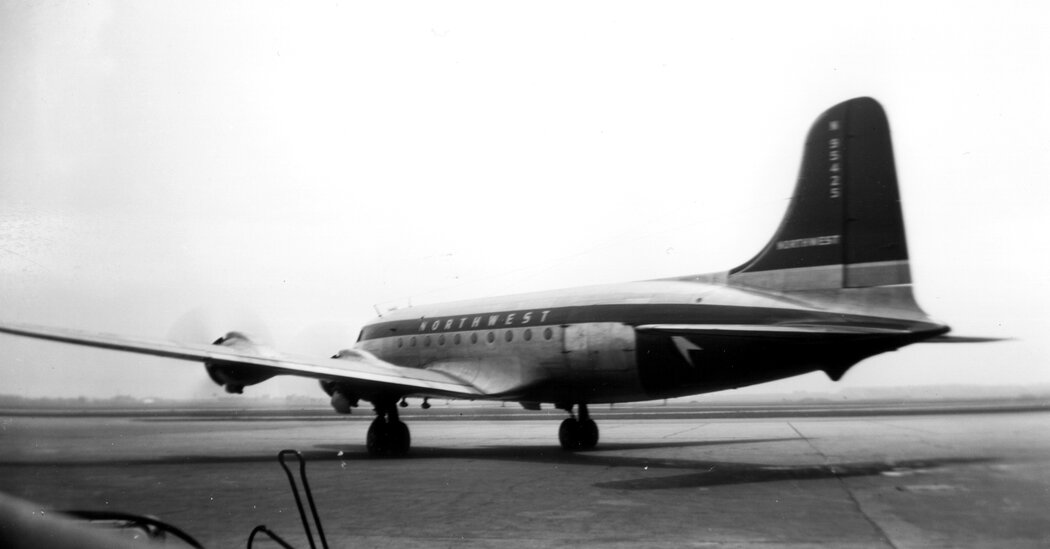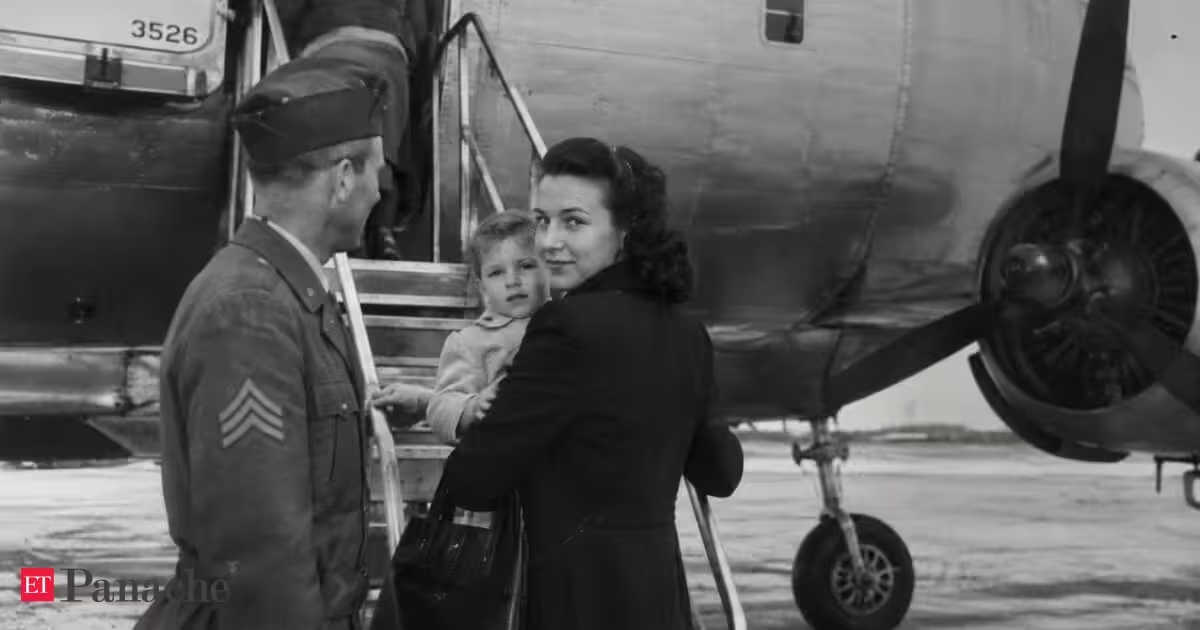
Some mysteries become harder to explain as the years pass. Others simply disappear from public memory. But the case of a U.S. Air Force plane, that vanished over the Yukon in 1950, has remained different because nobody has ever found the aircraft, its passengers or even a confirmed piece of wreckage. For decades, the remote mountains and forests of Alaska and Canada’s Yukon have hidden this aircraft that disappeared with 44 people aboard, including a pregnant military wife and her toddler son. 76 years later, investigators and volunteers are still trying to determine where it went down.The Douglas C-54D Skymaster, designated Flight 2469, left Elmendorf Air Force Base near Anchorage, Alaska, on January 26, 1950, on a flight to Great Falls, Montana. Among those aboard were Joyce Espe, who was pregnant with her second child, and her 23-month-old son, Victor.Before she left, her husband, Master Sergeant Robert Espe, gave her a warning that would become deeply unsettling after the aircraft disappeared.“If you have to jump, give the baby to Sergeant Roy Jones,” Robert told her, according to accounts cited by Smithsonian Magazine and Military.com.Jones, one of Robert’s friends, was also travelling on the plane. Neither Joyce, Victor nor Jones would ever be seen again.The last known contact with the SkymasterThe flight was not initially considered unusual. Around two hours after takeoff, the crew contacted a radio station near Snag, Yukon, and reported their position. They mentioned icing conditions but did not indicate that the aircraft was in serious trouble.The plane was flying at about 10,000 feet. Because the C-54 was unpressurized, it could not simply climb high above the mountains, leaving the crew with less room to deal with bad weather and icing.The next radio check-in, expected near Aishihik, never came.Clare Fowler, a 22-year-old civilian radio operator at Snag, was the last person known to have heard from the aircraft. The Skymaster was expected to continue towards Whitehorse before heading south towards Montana, but it disappeared somewhere along the route.The Air Force quickly began looking for it.Operation Mike begins in brutal winter conditionsThe search was named Operation Mike after the aircraft's pilot, First Lieutenant Kyle McMichael. American and Canadian forces joined the effort, with aircraft sent out from Whitehorse to search the enormous wilderness.The conditions were poor almost from the beginning. Snow continued to fall, temperatures were far below freezing and daylight was limited. Search aircraft also had difficulty seeing through the mountainous and forested landscape.The search covered a huge area, but the aircraft being used were not specifically designed for detailed search and rescue work. According to the Air Force's later accident report, search crews could pass over a crash site several times without seeing it.The problem became even worse when aircraft sent to search for the Skymaster themselves crashed.A C-47 went down south of Whitehorse, forcing rescuers to help its injured crew. Another C-47 crashed days later, leaving 10 men stranded on a mountain. Although the search crews survived, resources that had been focused on Flight 2469 were increasingly being diverted.False signals and fading hopesAs the days passed, reports of possible clues began coming in. There were claims of smoke, radio signals and sightings that might have been connected to the missing aircraft.Some people even contacted authorities claiming they had received telepathic messages or had dreamed about where the plane had crashed.None of the reports produced anything.One Indigenous trapper later reported hearing “a sound like thunder” around the time of the disappearance and seeing carrion birds in the area. Searchers investigated the location but found no aircraft.The terrain was described to reporters as “a sea of complexities, gully after gully that could have swallowed the plane and buried it in snow.”By then, the families were desperately waiting for news.“My wife and child are lost, and I’m absolutely just stunned,” Robert Espe wrote in an account published by the Associated Press. “I haven’t slept or eaten since Thursday.”The wife of another missing serviceman, Staff Sergeant Raymond Mangold, also wrote to the searchers, saying, “It is so heartbreaking, sometimes I think I can’t stand it any longer.”Another disaster changes the searchThe search was also taking place alongside Operation Sweetbriar, a large US-Canadian military exercise that brought thousands of troops into the Yukon.Then, on February 13, another major aviation emergency took attention away from the missing Skymaster. A US B-36 bomber carrying an atomic bomb suffered multiple engine failures during a training flight. The crew eventually detonated the bomb over the Pacific before bailing out.The incident became known as the first “Broken Arrow” incident involving a US nuclear weapon.Search resources were redirected, while Operation Mike was reduced. Another military aircraft crashed near Snag days later.On February 20, the search headquarters closed. The Air Force's report suggested that the aircraft might still be located after the spring thaw, when snow melted from the mountainsides.But that follow-up search never happened.Robert Espe kept searching for his familyFor Robert Espe, the disappearance did not end when Operation Mike ended.He spent years trying to find Joyce and Victor. According to Smithsonian Magazine, he kept a room dedicated to his missing wife and son, with maps of the search area and a ham radio. He continued to mark their birthdays and spoke about them in the present tense.He also wrote to relatives of other passengers, remembering the men who had disappeared alongside his family.Robert later remarried and had two daughters, but the disappearance remained part of his life until his death in 1968.“This just devastated him,” his daughter Kathy Luers later said.For the families, there was no confirmed crash site, no recovered belongings and no remains to bring home.Why the plane could still be hiddenThere has never been a confirmed explanation for what happened to Flight 2469.Icing is one possibility because the crew reported ice on the aircraft shortly before disappearing. Equipment failure has also been considered, particularly because the plane had experienced an engine problem before its final departure.Another possibility is that the C-54 crashed into an isolated mountain, forest or glacier and was quickly covered by snow.The Yukon is also vast and difficult to search. Thick vegetation can hide wreckage from aircraft flying overhead, while snow and ice can conceal crash sites for decades.There is evidence that wreckage can remain hidden for remarkably long periods. Northwest Airlines Flight 4422 crashed in the St. Elias Range in 1948, but its wreckage was not found until 1999.A similar case involved a US Air Force C-124 that disappeared in Alaska in 1952. Its wreckage was eventually discovered in 2012 after debris emerged from the retreating Colony Glacier.
In 1950, a pregnant military wife boarded a US Air Force plane despite husband’s chilling warning. Then the aircraft vanished forever and 76 years later no one knows what happened
In 1950, a US Air Force Douglas C-54 Skymaster disappeared over Canadas Yukon with 44 people aboard, including a pregnant military wife, her toddler son and her husbands close friend. The aircraft was never found despite a huge search operation, and investigators still do not know whether it crashed in the mountains, was buried under snow or ice, or suffered another fate.
1,089 words~5 min read