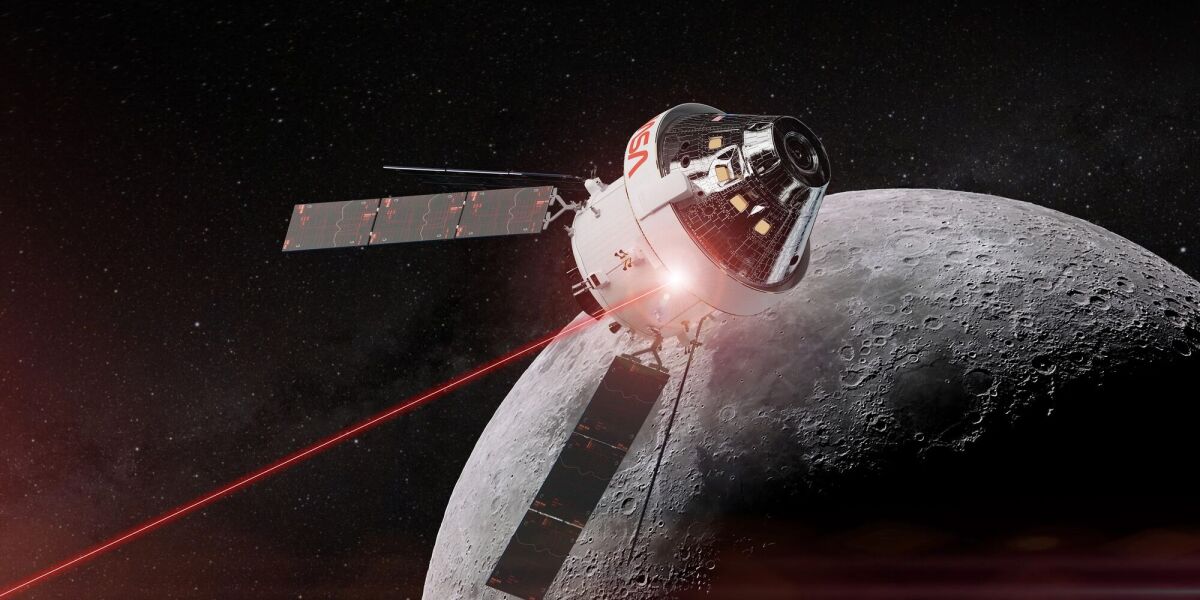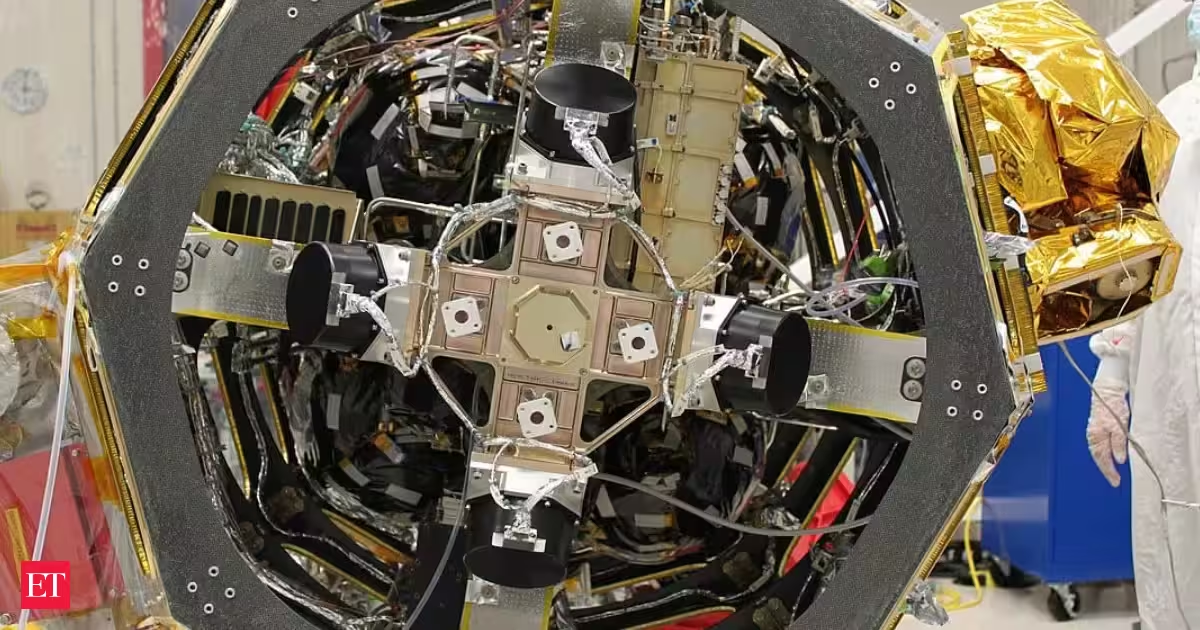
At some point in the early morning of October 18, 2013, while the nation was asleep, a craft circling the Moon emitted a pulsed laser at a ground facility in New Mexico and dumped information at a rate of 622 megabits per second over 239,000 miles. As the NASA summary of the project indicates, that download speed was over six times the speediest radio technology NASA had ever put into use on the Moon.Diagram showing the inner workings of the LLCD optical module. Image credits: Wikimedia CommonsTo put it into perspective: 622 Mbps is comparable to, and today, in 2026, actually somewhat faster than, the median fixed home broadband speed in the US, which Ookla's Speedtest Global Index puts at roughly 305–310 Mbps. In other words, a laser link beamed from lunar orbit in 2013 outran what a typical American home internet connection delivers today, over a distance of nearly a quarter-million miles.What actually happened up thereThe mission was known as the Lunar Laser Communication Demonstration, or LLCD. LLCD was a payload that flew aboard NASA's LADEE spacecraft, which was studying the Moon's thin atmosphere and dust environment, LLCD rode along as an instrument on that mission rather than being a mission of its own. Instead of a radio antenna, of the kind that had been used aboard spacecraft since the days of Apollo, LLCD carried information on a laser beam.The underlying idea is conceptually similar to fiber-optic internet on Earth, encoding data onto pulses of light rather than radio waves, except the light traveled freely through the vacuum of space instead of being guided down a physical glass cable. LLCD's laser communications terminal weighed around 50% less and required 25% less energy compared to the same-size radio systems, and all this while transmitting six times more data. But the demonstration continued over about a month, during which LLCD sent down two HD video streams and locked onto its ground station in seconds.Why radio suddenly looked ancientThe physics involved is refreshingly straightforward; it shows higher frequencies can support higher data rates under the right conditions. As stated in a 2014 peer-reviewed scientific paper titled “The Lunar Laser Communication Demonstration: NASA’s First Step Toward Very High Data Rate Support of Science and Exploration Missions,” written by Don Boroson and Bryan Robinson of the MIT Lincoln Laboratory and published in the journal Space Science Reviews, the LLCD did not merely meet but surpassed its intended data transmission rate, achieving up to 622 Mbps and setting new records for distance and data transmission speed in a laser communication link.The catchThe lasers can transfer data quickly, but they have a lot of issues as well. As mentioned in that very same MIT study, some of the flights had to be flown at half power because data rates were reduced in particularly turbulent atmospheric conditions, or in other words, the clouds and poor atmosphere affected the beams.A Lunar Laser Ranging Observatory in France. Image credits: Wikimedia CommonsA laser needs to be extremely accurately pointed at a target over very long distances, unlike the radio waves that just get spread out in the air.Thirteen years later, are we there yet?Well, sort of. NASA expanded on the theme with its Deep Space Optical Communications test on board the Psyche craft. NASA's Jet Propulsion Lab states this craft streamed ultra-high-definition video from nearly 19 million miles away at 267 Mbps in December of 2023, and then transmitted information from beyond 307 million miles away before retiring in 2025. Impressive, but do you see the trend? The connection reportedly weakened as the craft moved farther away, eventually dropping into single-digit megabits at Mars-like distances.So astronauts on Artemis missions are not getting fiber-optic-speed internet on the Moon anytime soon, and Mars livestreams remain a distant prospect. But what NASA demonstrated back in 2013 and continued to demonstrate since is that light trumps radio when it comes to sheer speed. Making this connection reliable enough to use in real-time by actual people would be the far harder sequel of that story.
In 2013, NASA beamed laser data from lunar orbit at 622 megabits per second, demonstrating faster space communications than radio
In 2013, NASA successfully demonstrated laser communication from lunar orbit, achieving unprecedented data transmission speeds of 622 Mbps, revolutionizing expectations for space internet and setting the stage for future exploration.
670 words~3 min read
 aboutamazon.com