"Earthset" captured through the Orion spacecraft window at 6:41 p.m. EDT, April 6, 2026, during the Artemis 2 crew’s flyby of the Moon
(Image credit: NASA)
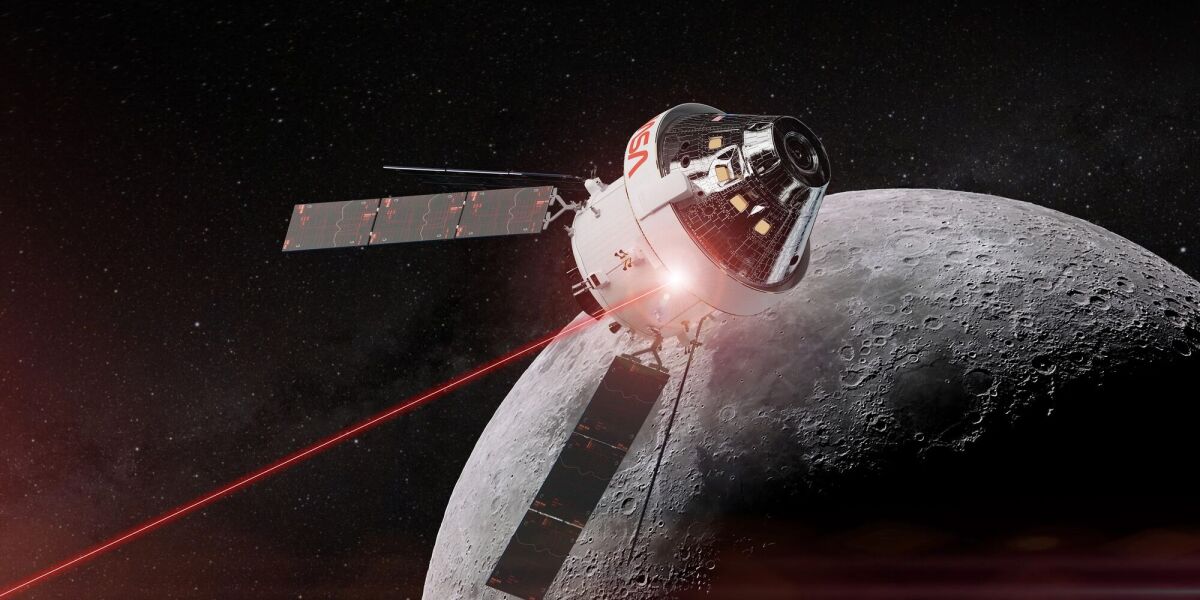
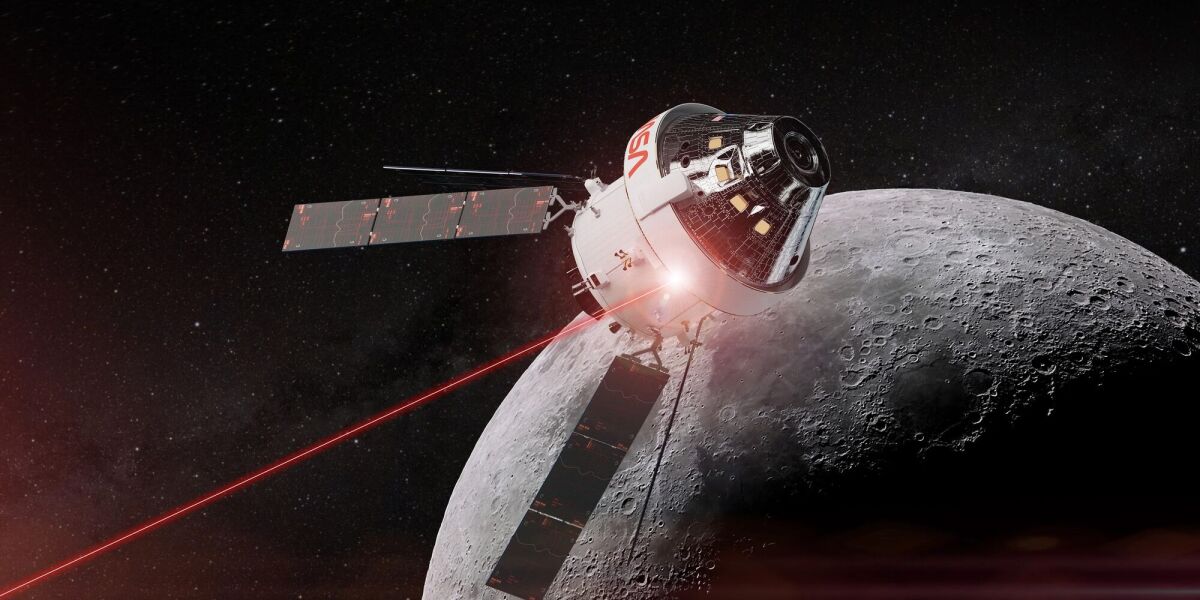
The world followed the exploits of NASA's Artemis 2 moon mission in near real-time thanks to a high-tech laser link between the astronauts and Earth that enabled high-definition streaming video and images.Transmitting data optically, in this case by infrared light, is referred to as 'lasercom', and was at the heart of what made Artemis 2 so successful in the eyes of the public. Thanks to the high-res imagery that was made available on a daily basis, it felt like we were all riding with Artemis 2 commander Reid Wiseman, pilot Victor Glover, and mission specialists Christina Koch and Jeremy Hansen every step of the way on their voyage around the moon.This was made possible by a device called the Orion Artemis 2Optical Communications System (O2O), developed by researchers at MIT's Lincoln Laboratory. An infrared laser, it transmitted data to Earth at bit rates of up to 260 megabytes per second — faster than some home broadband internet. Infrared signals, rather than radio, were chosen for a variety of reasons. For one thing, near-infrared light can pass through thin clouds, so an obscured sky wouldn't prevent communication. And secondly, optical light operates at a higher frequency than radio, enabling more data to be packed in."Our goal was to demonstrate O2O's operational utility for human spaceflight, extending the high-bandwidth connections that Internet users enjoy on Earth to astronauts in deep space," said Farzana Khatri, who is the lead systems engineer in Lincoln Laboratory's Optical and Quantum Communications Group, in a statement. "We not only demonstrated the first use of a lasercom on a crewed mission beyond low Earth orbit, but also attracted massive public engagement as the astronauts shared multimedia from their journey in near real-time."Imagery was very important on the Artemis 2 mission. The fantastic photos such as "Hello, World" and "Earthset" didn't happen by accident. The crew had been trained at NASA's Johnson Space Center in Houston to observe and photograph the moon and Earth, and the O2O system ensured that their best images could be beamed back to Earth and spread across news sites and social media within hours of taking them.The O2O system has its origins in a similar project developed by the Lincoln Laboratory team called the Modular, Agile, and Scalable Optical Terminal (MAScOT). It flew to the International Space Station (ISS) and was tested for the first time in 2023, itself following on from earlier lasercom tests such as NASA's Optical Payload for Lasercom Science (OPALS) instrument that beamed a 165-megabit video from the ISS in 2014.O2O is an evolution of MAScOT. It is composed of three modules. One is an optical module featuring a 4-inch telescope that focuses the laser and gimbals to help point it. A second module contained a modem that converted electronic data into optical data. Finally, the third module consisted of a controller that interfaced with the spacecraft to help point the telescope.
 aboutamazon.com