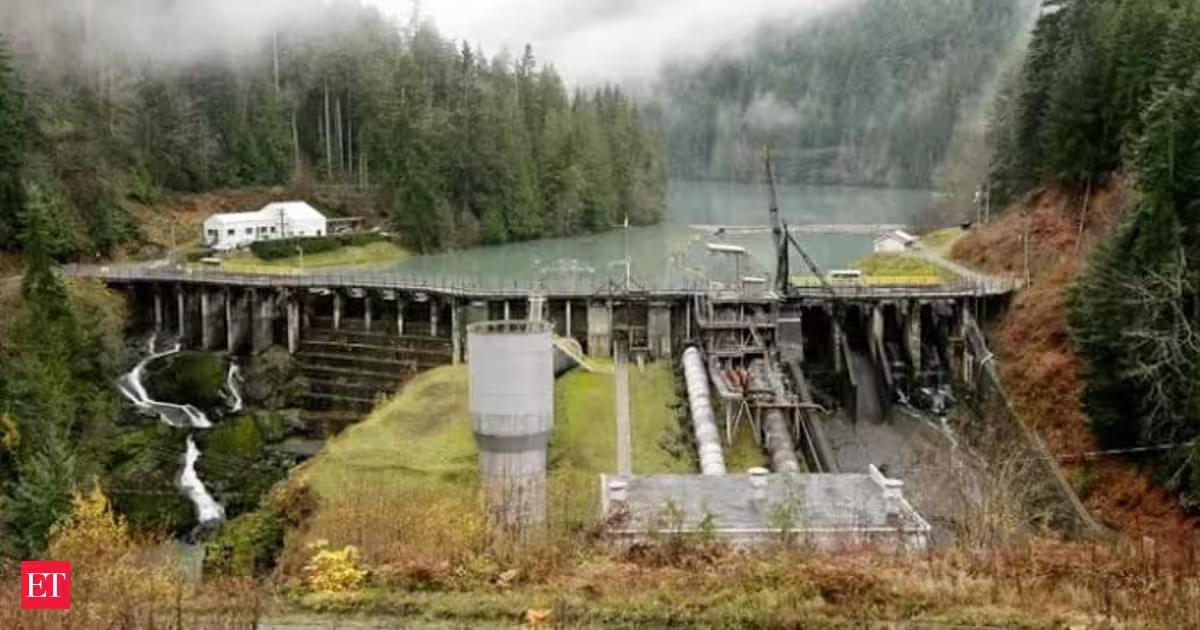
Detroit Dam on the North Santiam River. Image credits: The US Army Corps of EngineersIn 1953, the formal dedication of the Detroit Dam transformed Oregon’s North Santiam Canyon and forced roughly 200 residents of the original Detroit town to relocate. The 463-foot-high dam created Detroit Lake, inundating the old townsite beneath the reservoir. More than six decades later, a severe drought produced an extraordinary glimpse of what had disappeared. In October 2015, when Detroit Lake fell about 143 feet below capacity, a Marion County sheriff’s deputy discovered a 19th-century utility wagon partially buried in the exposed lakebed. This discovery highlighted a rare preservation phenomenon; as noted by the Smithsonian, the thick reservoir silt had completely sealed the wooden artifact away from oxygen, shielding it from decay for over six decades.A town relocated for a damThe original town of Detroit had developed along the upper Santiam River after beginning as a work camp for the Oregon Pacific Railroad in 1889. While the railroad project failed soon afterwards, the settlement survived. By the early 20th century, Detroit had become a small community associated with logging, transportation and access to the Cascade Mountains. However, its location beside the Santiam River eventually put it directly in the path of a major federal water project. In 1946, the Army Corps of Engineers began buying land for Detroit Dam, and the reservoir would ultimately inundate the original town.Congress had actually authorised the dam project via the Flood Control Act of 1938, which included Detroit Dam among seven other dams planned for the Willamette Valley Project; however, World War II delayed construction. According to the Oregon Encyclopedia, land acquisition and clearing began in 1946; construction began on 1 April 1949.Anticipating the valley's flooding, residents proactively established a new community about a mile away on higher ground. This new townsite was formally incorporated in 1952. Later that same year, the evacuation was completed, allowing the Army Corps to begin filling the reservoir ahead of the dam’s formal dedication on 10 June 1953.Detroit Lake at low water levels during a 1973 drought. Image credits: Wikimedia CommonsThe dam rose 463 feet above the North Santiam River and created a reservoir with about 455,000 acre-feet of storage capacity. The US Army Corps of Engineers reported that the dam was a part of the Willamette Valley project, a system of multipurpose dams whose primary purpose was flood-risk management, alongside hydropower, irrigation, recreation, water supply, fish and wildlife protection and water-quality management.Drought uncovers the past from beneath the lakeFor more than six decades, the original townsite remained mostly hidden beneath Detroit Lake. However, falling water periodically uncovered traces of what had been submerged. In 2015, the United States was experiencing a prolonged drought, and several reports said the lake’s water level dropped to an unprecedented 143 feet below capacity, its lowest level since the reservoir was filled six decades prior. On 29 October, Marion County Sheriff’s Deputy Dave Zahn went to investigate the newly exposed shoreline, expecting to find foundations or other remnants of the Old Detroit town. Instead, he discovered the remains of a utility wagon partly buried in the mud. According to the Statesman Journal, Zahn and US Forest Service archaeologist Cara Kelly later kept the wagon’s exact location confidential to protect it from vandalism and looting.A metal plate on the vehicle identified it as a wagon manufactured in 1875 by the Milburn Wagon Company of Toledo, Ohio, which was one of the country’s major wagon manufacturers at the time. The researchers were, however, careful not to claim that it definitively belonged to a particular resident of Old Detroit. Kelly told the Statesman Journal that the wagon might not have been in its original location and could have come from elsewhere in the former town or even farther up the drainage. The wagon was found alongside an octagonal cement-lined pit whose original purpose is yet to be determined by experts.While the deeply buried wagon required an extreme drawdown to be uncovered, shallower stone and concrete foundations of Old Detroit had surfaced whenever the lake’s level fell moderately. Those foundations and other traces became visible before disappearing again as water levels rose.
In 1953, Congress approved the Detroit Dam, and 200 residents left Old Detroit; 62 years later, record-low water exposed the Oregon town’s wagon and ruins
In 1953, the formal dedication of the Detroit Dam transformed Oregon’s North Santiam Canyon and forced roughly 200 residents of the original Detroit town to relocate. The 463-foot-high dam created Detroit Lake, inundating the old townsite beneath the reservoir.
690 words~3 min read