Park Jun-hee
I ask the hard questions, so you don't have to 🗞️📝
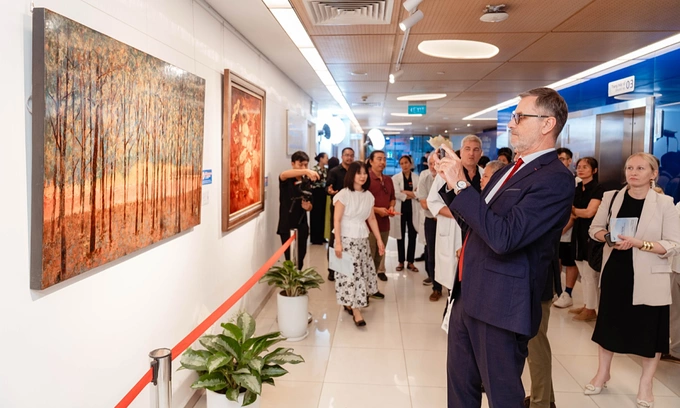
Curated exhibitions at Korean hospitals look to make clinical environments less intimidating for patients and their families Art gallery at Asan Medical Center in Songpa-gu, southern Seoul (AMC) A hospital visit rarely begins with treatment or seeing a doctor. It begins with waiting — and figuring out where to go next.Visits can stretch for hours, with patients moving between tests, examinations, registrations and payments. Even the most self-assured can feel helpless and lost, suddenly dependent on a system they do not fully understand.That sense of vulnerability can make the most ordinary hospital surroundings — rows of chairs, fluorescent lights, a closed examination-room door — feel more unsettling.Increasingly, major hospitals across South Korea are turning to art to make the experience a little less daunting.Asan Medical Center in Seoul, South Korea’s largest tertiary hospital with about 2,700 beds, has been staging exhibitions since 1996 to offer emotional support and create a restorative environment for patients and visitors.Emerging artists are given weeklong shows, while more established artists exhibit for two weeks. The hospital holds around 40 exhibitions a year, encompassing Western- and Korean-style painting, photography, sculpture and crafts. The institution tailors its selections to the people who use each part of the building.“Bright, hopeful works are displayed in areas frequented by critically ill patients, while shared wards feature comforting images. Each piece is assessed for its size, tone and suitability for the space and potential impact on patient safety,” an official at AMC told The Korea Herald.The approach underscores one of the central challenges of curating art in a hospital. Unlike museumgoers, hospital visitors rarely enter the building primarily to see an exhibition. They may be in pain, awaiting a diagnosis or caring for a critically ill loved one, making their emotional state an important curatorial consideration.The hospital said its own research suggests that the exhibitions are making a difference.In the qualitative portion of its 2023 brand perception survey, many respondents said the gallery helped them feel calmer and left them with a more positive impression of the hospital. Participation in docent-led gallery tours has also continued to grow since the program was introduced in 2024, according to the hospital.Park Jae-ik, 63, is among the patients who have taken notice of the art on the hospital’s walls.After being diagnosed with heart failure at AMC in 2014, Park went through some of his hardest moments at the hospital. He has since returned regularly for checkups.“When you are going through a difficult time, you want something to hold on to and a place to cry your heart out,” he said. Although “not an art person,” Park said he found some comfort in the gallery in the first-floor lobby of the hospital’s east building.“Fully cured now, I go to the hospital for general checkups, but passing by that gallery still gives me comfort,” he said. He hoped the exhibitions can give others something to focus on, too.Other major institutions have also brought art into their spaces.Samsung Medical Center has hosted exhibitions since 2018, when it opened a dedicated gallery in the passageway connecting the annex building to the cancer center. Now known as the SMC Care Gallery, the space offers moments of color and calm for the roughly 20,000 patients, caregivers and medical staff who pass through each day.Seoul National University Hospital’s Daehan Outpatient Center features works chosen to offer patients, families and staff a sense of comfort and respite. Severance Hospital also operates a permanent art space in its main building, displaying works by established Korean artists.Softening an intimidating environment Art gallery at Asan Medical Center in Songpa-gu, southern Seoul (AMC) Art can offer a brief respite from the impersonal clinical environment, an effect known as “positive distraction,” in which a landscape, colorful painting or familiar everyday scene briefly draws attention away from pain, fear or boredom.A World Health Organization report published in 2019 reviewing more than 3,000 studies found growing evidence that engagement with the arts can promote well-being and help manage a range of physical and mental health conditions.Lim Myung-ho, a professor of psychology and psychotherapy at Dankook University, pointed out that hospital art may offer psychological benefits by evoking pleasant memories and associations.Lim explained that landscapes, familiar figures and comforting images can bring to mind people, places or experiences associated with positive emotions. He added that in positive psychology, consciously appreciating or revisiting such experiences is known as “savoring.”“Art is widely used as a form of therapy, while time spent outdoors, including walking in nature around the hospital, can support the psychological well-being of some patients. Though different in form and purpose, these activities can shift attention away from distress and evoke more positive images and emotions,” Lim said.The professor said color may play a crucial role.“Greens and other nature-associated colors tend to have a more calming effect than intense shades such as red. Because visual cues strongly shape how people experience their surroundings, slight changes to the environment can influence mood.”Lim also noted that hospital galleries bring the museum experience to patients who may be unable to seek it out themselves.“For a patient who has difficulty moving around, displaying art inside the hospital makes it far more accessible. Having art close at hand can make the experience more immediate and personal,” Lim said."In spaces devoted to treating illness, art cannot promise a cure. But what it can do is make room for the person experiencing it."