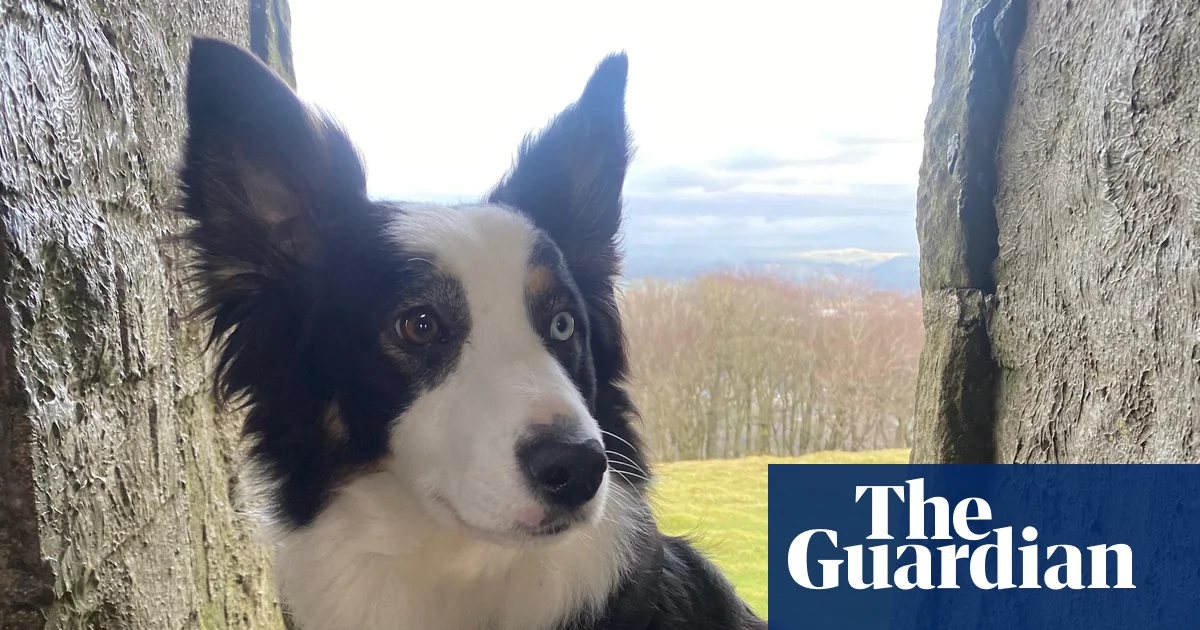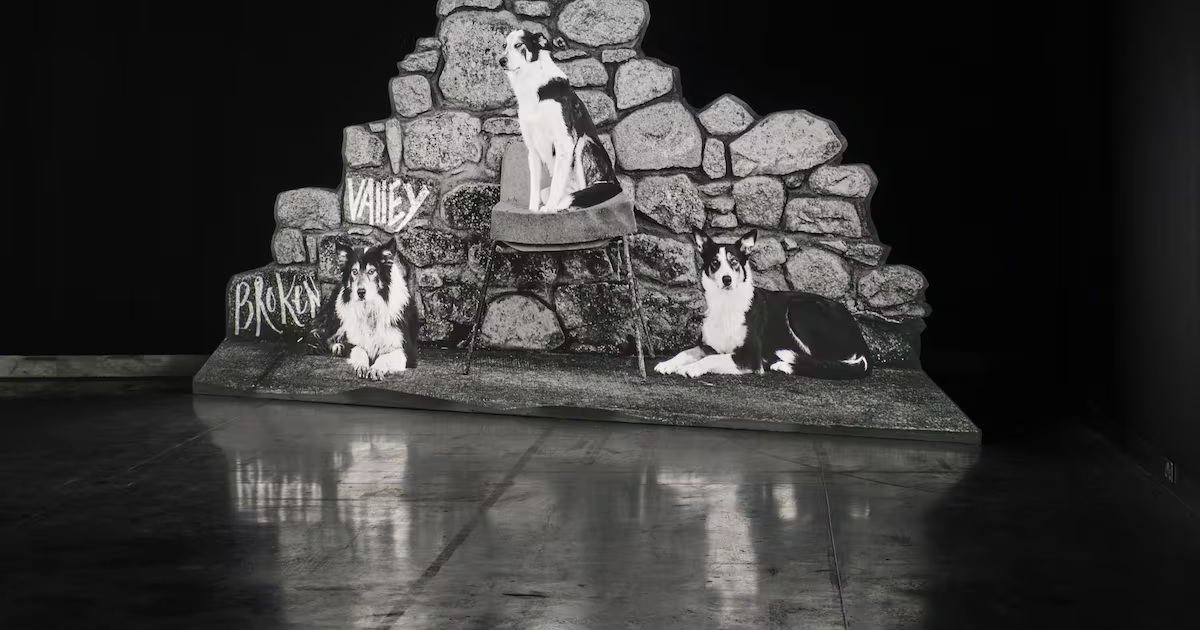
In the gallery, a trio of sheepdogs are sharing their heritage and skills, but it’s not quite as you might think. There is no herding, no farmer uttering arcane commands. Instead, the dogs are projected, backdropped by an old stone wall. “I’m Spot,” says an unspotted dog. “Coolness is my essential quality.”“My breeding would’ve come out of some of the first Border collies that came into Ireland about 80 years ago,” says Toss, father of Spot, and of Meg, who announces, “I can walk right up to a sheep, mesmerise it with my eyes and lick it on the nose.” Spot remarks that she hates her name. It is, she says, “not cool”.To one side of the three talking dogs is a sentient hedge. The installation – The Collie, the Cheviot & the Crouched Skeleton – is the work of the artist and shepherd Orla Barry. Spot, apparently, is indeed very cool.“I have never seen such a cool dog. I can’t even describe the elegance of her,” says Barry, who established her own sheep farm in Wexford in 2011, having returned from 16 years living in Brussels. By then, she already was an artist with a well-established international career. Her major exhibition, Portable Stones and Other Works, was held at the Irish Museum of Modern Art in 2006. Sheep didn’t creep into her work – which weaves storytelling with film, performance and installation – until Breaking Rainbows, at Wexford Arts Centre in 2016. Orla Barry's The Collie, The Cheviot & The Crouched Skeleton at Rua Red in Tallaght, Dublin. Photograph: Ros Kavanagh. That work, like her current installation, may have featured sheep, but it was about so much more. Across her art, including 2019’s Spin Spin Scheherazade, Barry uses the animals and the worlds that surround them (the pedigrees, the working dogs, the wool, the sales, the rural traditions) to explore ideas of gender, value, land, ownership and belonging, our relationship with the natural world, tradition, modernity, and the layered nature of time. In other words: you could say that all of life can be seen through the prism of sheep. All these come to the fore at Rua Red, the arts centre in Tallaght, in Dublin, where director Maolíosa Boyle’s way of working is to offer artists an extended period of research time, including financial support and a studio to develop their work. This singular commitment has resulted in some exceptional art works and projects, including Alice Maher and Rachel Fallon’s monumental 2021 The Map, which travelled to the Irish Arts Center in New York, and which is currently on show at the Venice Biennale. The Map commission was part of Rua Red’s Magdalene Series, in which Amanda Coogan, Jesse Jones and Grace Dyas joined Maher and Fallon in exploring and creating work in response to Mary Magdalene. As the former director of Derry’s Void Art Centre, Boyle understands the importance time and resources. The Magdalene Series was a three-year collaboration, and included writers Sinéad Gleeson, Silvia Federici and Kate Antosik-Parsons. It is a way of working that enables not only the exhibitions themselves, but periods of engagement with the various communities of Tallaght and its hinterlands. Earlier this year, Brian Maguire’s haunting These Beautiful Men saw the artist make portraits of men living in an Ipas centre. In the adjacent room, audio recordings of the men’s experiences and their journeys to Ireland were profound, upsetting and deeply sad. Cumulatively, the exhibition felt like a crucible of humanity, in which we appear to be daily failing.Brian Maguire's These Beautiful Men at Rua Red 2026. Photograph: Lee Welch In 2025, Belfast’s Turner Prize-winning Array Collective presented The Goose and the Common, creating a series of spaces in which visitors were encouraged to find themselves, and contribute to the artwork itself in a space polarised between the “ussuns” and “themmuns”. In 2024, Brussels/Luxembourg duo Brognon Rollin’s Templates of Chance saw the artists work with service users of addiction and rehabilitation centres, creating multi-hued sobriety tokens which continue in circulation and keeping today. The Goose and the Common by Array Collective at Rua Red 2025. Photograph: Ste Murray. Brognon Rollin's Templates of Chance at Rua Red in 2024. Photograph: Ben Ryan Other strands to the programming include a biennial exhibition of works made by artists from Ireland’s prisons and post-release centres, a biennial performance-art festival, an annual open submission exhibition, and showings of graduate and postgraduate artists from TU Dublin and National College of Art and Design respectively.Where does Barry fit in? When you think of Tallaght, do you think of suburban sprawl or sheep? Boyle describes getting to know the area a decade ago. She had noticed an abrupt demarcation between Tallaght old and new. Look at a map of the area and you’ll see it: where once, as the cliche goes, all this was fields, now the busy city suburb occupies the plain, above which are the Dublin Mountains and the farmlands of Bohernabreena, Glenasmole, Glencullen and Ballinascorney. If people sometimes like to wind up the idea of a rural-urban divide, here you can see it in close physical proximity. Drive or walk some roads and it might be almost as if you’re stepping through one of those portals so beloved of science fiction.An introduction to local farmer Donie Anderson, and further introductions via fellow local, Selina Guinness, began to open doors. “I decided to go on a walk with them,” says Barry, who describes the Farm Walk as a rich tradition by which farmers will not only check their own lands, but share knowledge, sources and resources. Such are the economics of small farming that many farmers double-job. Padraig Lambert is also adept with a chainsaw and during the pandemic, had turned a line of Leylandii in a local garden into a series of otherworldly druidic figures.Simultaneously intrigued both by the topiary and the story of the Leyland Cypress, Barry’s companion film installation at Rua Red, Chaddy & the Leylandii Gods, sees the four trees speak of their roots – in more ways than one. The Chaddy of the title is the local sheep ringleader, a prize Cheviot ewe on Philip Maguire’s farm. One by one, the trees tell of the origin story of leylandii, “the instant privacy boom”, as Irish people from the 1970s on discovered the fast-growing shrubbery, “blocking light and causing bad blood between neighbours,” as one bush, Beau, puts it.Maguire’s farm itself is embedded with Bronze Age and Neolithic archaeology, as the sheep “stand on high pasterns and graze on barrow graves and tumuli”. And as the narrative progresses, we discover how the sheep experience its layered histories almost simultaneously, like very practical seers. Barry, who is increasingly prioritising writing in her work, brings in witty touches, humanising, if you can imagine it, the strange topiary shapes. Buzz, another bush, says: “It’s a raw surface archaeology up there on the hill. At the moment, Chaddy and her Cheviot comrades are trying to get their heads around the origins of the Beaker people. They are doing sheep-style forward-to-the-past seances, to get in touch with their ovine ancestors.”A canine family have their own story to tell in Orla Barry's The Collie, The Cheviot & The Crouched Skeleton. Photograph: Ros Kavanagh Chaddy’s flock have a view of the section of the N11 between the two Sugarloaf mountains, and they watch, but don’t fully understand the traffic and its various purposes. This is paralleled with the older desire lines on the farm, formed by use, rather than a line drawn by planners on a map. “Chaddy says this is a processional walkway to the tomb. She says in May, she still sees ghostly girls walking backwards, throwing kissed hawthorn blossoms from a basket…” In the background, another bush incants the nesting habits of birds. Both the dogs’ and the trees’ set of texts have come from Barry’s interviews with the local farming community. “With Donie’s dog piece, I was dealing with bloodlines,” Barry says, going on to explore how ancestral lineages encapsulate whole worlds of ownership, migration, patterns of value and what we have prized over time. They knit in traditions and mythologies, as stories unfold, are retold, and often distorted in the process. The leylandii piece extends this to explore the immemorial aspects of land usage and farming, and Barry has given the trees American voices, which recognises the North American origins of the hybrid species, and, she explains, is intended to underscore how farming is now being conflated with an idealised way of looking at the land, repackaged for tourism. She was thinking, she says, about fashions in planting, rewilding and how ideas can take over the landscape. It is a fascinating position and yet it would be very interesting to hear that piece re-narrated with more local voices as the accent choice loads the underlying meanings with a somehow extraneous sense of perspective, negating the deep-land, deep-time knowledge of place that the trees, and Chaddy, embody. On the other hand, given recent purchase patterns of our more desirable rural properties, maybe one day we will all be speaking that way.The films take turns: dogs, trees, dogs, trees, and the effect is calmly immersive. Upstairs, Rua Red is a vibrant and busy place. There are music rooms, rehearsal rooms, a large dance studio. There are artist and creative studios, and offices and community spaces. Meanwhile, downstairs on a sunny day, the cafe is busy and the galleries are cool and quiet. The practice of slow commissioning means you get deeply considered artworks that can carry a rich engagement with a part of Dublin so frequently mischaracterised and misunderstood. Does that mean you have to know the backstory, or have been part of the research to get into the exhibitions? No, you just need to open your mind. With the idea of facilitating work that is both relatable and radical, Rua Red’s way of working enables art that rewards repeated viewings. While I am in the gallery, some have come deliberately to see the show, others have looked in, briefly curious, and then stayed, enraptured by the dogs. One day, Barry says, Donie Anderson brought his own dogs to see themselves. They sat on the benches and watched. Who is to say what they thought? Orla Barry’s The Collie, The Cheviot & The Crouched Skeleton is at Rua Red until September 26th. A farm visit to Newtown Hill with the Maguire family, including a sheepdog demonstration, takes place on August 29th; booking at ruared.ie. Orla Barry’s work is currently also on show as part of Memory of a Free Festival, at Wexford Arts Centre until October 3rd and at Uillinn: West Cork Arts Centre from January 23rd, 2027
Artist Orla Barry presents life and its deepest strands through the prism of sheep
Exhibition at Rua Red in Tallaght uses animals to explore ideas of land, time, gender, belonging and the natural world
1,780 words~8 min read