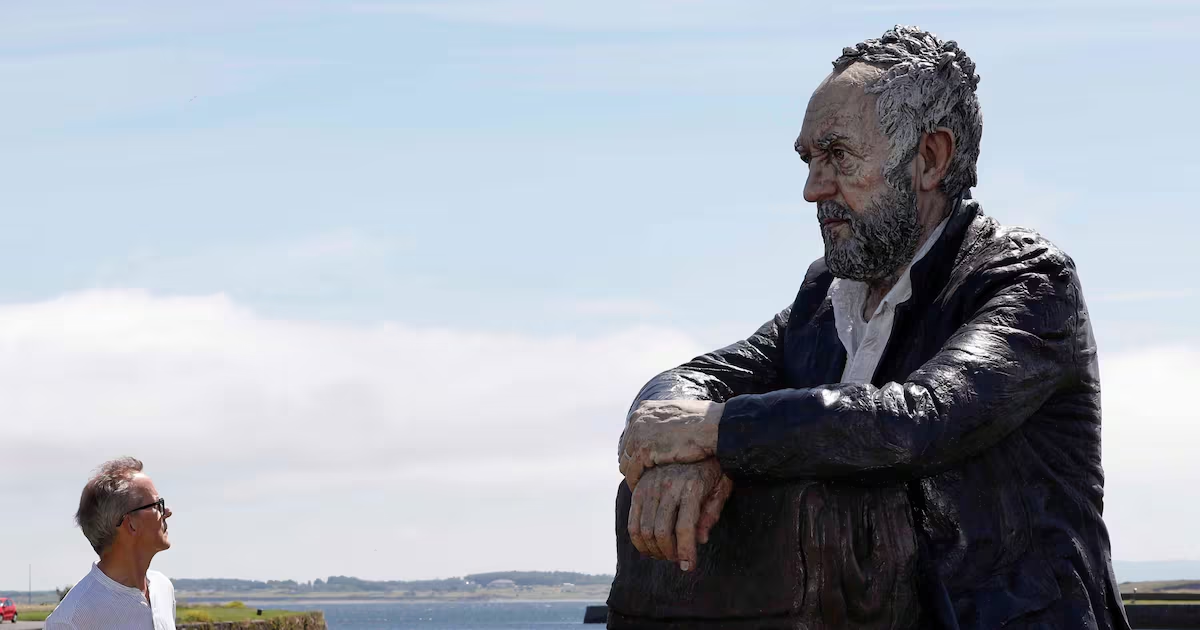
Surprises always await at the Festival Gallery in Galway. Since it opened, just off William Street, in 2019, the former An Post sorting office has hosted an exploding Range Rover, a clutch of almost-human hybrid creatures and a robed group witnessing a martyrdom. Figures have, for want of a better word, figured largely. These previous shows, courtesy of David Mach, Patricia Piccinini and Ana Maria Pacheco, respectively, have pulled off the particularly arts-festival feat of giving you something to think about while also offering a wow for the passing crowds.The surprising thing is the sheer variety of expression. Aside from Mach’s frequent explosions – he has featured at Galway International Arts Festival four times – the sculpted humanity by Sam Jinks, Pacheco, Piccinini and, now, Sean Henry is all remarkably different.Perhaps that shouldn’t be surprising, as we are, of course, infinitely varied ourselves. First up are the raw materials: Jinks and Piccinini work with variations on the theme of silicone, fibreglass, resin and human hair; Pacheco with wood. Henry’s medium is clay, cast in bronze for the larger pieces, then hand painted.“It humanises them, I think,” the softly spoken artist says of the painting process. “When they come back from the foundry they have a different feeling. It can be nice in its own way, but it’s quite Mount Rushmore – immutable, you know?” Ramp, by Sean Henry. Courtesy of the artist and Galway International Arts Festival 2026 He started making clay objects at a young age. “When I was growing up they were always little figures for some reason, little clay figures.” There’s a thoughtful and intelligent quietness to Henry, who is best known for his big public sculptures. Despite his success, you get the impression he’s uncomfortable with the workings, and the competitive measurings, of the art world. Most artists find the art world disheartening, to be fair, but some appear to manage a thicker public veneer. Henry seems to have almost painful levels of attention, soaking up mood and detail and diffusing it into his work.Apart from a couple of initial sessions, such as for his portrait, in 2015, of Tim Berners-Lee, creator of the world wide web, for the National Portrait Gallery in London, he works from photographs. “I’m not good at having someone in the studio, standing before me, not least because the clothes move all the time,” he says. “You’d think after all these years I could invent folds, but I really need to look at them. They’re so mysterious.”Man in a Room, by Sean Henry. Courtesy of the artist and Galway International Arts Festival Born in Woking, in the southern English county of Surrey, in 1965, Henry studied at what was then Farnham School of Art; he went on to become a visiting artist at the University of California. Location mattered. “The brightly glazed, colourful ceramic work I made in California in the early 1990s made sense,” he says. “The bright light, big cars, the positivity of that period in America … Then I brought these objects back to London, where I got my first studio in 1994, and they looked kitsch.” These days his works are more muted; he cites Lucian Freud and Alberto Giacometti – “the way he handles clay is so, so beautiful” – as influences.Seated Figure, by Sean Henry, when it was on the North York Moors, in England. Photograph: RJB/Loop/Universal via Getty Out in the world, Henry’s Couple (2007) stands on a raised breakwater at sea in Newbiggin Bay, in Northumberland, in northeastern England. Standing Man (2010) is in Stockholm, and Lying Man (2011) is in Michigan. [ Alberto Giacometti: Sculptor of existential angstOpens in new window ]So popular was his piece Seated Figure (2017) when it was up on an outlook on the North York Moors, that it was ultimately moved to Yorkshire Sculpture Park to protect the fragile environment. Another version of the edition is in New Zealand, while a third is, for the duration of Galway International Arts Festival, installed outdoors at Claddagh.The figures are always either outsize or small scale, but even with the enormous pieces there is a commensurate quietness and thoughtfulness to Henry’s work. Exploring the Festival Gallery, I can’t help thinking of Blade Runner. “I make friends,” JF Sebastian says in Ridley Scott’s 1982 film. “My friends are toys. I make them.” For a sci-fi action flick, Blade Runner is remarkably replete with moving and poetic moments, as the emotional boundaries between the made and the human intersect and are breached. Standing Man, by Sean Henry. Courtesy of the artist and Galway International Arts Festival 2026 We don’t need science fiction for this – we are prone to anthropomorphise anything, from swearing at our computers to patting our cars – but go into a gallery full of lifelike, if not life-size, human figures and it’s almost impossible not to feel a sense of living presence.Some of this is in the detailing, and a great deal in the process. “There is a point, early on when I’m making a figure, when I do the eyes. That’s when I get a sense of presence. I’ll jump around. I’ll look at a shoe, then a shoulder. I’ll build up to an eye.” Henry points out the surface of Standing Man (KL) (2018), a rugged grey-bearded figure in black shirt, trousers and boots. The folds on the fabric are extraordinary, as are the hues in the aged skin. “People never comment on it particularly, but there are no buttons, no zip. There’s no extra in the surface detail … It’s an issue with more hyperrealistic work,” he says. “Because you don’t get the soul.”The size is important, according to Henry. He recalls Ron Mueck’s sculpture Dead Dad, from 1997, which appeared in Charles Saatchi’s Sensation exhibition at the Royal Academy in London that year. That piece has the hyperreality Henry decries, but it works because it’s at approximately half life-size. The vulnerability in the piece is overwhelming. Often we can let ourselves into art through those little gaps of not-quite-rightness, although they must be finely judged. “It’s the psychology of scale. If we come across something that’s mimetic, that’s trying to be like us, it’s horribly wrong. When something is smaller we can imagine ourselves into it.”For all the reality, theatricality matters too, and Henry frequently breaks his train of thought to describe how the lighting will be when the show opens. Seated Figure by Sean Henry. Courtesy of the artist and Galway International Arts Festival 2026 He goes to the theatre obsessively, he says, and there’s a sense of the stage set in some of the tableaux. Freed from the gallery-imposed politesse over at Claddagh, Seated Figure, just beyond Galway’s Spanish Arch, is already a climbing frame for local kids enjoying the summer-afternoon sun. During their periodic absences, the stoic thinker serves as an inscrutable backdrop for selfies. On Eyre Square, Henry’s piece The Wanderer (2013) is based, he admits, on the opera singer Bryn Terfel. In the gallery, Hedda (2018) is clearly the actor Ruth Wilson. The Wanderer, by Sean Henry, when it was on show in Sydney. Photograph: William West/AFP via Getty Many figures are portraits of self and family, some born of necessity during the pandemic. “But,” Henry says, “knowing who it is reduces it.”He’s right, in that his sculptures are most impactful when they are open to interpretation. Lying Man (2021), in which a small incubus-type figure prances on the chest of a supine man, has too much overlaid narrative to allow the mind of the viewer to fully run free. At their best, instead, Henry’s figures hold time in a way that implies an antidote to our fear of loss: that anxiety about the memories of loved ones slipping away. [ Monumental misstep: Frank McNally on the ‘tragedy’ of a great Irish sculptor, John HughesOpens in new window ]It’s not just making friends: it’s making eternity. This comes back to my mind as I later listen to a radio segment about the funerals of the future, where the dead can play, and replay endlessly, via AI. It seems an almost unimaginably awful thought. These sculptures do defy, and deny, time, but an aspect of this art is that it holds on, so that we can love and let go.You're Not The Same (installation detail), by Sean Henry. Courtesy of the artist and Galway International Arts Festival 2026 Back to those Galway gallery surprises: perhaps the biggest is that, unused for 30 years before the festival team brought the interiors back from dereliction, the William Street Festival Gallery is still dark for 11 months a year, apart from an occasional pop-up courtesy of the Tulca Festival of Visual Arts. It will be up to whichever developer buys the site from An Post to deliver a cultural space as part of the overall development, although the shape and scope of that are not yet set.When the space first opened as a gallery, in 2019, the festival’s artistic director, Paul Fahy, reminded visitors that “this is a space that Ireland owns”, An Post being a commercial state company. Noting then the festival’s origins in 1978, Fahy said “it’s kind of shocking that, 42 years later, Galway is still without a proper cultural hub and a proper gallery”. This is notwithstanding the sterling work done by smaller spaces, such as Galway Arts Centre and the 126 Artist-Run Gallery. Seven years on, Fahy remains hopeful although, one must assume, frustrated. “Obviously, it is a wonderful space with great possibility,” he says. “We would love to imagine the gallery as a long-term space for the festival and Galway.” Wouldn’t we just.Sean Henry: Presence is at the Festival Gallery, as part of Galway International Arts Festival, from Monday, July 13th, to Sunday, July 26th More art highs at GalwayAleana Egan: A Maritime ChildInterface InaghA detail of Remote Sense (Isuzu Trooper), by Aleana Egan. Photograph: Silva Cappellari The set-up at Interface, in the Lough Inagh Valley, is almost an art installation in itself. Working indoors and out, Aleana Egan’s subtle abstract sculptures trace networks in the former salmon hatchery, bringing in materials from the rich trove on site. Don’t expect immediate meaning; with Egan’s work, ideas tend to come to you later. Always worth an explore.Dolores Lyne: Rebel KinFestival Printworks GalleryHouse, by Dolores Lyne McCarthy A recipient of the festival’s forward-thinking Elevate bursary, Dolores Lyne continues work from her earlier To the Letter exhibition, based on the discovery of correspondence between her great-uncle Gen Liam Lynch and his brother Tom. Lyne’s large folded-out canvases write the letters large, and re-create locations from the War of Independence and the Civil War. Moving and fascinating. John Rainey: DeviationsGalway Arts CentreVenus Error, by John Rainey. Courtesy the artist and Berg Gallery, Stockholm Riffing on classical statuary, John Rainey’s mythological figures imagine a world where postmodernism blends with cyberpunk to add prosthetics, grafts, new alignments and adaptations. Depending on your own feelings about the future, this is either beguilingly witty or redolent with dystopian dismay. Lorraine Tuck: LimboFestival Printworks GalleryGlenhoghan Cillín, by Lorraine Tuck Moving and haunting, Lorraine Tuck’s imagery of cilliní – historic burial grounds for stillborn and unbaptised children – are initially arresting for their stark beauty. Knowledge of what lies beneath adds its own shocking power, extending to the realisation that all lands hold their secrets, often their secret shames. Alongside, Jackie Nickerson’s Stateside, also at the Printworks Gallery, tours from the Highlanes Gallery, in Drogheda, showing excerpts from the photographer’s visual diary of a decade living and working across the United States.
Sculptor Sean Henry: ‘When I do the eyes, that’s when I get a sense of presence’
Galway International Arts Festival 2026: Sean Henry’s lifelike sculptures lead this year’s visual-arts line-up
1,925 words~9 min read