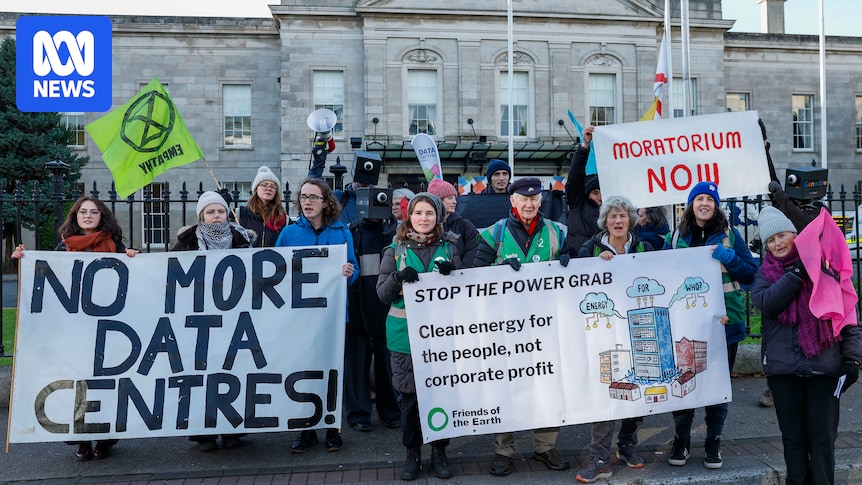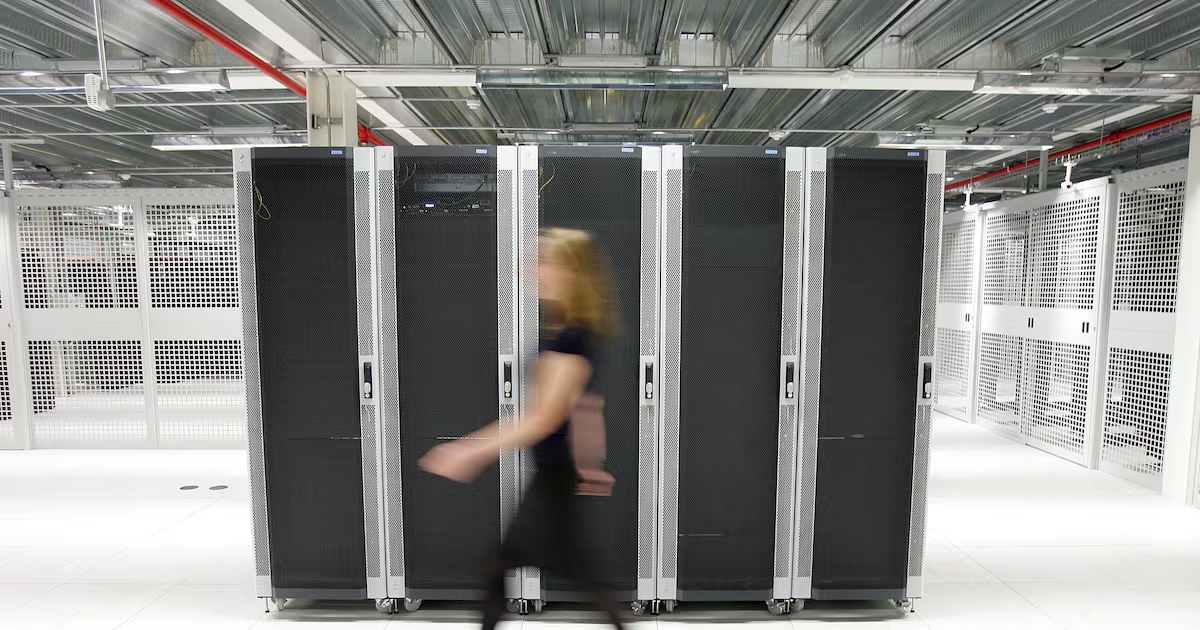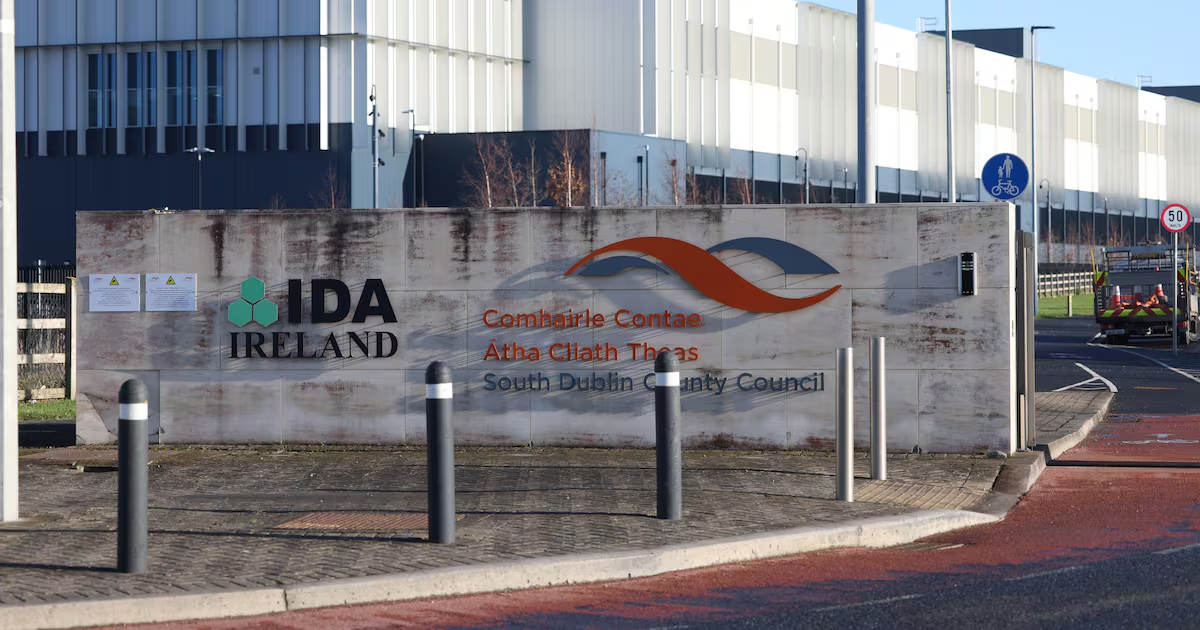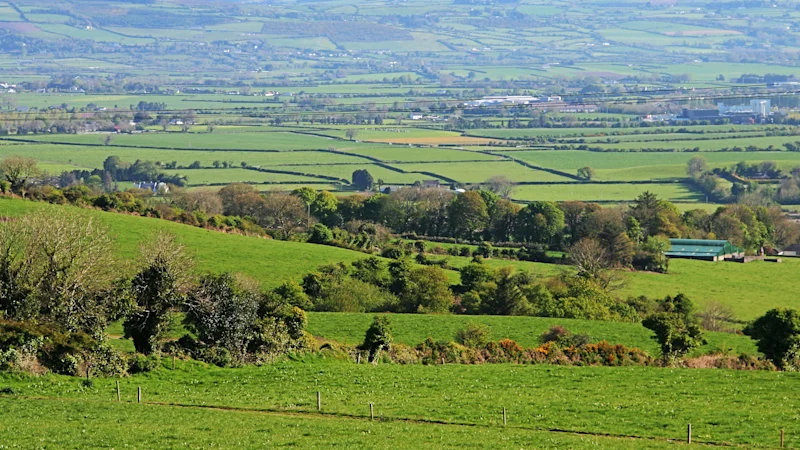
Dublin: The sun is setting over the rolling fields near a small town in Ireland as Sorcha O’Neill and Dolores Moore point towards a large stretch of farmland that is meant to be bulldozed to make way for a row of data centres.We are standing at the edge of their suburb in Naas, a centuries-old town in County Kildare, at an old fence covered in blackberry bushes. Within weeks, they fear, their council will approve the next step in building the data factories of the internet age.“We were never informed about this,” says O’Neill, a former local councillor who understands the planning system. Only four weeks earlier, she tells me, she was checking plans for a more distant data centre when she noticed the paperwork for the farmland in an area known as Jigginstown.Sorcha O’Neill stands near a Microsoft data centre at Castle Grange Business Park in Ireland. She and her neighbours are worried about a similar project being built near their homes in Naas, in County Kildare.David CroweHer heart sank. “That’s right next door.”Now the two neighbours have joined the agonising debate in Ireland about the scale of these new projects. The country already has about 72 data centres and is forecast to have dozens more in only a few years because it is so attractive for developers. It has skilled workers, low company tax rates, a cool climate and good land.Most importantly, it has the location. The facilities here, close to the high-speed lines that connect Europe to America, can quickly crunch data for artificial intelligence applications being used by businesses and consumers in the world’s wealthiest nations. Already, these facilities use one-fifth of the electricity from the nation’s grid. Soon it will be one-third. That makes Ireland a test case in the march of the data centres.O’Neill and Moore discovered too late that Kildare County Council had zoned the land next to their homes for data centre use by the owner, Microsoft. That decision, made without fanfare several years ago, now makes it very difficult for them to challenge the outcome and ensure the land is zoned only for agriculture, as it was for years.Moore, a former catering worker, has been in this community since 1995. “I moved here from Dublin to make a better life for my children,” she says. “And my kids loved it here.” Now she worries about the construction noise from the project and the changes when the data centres are built.O’Neill, a tech worker, talks about the scale of the project when we drive around the perimeter of the farmland, passing horse studs and an old canal. “Who’s going to want to buy to live next to a data centre?” she asks.The rolling fields in Waterford could soon be hosting enormous data centres.Nobody in this community knows how big the data centres may be because those plans are yet to be unveiled. For many, the goal is to stop the plans at a council meeting on September 9, before the developers take the next step.A short drive away, just off the motorway into Dublin, stands a sign of things to come. The Grange Castle Business Park hosts tech giants including Amazon, Google and Microsoft. It is also home to a vast Pfizer facility that makes medicines for global markets – a high-tech contrast to the old pubs and traditional music found in Dublin’s city centre.O’Neill stops outside a long row of white buildings at Site 075. There are no logos on the fence, but this is Microsoft’s address. And it is a future O’Neill does not want in her backyard.Demand for data is soaring as people use more AI. The Grange Castle data centre complex is Microsoft’s largest outside the United States, consuming 1.3 million megawatt hours of electricity last year, according to its latest environmental report. To put that in perspective, the Microsoft data centre in Sydney consumed only 7704 megawatt hours.Microsoft is building a new gas-fired power station to support the Irish site and take some of the load off the national electricity grid. It is also vowing to minimise water use. Each year, the Castle Grange facility uses the equivalent of seven Olympic swimming pools – very low compared to the 392 used by the company’s data centre in Phoenix, Arizona. (The Sydney facility used three last year.)As demand grows, Microsoft needs more space. That is why it is working on the Jigginstown project. The precinct is 54.55 hectares – bigger than the Royal Botanic Gardens in Melbourne (38 hectares) and in Sydney (30 hectares). The company says 37 hectares will be set aside for new parklands, including a boardwalk and a walking track.This is not enough to mollify local residents – especially when O’Neill sees the size of the buildings at Grange Castle.The challenge for Ireland, however, is that it wants more growth in the tech industries that set up there during the nation’s “Celtic Tiger” economic revival in the 1990s, helping to lift living standards.Swimming against the tideCritics say the data centres use too much power and water without creating enough jobs or paying enough economic dividends to local communities. But they are wrong on all counts, according to Ronan Kelly, the chief executive of Digital Infrastructure Ireland, an industry group that represents companies that build and operate these facilities.“The world is in a wave of investment in the data centre space at the moment, which is underpinned by the wave of investment in the AI sector in general, and that won’t last forever,” he says. “When this wave of investment in the AI space stops, the data centres that have capacity will capture the workloads for the next 20, 30 or 40 years. With that will come the taxation from the revenues that flow through them. With that will come the high-skilled jobs to continue to develop and adapt those facilities for emerging workloads.” Ireland has a natural advantage with data centre location, positioned as it is between the US and Europe. Latency, measured in the milliseconds it takes to get a response from an AI app or an online service, is its strength. A facility in Ireland can deliver faster speeds for multiple applications talking to each other across continents, and Kelly believes this will be vital for “agentic AI”, where the apps are increasingly autonomous.Australia, located at the end of the world’s data lines, is unlikely to be able to offer this kind of low latency.For Kelly and the data centre companies he represents, there is a limited time for Ireland to ride this economic wave. He rejects the argument that the projects are vast spaces without workers, pointing to the jobs that are created to build and operate them. This includes the creation of specialist Irish companies that develop power and cooling systems for projects in and outside the country.The Irish government has data to back these claims, courtesy of a report it commissioned from KPMG, received in June, which estimated that Irish-owned high-tech construction generated €2.1 billion ($3.4 billion) in exports in the data centre business in 2024.From 2010 to 2014, it found, the sector created about 17,000 jobs directly. This comprised 9356 additional construction jobs and 7636 operational jobs. Even if the building boom eased over time, KPMG said, the tax benefits would continue to flow from this workforce. Over five years to 2030, it estimated this would be worth €1.36 billion to the government.When KPMG looked at the broadest possible benefits of digital infrastructure, it claimed this part of the economy supported 876,000 jobs and €14.6 billion in annual employment-related tax in 2024 alone.Stopping this growth, says Kelly when we meet in Dublin, means letting other countries gain the jobs instead.“If you look at the backdrop of the world today, where they talk about AI, it is going to have a significant impact on the number of jobs that are out there,” he says. “Sending capacity overseas is really dangerous. You need to look 10, 20 or 50 years out to consider all the implications of this. Any short-term decisions taken today can have really damaging long-term implications.”Feeding the AI beastNoise, however, is a problem. Kelly acknowledges that data centres in the US can generate noise that makes them unsuitable for residential areas. He is confident this is being addressed in Ireland.Water use is also an immense challenge, especially after the recent heatwaves that raised concerns about drought and higher temperatures in Ireland and other parts of Europe. Some older data centres in the US use evaporative cooling with large water use; in Ireland, however, cooler air temperatures make this unnecessary.Newer projects can recirculate water for cooling. But as Microsoft’s data shows, they still require fresh water that can be measured in terms of Olympic swimming pools.Energy use is the most intractable problem. A report last year by parliamentary researcher Kate Walsh found that data centres used 5 per cent of Ireland’s electricity in 2015 but increased their demand to 21 per cent in 2023. Walsh forecast they would need 33 per cent of the grid within a few years.This astonishing growth highlights the lessons Ireland has for countries such as Australia. The Australian Energy Market Operator expects data centres to use about 12 per cent of the east-coast grid by 2040.In Ireland, the trend angers voters who are struggling with higher electricity bills. The government has responded by dictating that all new data centres must provide their own energy generation on-site or nearby. It also says 80 per cent of this power must come from renewable sources.In theory, this might relieve the pressure on households by expanding the capacity of the electricity grid. The data centre companies fault the government for failing to invest enough in power generation over many years, and they would like to build their own power sources without needing to connect them to the grid. Right now, that is not allowed.The logical design for every data centre project includes a gas-fired power generator to ensure reliable electricity to cool the systems at times of peak demand on the grid. This has widened the opposition to the industry among environmental groups that abhor gas-fired power due to its greenhouse gas emissions.The argument in Ireland, and worldwide, is being shaped by this direct link between AI and emissions.Mary Sue Connolly used to fish for mackerel and trout near Waterford on Ireland’s southern coast.‘It’s not for our benefit’Mary Sue Connolly can see all of this playing out in her community of Kilmeaden, near Waterford on Ireland’s southern coast. Here, the town’s old cheese factory is being targeted for demolition to make way for a data centre.With it will come more energy generation from solar farms and wind turbines, along with battery storage. On paper, it will be a digital economy powered by green energy. In this community, however, it means unwelcome change.Connolly, the daughter of a cattle farmer, used to fish for mackerel and trout along this coast with her father. Now she worries about large wind farms that will be visible from the shoreline. And she questions the benefit of all the new power projects if they only benefit the data centre operator, without cutting prices for households.“Our electricity prices are still going up,” says Connolly, a documentary maker who is campaigning against the new data centre. “You know, we are paying for these huge billion-dollar offshore wind, or onshore wind or solar projects. And they are taking our land and our seas.“So, basically, what they’re doing is taking the soul out of Ireland. They’re demoralising people. They’re taking the agricultural land. It’s like we’re being robbed, and it hurts. It really hurts if you live in rural Ireland to see this happening, because it’s not for our benefit.”Connolly and her allies are trying to stop the project at their local council, but they have to prepare for a long legal fight. In June, the nation’s High Court ruled in favour of a €1.6 billion project at Ennis, on the west coast, after at least two years of dispute.The march of the data centres seems relentless. But it will be contested at every step.Get a note directly from our foreign correspondents on what’s making headlines around the world. Sign up for our weekly What in the World newsletter.
‘It’s like we’re being robbed’: The relentless march of data centres
With skilled workers, low company tax rates, a cool climate and good land, Ireland is a test case as data centres spread globally.
2,041 words~9 min read