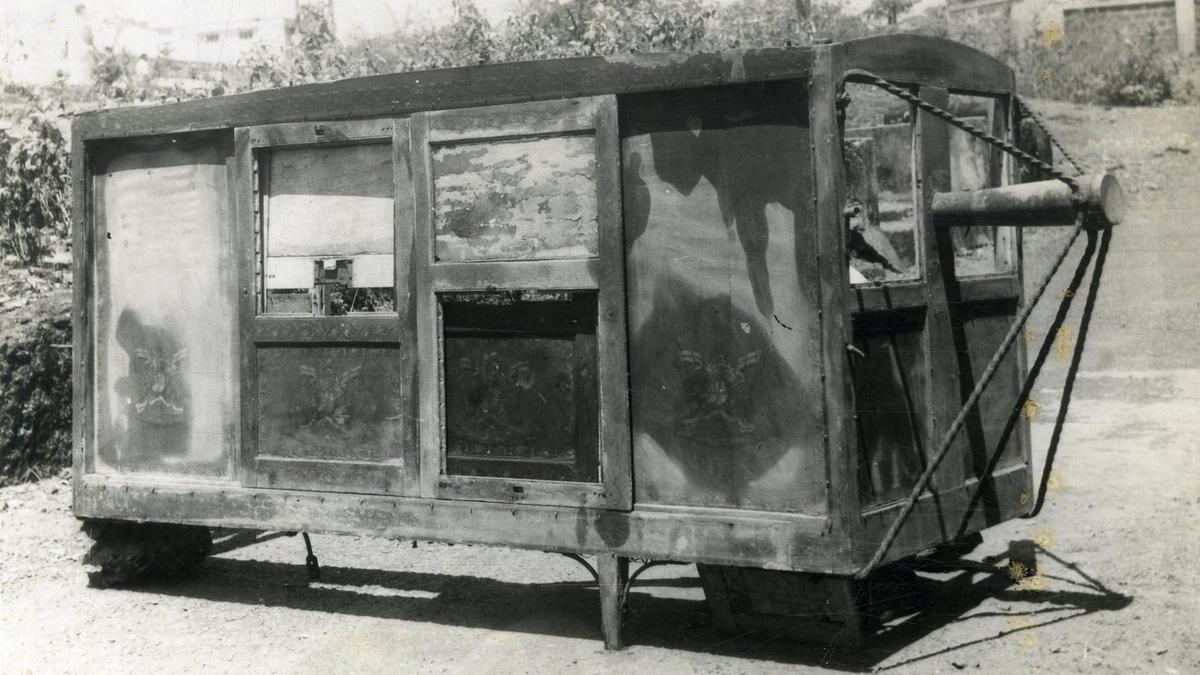
The English too used palanquins, and Charles Lockyer, in his 1711 account of Madras, noted that “the better sort of people travel in palankeens carried by six or eight coolies, if they do not go far from the town, is three pence a day each”.
| Photo Credit: The Hindu Archives
PM Nagar is a gully behind the Mylapore Club. It is not as the name may suggest some scheme of the Central government but a locality with a long history. Originally it was Pallakku Manyam Nagar – land given to those who were responsible for carrying the palanquins of the Kapaleeswarar temple deities. It may be the only vestige of what was once a popular means of transport in our city – being carried around by men. Now consigned to museums, palanquins, the very word tracing its origins to the Sanskrit paryanka and the Tamil pallakku, were how the high and mighty got around Madras. Not unlike the AI of today, dubashism or interpreting was the business everyone aspired to in the 17th and 18th Centuries. A sure sign of a dubash having arrived was the granting to him the right of being carried around in a palanquin.The English too used them, and Charles Lockyer, in his 1711 account of Madras, noted that “the better sort of people travel in palankeens carried by six or eight coolies whose hire, if they do not go far from the town, is three pence a day each; but they are paid more on long journeys.” The East India Company records are replete with details of hire charges of the palanquin bearers, and their rates were invariably higher than hiring a horse! Which probably meant palanquins were an indication of status. There were apparently various types of palanquins. H.D. Love in his Vestiges of Old Madras lists two – the fly and closed palanquins. While the latter is clear in that it was like a box, there is no description of the former. What was it like to be carried about? Lady Elizabeth Gwillim, wife of Sir Henry, a Judge of the Supreme Court of Madras, gives us some glimpses. During her years here between 1801 and 1807, she proved a prolific correspondent and painter. Her letters home and those of her sister, were compiled as A Tale of Two Sisters by Patrick Wheeler and published in 2021. Writing in 1801, Lady Elizabeth notes that for a high society Madras dinner, most people arrived in palanquins.“Each palanquin has from nine to nineteen men and two lanthorn (lantern) men. These set the palanquins under the trees before the door, and lie down to sleep, or talk till they are called. If it be all night, they together form very pretty groups under the trees.” Lady Elizabeth also travels to the beach, not the Marina of today but very likely the sand that stretched in front of Fort Saint George. For her journey there she takes the palanquin, and notes that “the men always walk in the first breaker, for they wear no shoes nor stockings, and they feel no inconvenience in doing so.” That is how Lady Elizabeth saw it. The very reason the bearers were walking in the first breaker, which means the water closest to the shore, was probably because they liked to avoid the blistering heat of the beach sand. So much for them feeling “no inconvenience in doing so.”There is considerable 20th Century literature lamenting the hand-pulled rickshaw’s indignity of one man transporting another. But in the 18th Century, the palanquin was viewed as par for the course. By the late 19th Century, it became an anachronism. But from Pammal Sambanda Mudaliar’s reminiscences of his childhood, which are set in the 1870s, we know of at least one grandee, Mahfuz Khan, who went about in a palanquin. Today, being carried about by four people means something else entirely! Published - August 22, 2026 05:31 am IST