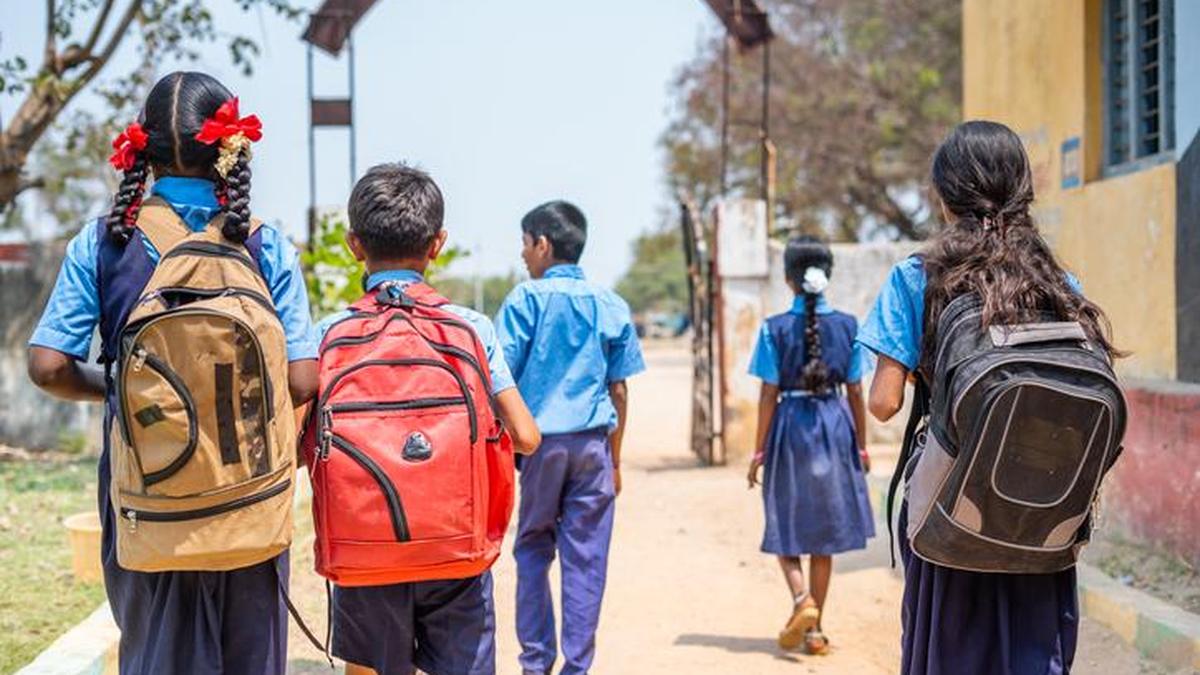
Imagine three children who are not getting the education their neighbours get.The first is an Adivasi. The second is from a household belonging to the poorest 20% of the population. The third is a girl. The intuitive picture is that these disadvantages pile on top of one another: that a poor Adivasi girl carries three burdens, each multiplying the last.Using household-level data from the government’s 2025 Comprehensive Modular Survey: Education (CMS-E), conducted as part of the 80th round of the National Sample Survey (NSS), we looked at whether that is true. Some of it is. A good deal of it is not. We found that the gender gap barely moves at all. It does not change with caste, or with income, or with anything a family can buy its way out of.(Sign up for THEdge, The Hindu’s weekly education newsletter.)Caste and moneyStart with private schooling. 42% of children from the General category attend a private school. For Adivasi children, the figure is 16%.A major reason for this difference is that the cost of attending a private school is high, which many families cannot afford. Average monthly spending per person ranges from about ₹2,500 in Scheduled Tribe households to ₹3,900 in General category households.We compared children whose families has similar education expenditure, live in the same State, and are at the same stage of school, as far as the data allowed.For children from Other Backward Classes (OBC), the disparity in private schooling is mostly caused by income. 36 in every 100 OBC children attend a private school, about six in every 100 less than General category children. However, for OBC and general category families spending similar education expenditure per person, the gap nearly vanishes. But it returns when comparing children living in the same State, to about four in every 100.For Dalit and Adivasi children, the difference barely narrows. About 22 in every 100 Dalit children and about 16 in every 100 Adivasi children attend a private school. Compare this with General category children, whose families spend the same amount per person, in the same State, at the same stage of school, Dalit children are still about 15 in every 100 behind and Adivasi children are 13 in every 100 behind. Two families spending the same amount, in the same State, with children the same age, and one child is markedly less likely to be inside a private school gate.
Data check: India’s gender gap in private education defies caste and class
Caste and money both shape who gets private schooling and private tuition. The gender gap moves with neither, nor with how far a child has got through school
1,256 words~6 min read