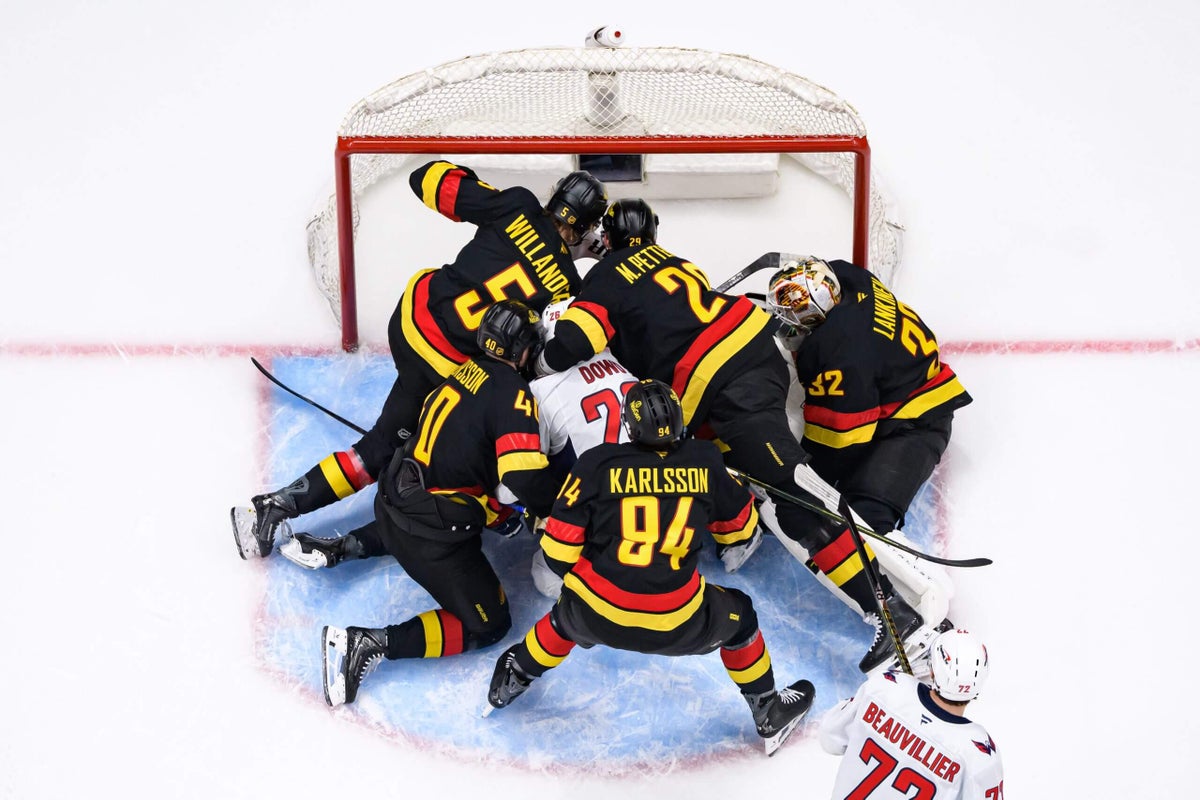
In a hard-cap league like the NHL, it’s actually an accomplishment to perform as poorly as the Vancouver Canucks did last season.Last season, the Canucks finished last in the NHL standings, 14 points behind the next-worst team. It was the largest margin by which a team has finished in last place in a full season in nine years. Vancouver wasn’t just bad and disorganized — it was a rare variety of bad and disorganized.The 2025-26 Canucks, in fact, set such a high bar for fecklessness that the 2026-27 Canucks will be hard-pressed to match it, even if their lineup is worse on a true talent basis today than it was entering the offseason. They should be better organized on a night-to-night basis, it’s hard to imagine that they’ll sustain as many injuries, and you’d certainly hope the organization can avoid the steady flow of off-ice drama that has sabotaged so many seasons over the past five years.It’s important, too, given how many younger players will begin to populate this lineup, that new Canucks hockey operations leadership under Henrik and Daniel Sedin and this first-year coaching staff under Manny Malhotra find a way to create a better developmental environment than what the players slogged through last season.And yet, as the Canucks begin their first focused rebuild in a generation, the losing still matters. Finishing in 32nd place and nabbing the highest draft lottery odds still matter — even if the persistent betrayal of the NHL’s draft lottery balls remains an open wound in this market.How can the Canucks go about improving and developing players this coming season, while still maintaining their perch at the nadir of the NHL standings? What does the road map to finishing in 32nd place, but in an ethical manner, look like? Let’s lay it out.Regress on the power playThatcher Demko isn’t the biggest threat to Vancouver’s ability to finish in 32nd place next season, and neither is an Elias Pettersson bounce back. Even the structural improvement we should reasonably expect in Malhotra’s first season is a secondary concern.Jake DeBrusk scored 19 of his 23 goals last season on the power play. In search of the best chances at winning the NHL draft lottery, the Canucks this season would benefit from a power play that was less effective than last season’s version. (Nick Wosika / Imagn Images)No, if there’s one part of the Canucks’ game that is most likely to prevent them from securing top lottery odds for a second consecutive season, it’s the shockingly efficient five-on-four play. After the Olympic break, once Marco Rossi returned to full health and capacity and was installed in J.T. Miller’s old spot at the left flank, the power play ran hot. Over those 25 games, Vancouver scored 19 power-play goals, converting on 32.8 percent of its opportunities.If Vancouver can sustain that level of consistent threat on the power play, the Canucks will be hard-pressed to remain at the bottom of the standings. That is, unless their team-wide attention to defensive detail remains catatonic, which isn’t an acceptable solution.Certainly offensive puck luck was part of the story for the power play down the stretch; the club converted nearly 24 percent of its power-play shots over the final 25 games. So perhaps this problem will take care of itself. Personally, however, I doubt the late-season success on the man advantage was solely an unsustainable mirage. The power play generated shots on goal at a fringe top-10 rate across this stretch, and the Canucks are returning the same personnel, many of whom are excellent in their specific power-play roles.Whatever other limitations this roster possesses, Jake DeBrusk is brilliant at the front of the net. Filip Hronek is a capable distributor and a legitimate shooting threat up top. Rossi is an effective puppeteer on his downhill side. Brock Boeser is a versatile, polished power-play weapon, and Pettersson can be an elite one-time finisher.If the power play doesn’t regress and remains a potent weapon, it won’t take much tightening of Vancouver’s overall structural game for the Canucks to pick up points at an inconveniently high clip.Resist temptation on the waiver wireWhile there are compelling reasons to be bullish about the power play, the penalty kill is another matter.Vancouver’s PK units were permissive in the extreme last season. They surrendered 65 goals and finished 32nd in the NHL in kill rate — and that was with sturdy defensive centres such as Teddy Blueger and David Kämpf and stalwart shutdown defender Marcus Pettersson playing major short-handed roles.Especially at centre, the Canucks haven’t adequately replaced Kämpf and Blueger as short-handed contributors. Aatu Räty shows promise as a defensive option and is better than both in the faceoff circle, but he’s largely unproven in significant four-on-five minutes. Elias Pettersson, meanwhile, is Vancouver’s most impactful defensive centre five-on-five, but his defensive chops haven’t historically translated into penalty-killing success.Perhaps KHL import Ilya Safonov, a 6-foot-4 centre who won north of 55 percent of his faceoffs last season, can provide a reasonable facsimile of what Vancouver lacks in terms of defence-first options at centre, but he’s never played a professional game in North America.In short, Vancouver may struggle on the penalty kill for personnel reasons alone, and that could help offset the expected effectiveness of the power play.Between now and the start of the season, however, Vancouver may have significant opportunities to upgrade its defensive options on the waiver wire. The Canucks have top waiver priority throughout training camp by virtue of their 32nd-place finish, and they’ll continue to hold that hammer through roughly the first month of the season. The club could tap into that vein if it seeks a defensive centre who might solidify penalty-killing options.General manager Ryan Johnson, however, should avoid that temptation. There is no benefit to Vancouver’s long-term best interest in seeking to raise the floor of this group. Any waiver claims the Canucks execute should be targeted solely at landing players with skill and potential exchange value.If the Canucks don’t have the horses at centre to kill penalties at a league-average clip, so be it.Forget about insulating young playersThe notion of insulating young players at the NHL level has always seemed a bit farcical.Of course there’s a difference between playing top-of-the-lineup minutes and playing on the fourth line. It’s one thing to be hard-matched against the best of the best in the NHL every night, and another to play nine minutes a night with a steady stream of offensive-zone starts. On a shift-by-shift basis, however, if a young player isn’t able to hack it in the NHL, that’s going to show up. It doesn’t matter who they play with or how they’re deployed. Hockey players in the NHL are too good at probing their opponents for weakness and ruthlessly exploiting it. There’s no hiding on an NHL ice sheet.The insulation that matters is cultural and educational. It happens off the ice. Instead, the Canucks should spend this season propping up their veteran players so as to maximize their exchange value, while remaining focused on gathering information on their best young players.The club should shelter players such as pending unrestricted free-agent wingers Drew O’Connor and Paul Cotter, making sure they’re producing enough to net quality assets ahead of the trade deadline. The Canucks should challenge Linus Karlsson to play 20 games on the top line, give Zeev Buium a 30-game audition on the first power-play unit and on the top pair, see what Braeden Cootes can do with middle-six linemates over the course of a month, and find out if Kirill Kudryavtsev can hold up in matchup minutes.At the NHL level, you can do only so much to bring a young player along slowly. Instead, be as efficient as possible in gathering information and figure out who among the team’s young players will sink and who can swim.Prioritize consistency over winsThe Canucks played just about 4,000 five-on-five minutes last season and spent an astounding 1,750 minutes trailing. Despite constantly losing and chasing the game, Vancouver was still soundly outshot, out-chanced and exposed at five-on-five. It’s hard to capture just how poor the Canucks’ systems play was, how disorganized their team game was and how infrequently they even looked engaged night to night.As a baseline expectation, Canucks fans recognize and understand it’s not going to be about wins and losses. It still has to be about all of the other stuff. That’s fine. That’s the reality of rebuilding.Even if fans don’t expect wins, however, they should expect a more consistent work rate, a more organized brand of competitive hockey and some level of passion and professionalism night to night — especially on home ice.Last season, Vancouver repeatedly lost games because it was the NHL’s most disorganized and most lifeless five-on-five team. This season, no one should complain if the Canucks lose because they’re overmatched and struggle to score against superior opponents. But the Canucks need to maintain a baseline level of competitive and structural integrity, even in the midst of what’s likely to be a challenging campaign.Get no better than average goaltendingNo team in the league had a lower team save percentage than the .872 all-situations mark Canucks goaltenders posted last season. In fact, no other team’s goaltenders came in with a save percentage under .875.The sport is rapidly changing. Shooters have put in the work to become experts at attacking transition moments in the butterfly, and they are ruthless at exploiting screens and layered traffic to make life harder than ever for goaltenders. For the first time since the 1980s, shooters have regained the upper hand from netminders in determining outcomes at the NHL level.That’s a very good thing for fans of the sport, but it’s a tricky thing for the Canucks to navigate, given the money and term committed to their aging goaltender duo of Demko and Kevin Lankinen.You’d like to see Demko maintain health and availability and get back to something more closely approximating his Vezina-nominee form before his knee tear (and his second hip surgery), although the former is clearly more important. And you’d like to see Lankinen bounce back to the exceptional form he showcased in the first half of the 2024-25 season, before he signed a five-year extension in early 2025.Ideally, the goalies perform well enough to reestablish exchange value — it is asinine for a team dealing with apparent budget constraints to have $13 million committed to its tandem during a rebuild — but it’s also vital for the Canucks’ long-term interests that they don’t perform too well. Just about league average behind a team that’s likely to struggle defensively would hit the Goldilocks zone and provide the club a path to finishing in 32nd while maintaining a reasonable level of competitive integrity.
How Canucks can see a big improvement in 2026-27 and still finish last in the NHL
Heading into a rebuild, keeping the best odds for top draft picks remains a priority. But how to balance that with development?
1,782 words~8 min read