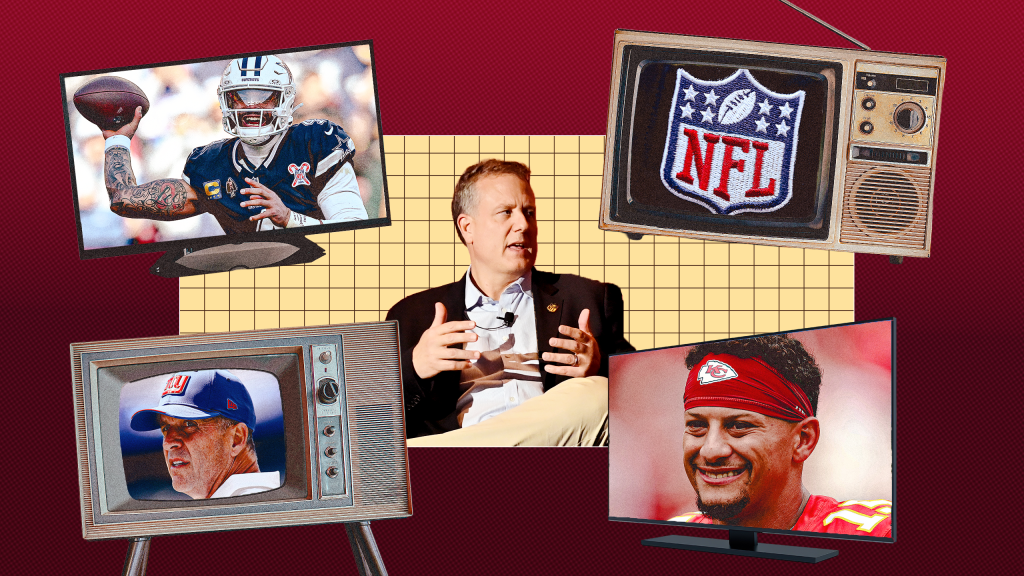
For tens of millions of NFL fans and the 550 advertisers that tirelessly interrupt their game day viewing marathons, football season cannot get here soon enough.We’re specifically addressing the twitchy countdown to Sept. 9, when the 2026-27 NFL campaign kicks off on NBC, although the homonymous sport with the much rounder ball plays a supporting role in this.
Since Spain dispatched defending champs Argentina in the World Cup final on July 19 in front of a U.S. TV and streaming audience of 66.4 million viewers, only one sporting event has racked up more than 5 million impressions. Zero points for guessing, but yeah: it’s the Pro Football Hall of Fame Game, a wholly meaningless exhibition between the Arizona Cardinals and Carolina Panthers that managed to draw just shy of 7 million viewers on NBC/Peacock. That marked a five-year high for the annual scrimmage in Canton.Boy, do we miss football. The next-biggest televised sports gathering since La Roja hoisted the trophy was CBS’ coverage of the Sunday round of the FedEx St. Jude Championship, which averaged 3.79 million viewers. That’s as good as it gets; as so often happens during the back half of the summer, when vacation travel and an abundance of beach days put TV deliveries in a sweaty chokehold, August has basically been lights-out for big-time sports.That’ll change soon enough, although the inevitable huge ratings that are in store may not be sufficient to satisfy the NFL.Despite coming off a 36-year audience high—last year’s slate averaged 18.7 million viewers per game, just shy of the all-time record set in 1989—NFL execs don’t seem satisfied by Nielsen’s efforts to measure its media impressions. Which is somewhat curious, as the ratings service’s fall 2025 currency upgrades, which were designed to provide a more accurate assessment of in-home and out-of-home viewership, likely played at least some part in helping juice last season’s numbers.But according to Paul Ballew, NFL senior VP of data and analytics, the league still isn’t fully satisfied with Nielsen’s behind-the-scenes endeavors. Speaking to members of the press on a Thursday afternoon Zoom call, Ballew said his team was still studying the potential downstream effects of the latest round of tweaks that have been made in the ratings-gathering space.“It’s an interesting mix for us to try to make sense of,” Ballew said, noting that Nielsen had “rushed … a number of fixes into the market” ahead of the fall season. Ballew went on to add that the NFL does not “have enough impact data to fully assess” how the revised measurement scheme may show up in the ratings this fall, as it is “still trying to make sense of some of the logic behind some of the methodological changes.”After the NFL had been particularly vocal about its misgivings over Nielsen’s capacity to measure multiple impressions across a single, shared screen—a year ago, Ballew told reporters the reported co-viewing factor of 2.4 people per household for Super Bowl LIX “just makes no sense”—the company subsequently ran a pilot program to underscore some of the advances it had made on the passive-measurement front. The February test demonstrated that consumption of a host of major sporting events, including Super Bowl LX, saw a 4.2% lift upon application of its enhanced co-viewing data.For all that, the NFL still has its misgivings about the Nielsen upgrades, which also include a change in how the company weighs connected-TV deliveries and a fine-tuning of its measurement of Spanish-language media. “From our initial impact, it looks like a negative for sports; on the other side, co-viewing or partial co-viewing implementation is a positive,” Ballew said. “So, we’re going to have to continue to spend some time pulling this apart and making sense of it.”Nielsen, for its part, notes that the NFL’s TV partners and the media-buying counterparts on the agency side of the table have had an opportunity to examine the new data enhancements since before the 2026-27 sports upfront market kicked off in early spring. Performance guarantees for much of the inventory sold in this year’s $33.8 billion video bazaar were derived via estimates modeled under the new system, and if early unit pricing is any indication, the enhancements aren’t likely to have an outsized impact on the official ratings numbers. (The early data from the spring sell-off suggests that pricing in fall football is up around 2% versus last season.)Ballew closed out his assessment by noting that the latest Nielsen upgrade is “adding to the amount of homework we have to take on going into this season,” before reiterating that the league believes “it’s a misstep on Nielsen’s part to go do this the way they’re doing it.”The Seahawks’ victory over the Patriots last winter averaged 124.9 million viewers on NBC/Peacock/Telemundo. If the NFL’s negative feelings over that near-record delivery may seem somewhat disingenuous—griping about reaching that many fans on a single night is a bit like Scrooge McDuck complaining about how his habit of executing half-gainers into a vault of gold coins leaves him covered with bruises—Ballew and NFL exec VP of media distribution Hans Schroeder have made it clear that they’re just looking for the most rigorous assessment possible. Or as Schroeder puts it, “the righter number.”In that respect, Nielsen and the NFL are on the same page. The company never fails to emphasize that its frequent interventions are designed to provide a more accurate picture of media consumption—which, as everyone at least seems to agree, is what it’s accomplished with its out-of-home measurement.In the absence of all the millions of fans who take in the Thanksgiving Day games after traveling over the river and through the woods to grandmother’s (or somebody else’s) house, there’s no way that CBS gets anywhere near the record 57.2 million viewers it served up with last year’s Chiefs-Cowboys broadcast. Nearly 23 million of those impressions would have been overlooked in the pre-OOH era, and Schroeder himself acknowledged the way the 2020 measurement glow-up has shaken up the Tryptophan Fest.In fact, Schroeder specifically gave OOH a nod when discussing the NFL’s move to launch a Thanksgiving Eve game later this fall. Traditionally the biggest bar-crawl night of the year for collegians returning to their hometowns for the November break, that Wednesday before the holiday is a gold mine for advertisers now that OOH impressions are officially transactionable metrics. While the Packers-Rams game will stream exclusively on Netflix (with traditional TV coverage originating from local affiliates in the two home markets), this NFC battle could easily top 25 million viewers—with about 40% of those impressions expected to be driven by revelers in bars and restaurants.Before OOH, the NFL would’ve never even considered a Wednesday night showcase; since 1948, all of three games have been staged on Hump Day. There will be two Wednesday games this season alone.At any rate, while Ballew’s data crunchers continue to pore over the new Nielsen offerings, Schroeder took care to sidestep questions about the NFL’s seemingly thwarted plan to rewrite some of its legacy rights deals ahead of this year’s Kickoff Game. Shattering ankles like Saquon Barkley, Schroeder juked around queries about the status of these discussions, saying, “We’re always talking to our partners, we’re always talking about what we can do better both in what’s right in front of us and what’s longer term.”When asked again about the rights talks, Schroeder acknowledged that three of the league’s biggest media partners are currently going through a whole lot of major changes at the corporate level, which understandably may have an impact on advance planning at the network level. “We have one partner in NBC that’s going through a transactional split … and you see Fox, who has now gone out and is buying Roku,” Schroeder said, before giving a nod to the ongoing Paramount Skydance-Warner Bros. Discovery stalemate.The NFL’s media guru threw a Heisman stiff-arm in the direction of follow-up queries pertaining to Fox’s recent decision to hold its fire until closer to the triggering of the 2029-30 opt-out clause, before emphasizing that the terms of the league’s deal with CBS (specifically the network’s change-of-ownership clause) are confidential.“I don’t think anything’s changed on our end,” Schroeder said. “We’re always going to look at opportunities to sort of make sure we have the right model partnerships in place for the future. … We remain committed about delivering the best experience for our fans and we’ll continue to stay focused on that, and continue to engage with our partners about opportunities that we have ahead of us where we can even better serve our fans.”While tens of millions of fans count down the hours until the NFL season lifts off next month, the wait to assess the impact of Nielsen’s latest methodology tweaks will only be a few days longer. As NBC is getting things started on a Wednesday night, the official ratings data should land before the end of the day that Friday. At that point, the NFL and its 550 advertisers will either conclude that the early misgivings over the new currency were misplaced, or we’ll be hearing a lot more from Ballew and Schroeder as the leaves start changing color.