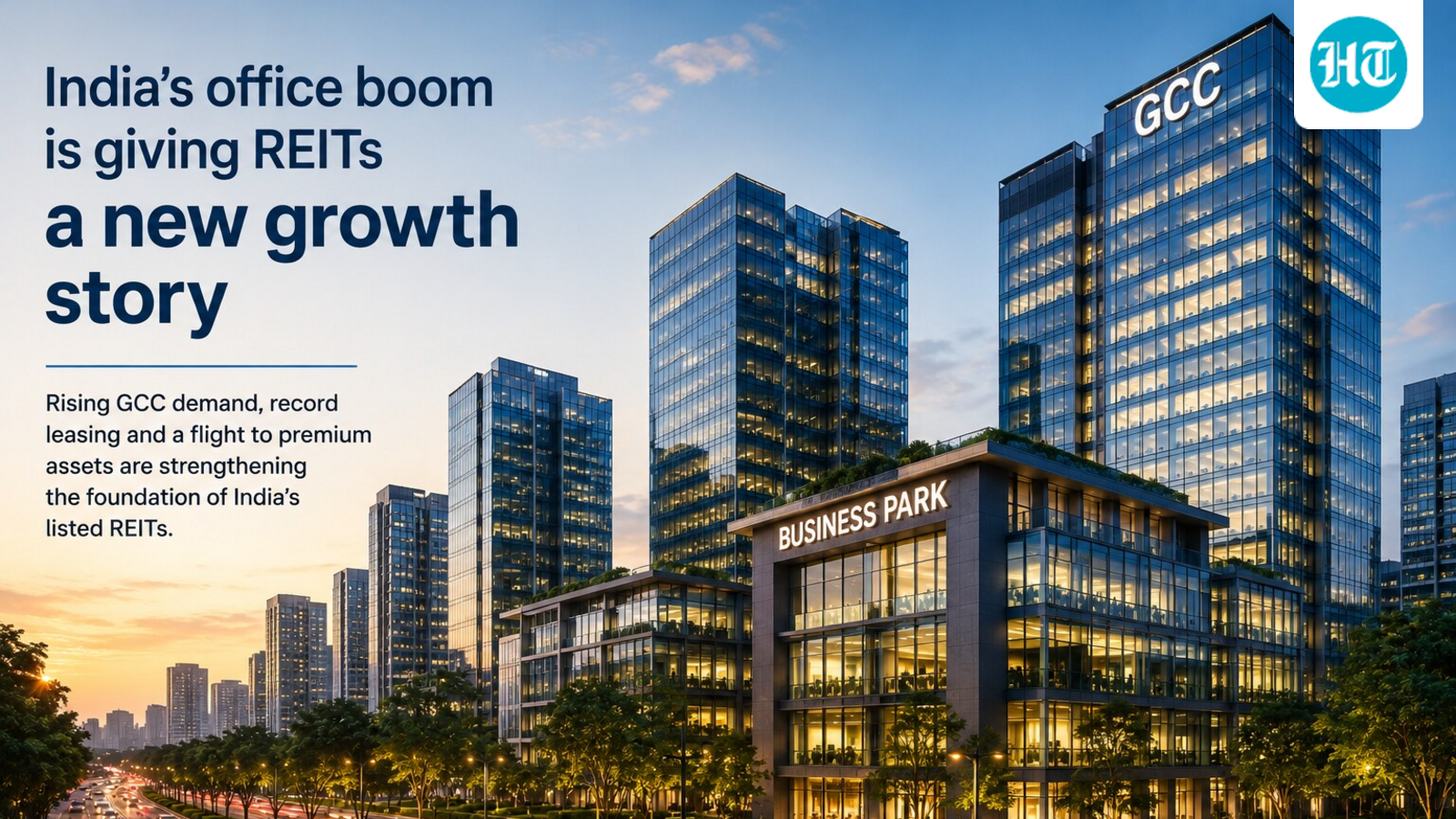
For investors looking at India's REIT market in 2026, the most interesting question may not be what happens to REITs themselves. It may be what happens to the buildings they own.India's office market is skyrocketing, with leasing hitting record highs in 2026.The answer, at least for India's office market, is encouraging.India's office sector is experiencing a remarkable run. According to CBRE India's India Office Figures Q2 2026, gross leasing reached an all-time quarterly high of 24.6 million sq. ft. during April-June, taking first-half absorption to a record 45.5 million sq. ft. Global Capability Centres, or GCCs, remained a major demand engine, accounting for 43% of leasing in the first half.That matters to REIT investors because offices are the backbone of India's listed REIT universe.Six REITs are now listed in India, with the latest addition, Bagmane Prime Office REIT, taking the number to six in 2026. The Indian REITs Association says the six trusts collectively cover about 214 million sq. ft. across India's major commercial and retail markets, with gross assets under management of more than ₹3.15 trillion.The story is no longer simply about adding more buildings. It is about the quality of those buildings and the tenants willing to occupy them.CBRE's 2026 outlook points to India's office stock crossing the one-billion-sq.-ft. mark, with demand increasingly shaped by GCC expansion, technology, artificial intelligence, semiconductors, robotics and other high-value businesses. Premium offices with strong digital infrastructure, security and flexible layouts are gaining importance as occupiers become more selective.For REITs, this creates a potentially powerful combination: long-term institutional ownership on one side and structurally expanding corporate demand on the other.GCCs are particularly important. These centres were once associated primarily with back-office functions. Increasingly, they are becoming hubs for research, engineering, analytics, product development and global decision-making. CBRE estimates GCC leasing reached 19.6 million sq. ft. in H1 2026, up 17% from the corresponding period a year earlier.For a REIT, a high-quality tenant base can translate into more predictable rental cash flows. That, in turn, supports distributions to unitholders.But there is another structural change underway. India's REIT market is increasingly becoming part of the mainstream capital-market conversation. CBRE estimates that the listed REIT market capitalisation expanded from ₹27,100 crore in FY20 to ₹1.726 trillion in the first nine months of FY26—a more than six-fold increase.Regulation is also evolving. CBRE notes that SEBI's reclassification of REITs as equity-related instruments from January 2026 could broaden participation from mutual funds and other institutional investors. The proposed framework allowing commercial banks to lend directly to REITs could also improve access to capital and borrowing flexibility.None of this makes REITs risk-free. Investors still need to track occupancy, lease expiries, tenant concentration, debt and interest costs. Unit prices can also move with equity-market sentiment.Yet the underlying story is compelling.When India's companies expand, someone needs to provide the offices. When GCCs deepen their mandates, they need larger and better workplaces. And when premium real estate becomes scarce, owners of the right assets can gain pricing power.That makes the 2026 REIT opportunity less about simply collecting rent – and more about participating in India's transformation into a global business and innovation hub.Note to the reader: This article has been produced on behalf of the brand by HT Brand Studio and does not have journalistic/editorial involvement of Hindustan Times.
India’s office boom is giving REITs a new growth story
As demand shifts towards premium, technology-driven spaces, the landscape for Real Estate Investment Trusts (REITs) is evolving. | Real Estate News
546 words~2 min read