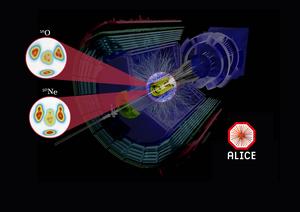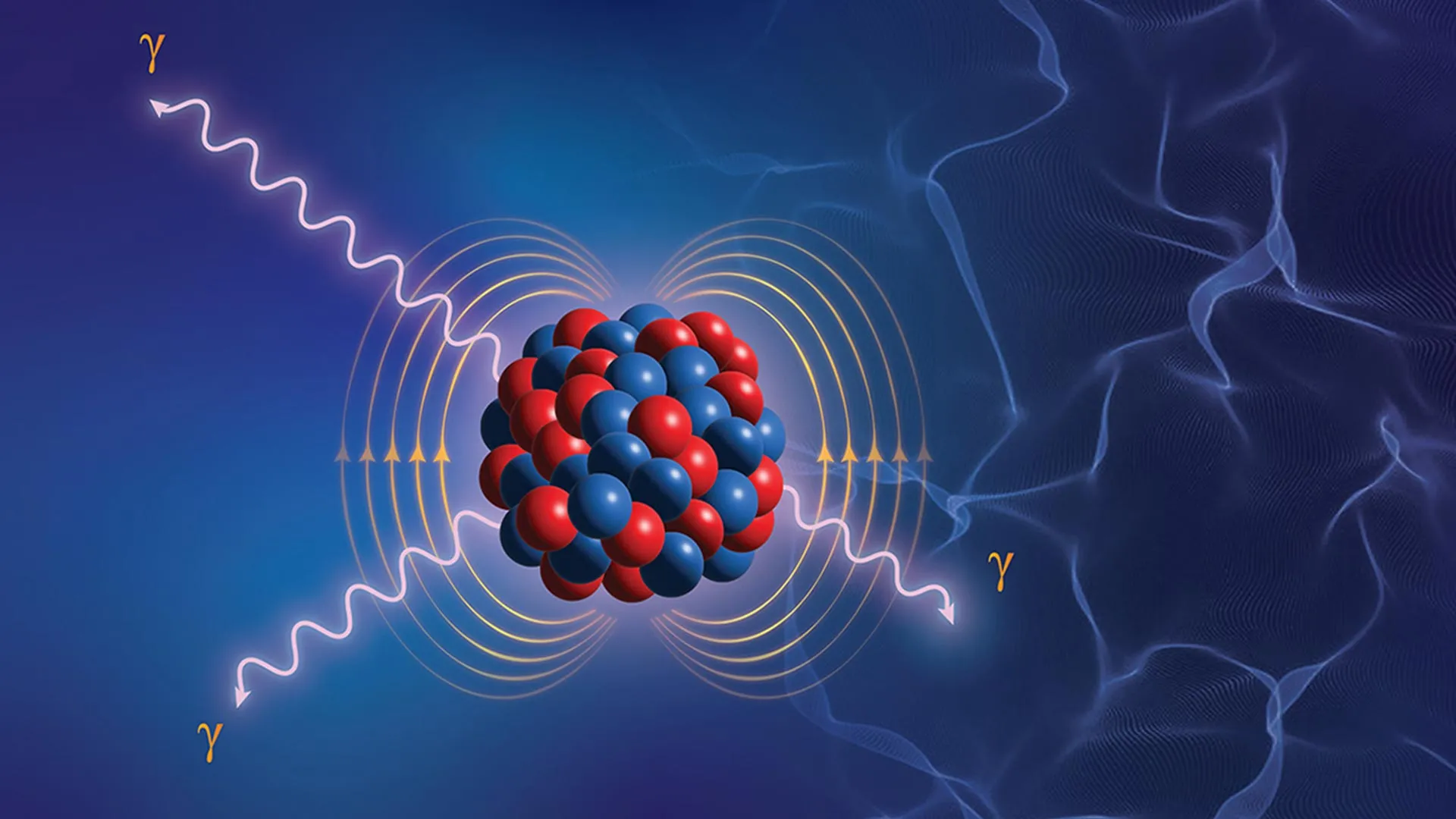
Every atom of matter in the Universe is built around a nucleus.It's a tightly packed bundle of protons and neutrons that makes up the atomic core, defines its elemental identity, and contains most of its mass.Textbooks often depict this blob of particles as a sort of spherical raspberry, around which electrons whirl in a series of orbits – but that isn't always the most accurate picture.Now, in the Large Hadron Collider at CERN, physicists have found evidence of one of those shapes: a nucleus structured like a bowling pin lurking inside every atom of neon.It's not a mere curiosity, either. Understanding this shape has implications for nuclear physics – and for understanding the strange collective behavior of matter produced when atomic nuclei collide at tremendous energies.
Not all nuclei are built alike. Some can have shapes that diverge from a sphere; radium-224, for example, has a distinctly lopsided pear-shaped atomic nucleus. Understanding those shapes can help physicists predict how the nuclei might misbehave under extreme conditions.But actually seeing those shapes isn't quite so simple, and not just because atomic nuclei are so small.In ordinary measurements, a nucleus doesn't sit still. Its quantum state effectively averages over all possible orientations, so a non-spherical nucleus with zero angular momentum will still appear spherical when viewed in the laboratory.This is where it comes in handy to have a particle collider at your disposal. When atomic nuclei smash together, their intrinsic, underlying structure can influence the flow of the matter produced in the collision.Imagine placing two differently shaped objects in a stream of water, hidden from view. By studying how the water flows around each object downstream, you could work backward to learn something about the shape of the object that disturbed it.The principle here is similar, although instead of disturbing an existing flow, the nuclear collision creates the flowing matter in the first place.For their experiment, the CMS Collaboration compared collisions between two different atomic nuclei – oxygen-16 and neon-20.They weren't smashing oxygen and neon together, but studied the outcomes of different collider runs involving oxygen-oxygen collisions and neon-neon collisions.