In our inaugural issue, we established that the future of enterprise AI lies not merely in raw model parameters, but in the architectural paradigms—specifically Graph Neural Networks (GNNs)—that capture relational intelligence. However, the most sophisticated architectural decision is rendered obsolete if the deployment infrastructure introduces prohibitive latency.
At Informatiqs, we emphasize that model deployment is fundamentally an operations research problem. As we transition from batch-processed predictions to real-time Generative AI and dynamic Machine Learning on Google Cloud Platform (GCP), we confront the inherent friction between compute elasticity and system responsiveness: the notorious "Cold Start" problem.
In this issue, we dissect the mathematics of serverless inference, the orchestration of Cloud Run and Eventarc, and how minimizing initialization latency is the ultimate enabler for high-frequency, event-driven enterprise intelligence.
1. The Mathematical Anatomy of the Cold Start
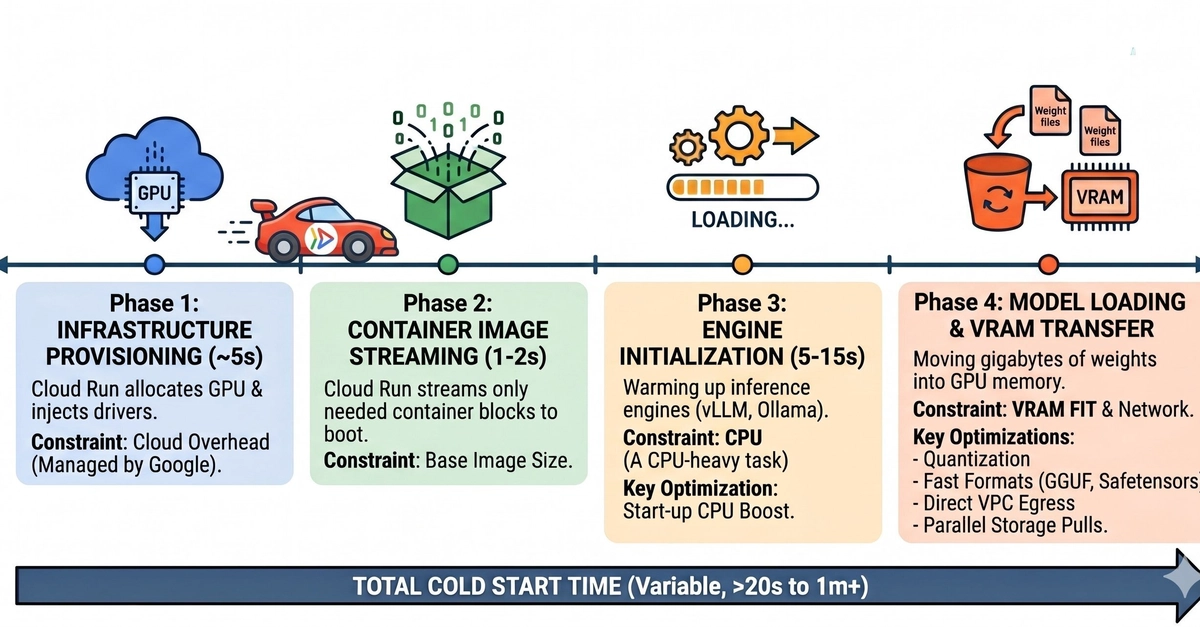
To engineer a solution, we must first formalize the problem. In a serverless architecture (scale-to-zero), infrastructure scales dynamically with demand. The total response time for an inference request can be understood as a composite of three phases. First, the baseline network latency. Second, the actual inference time—the computational effort of the model itself.