Originally published on tamiz.pro.
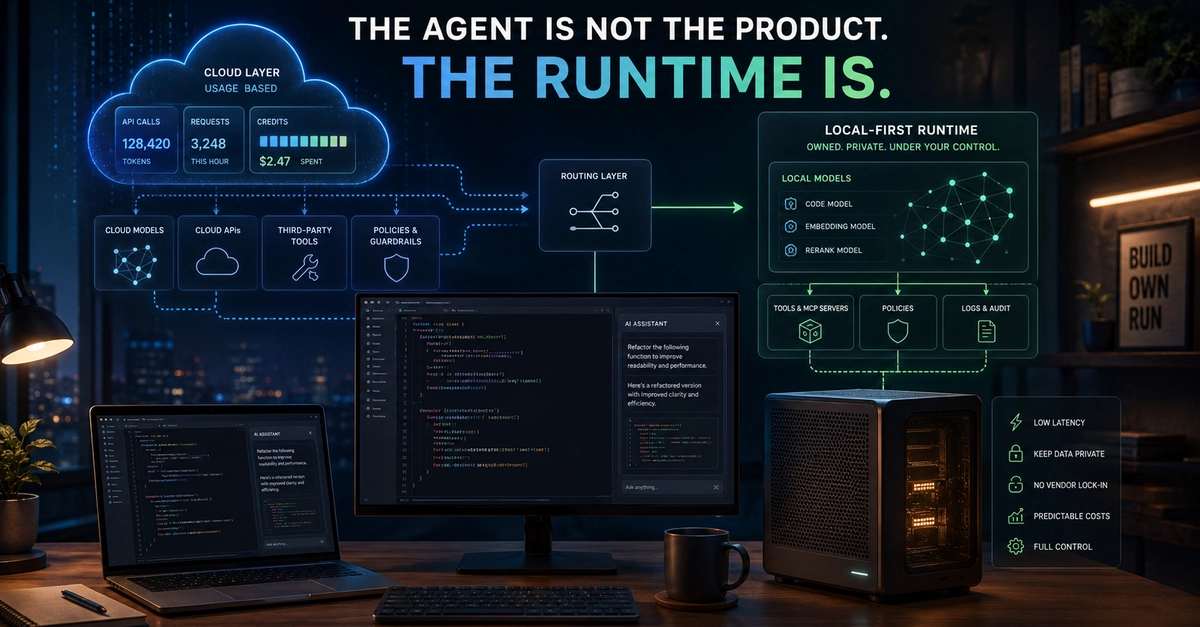
The paradigm of artificial intelligence is undergoing a seismic shift. For the past three years, the dominant model has been \"Cloud-First\": send raw prompts to a massive data center, pay for tokens, and wait for the stream. While this approach democratized access to powerful models like GPT-4, it introduced critical bottlenecks for enterprise software engineers: latency spikes, data privacy liabilities, and unpredictable API costs. \n\nToday, we are witnessing the rise of Local-First AI. This isn't just about running Llama 3 on a laptop for fun; it's about architecting robust, deterministic, and private AI systems that run entirely on the edge. By leveraging hardware acceleration, advanced quantization techniques, and custom agent harnesses, developers can build applications that are faster, cheaper, and more secure than their cloud-dependent counterparts.\n\nThis deep dive explores the engineering realities of local inference, the architectural patterns for custom agent harnesses, and the code required to implement them.\n\n## The Engineering Case for Local Inference\n\nBefore writing a single line of code, we must understand the technical trade-offs. Why are systems architects moving inference to the edge?\n\n### 1. Latency and Determinism\nCloud inference involves network round-trips, load balancer overhead, and queuing in shared model endpoints. For real-time applications (e.g., voice assistants, live coding assistants), even 200ms of latency is unacceptable. Local inference eliminates the network hop. With modern NPU (Neural Processing Unit) acceleration on ARM and x86 chips, token generation can happen in <10ms.\n\n### 2. Data Sovereignty and Privacy\nRegulations like GDPR, HIPAA, and CCPA restrict how personally identifiable information (PII) can be transmitted. Sending user context to a third-party API is a compliance nightmare. Local inference ensures that sensitive data never leaves the device. This is critical for healthcare, legal, and financial verticals.\n\n### 3. Cost Predictability\nCloud LLM APIs charge per token. For high-volume applications, this cost scales linearly and unpredictably. Local inference shifts the cost model to capital expenditure (hardware) rather than operational expenditure (API calls). Once the hardware is purchased, the marginal cost of inference is effectively zero (minus electricity).\n\n### 4. Offline Capability\nEdge devices often operate in environments with intermittent connectivity. A local-first architecture ensures that core AI features remain functional regardless of network status.\n\n## The Stack: Tools for Local Inference\n\nGone are the days of PyTorch-only workflows. The current ecosystem for local AI is rich, optimized, and diverse.\n\n| Tool/Library | Best For | Key Feature |\n| :--- | :--- | :--- |\n| **llama.cpp** | C/C++/Rust bindings, maximum portability | GGUF format, quantization, CPU/GPU offloading |\n| **Ollama** | Developer ease-of-use, Docker integration | One-command model serving, local API endpoint |\n| **MLC LLM** | Mobile/Edge deployment | WebGPU, Vulkan, direct compilation to target hardware |\n| **ExLlamaV2** | High-performance NVIDIA CUDA inference | Optimized attention mechanisms, high throughput |\n| **Candle** | Rust developers | Pure Rust implementation, safe memory management |\n\nFor this guide, we will focus on **llama.cpp** and **Ollama** as the foundational layers, building a custom Python-based agent harness on top.\n\n## Step 1: Model Quantization and Selection\n\nRunning a 70B parameter model requires ~140GB of VRAM. Most developers don't have this. The solution is **quantization**—reducing the precision of the model's weights (e.g., from FP16 to INT4) with minimal loss in quality.\n\n### Understanding Quantization Levels\n\n* **FP16 (Half Precision):** The standard for training. High quality, high memory usage.\n* **Q8_0:** 8-bit quantization. Near-lossless, good for high-end GPUs.\n* **Q4_K_M:** The sweet spot for most local inference. Uses mixed precision (mostly 4-bit, some higher bits) to maintain quality while reducing memory usage by ~75%.\n* **Q2_K:** Aggressive quantization. Fast, low memory, but noticeable degradation in reasoning capabilities.\n\n### Loading a Quantized Model with llama.cpp\n\nThe `llama.cpp` library uses the **GGUF** format. Let's look at how to load a model programmatically in Python using the `llama-cpp-python` wrapper, which binds to the highly optimized C++ backend.\n\n