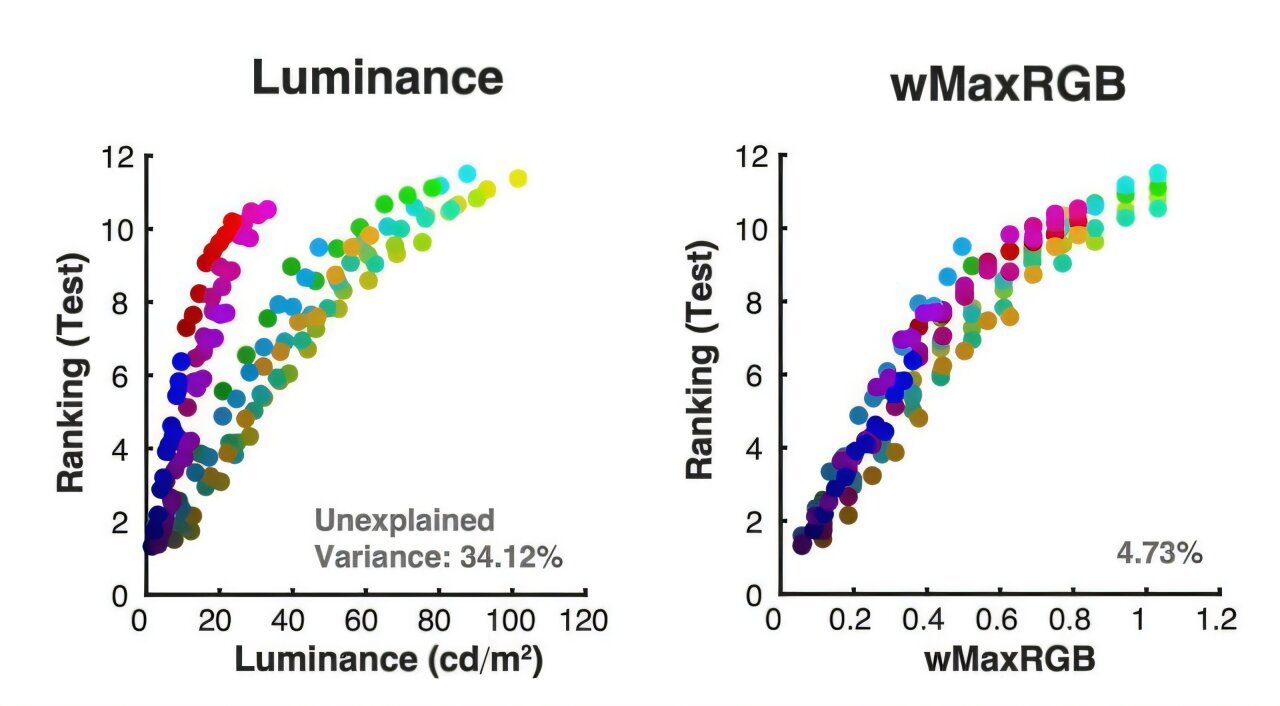
Prediction of perceived brightness by the established photometric measure (left) and by the new rule (right). Each point represents one color. The more closely the points follow a single curve, the better the prediction. Credit: Prof. Karl R. Gegenfurtner
The candela, the international unit of light in use for almost a century, forms the basis of photometry. According to a new study, measurements derived from it systematically misjudge the brightness of colored light sources and depart markedly from human perception.
An international team led by perception researcher Karl Gegenfurtner at Justus Liebig University Giessen (JLU) has found a surprisingly simple rule for how bright colored surfaces actually appear: Perceived brightness can be predicted almost completely by taking only the highest of the three weighted color components: red, green and blue. The rule accounts for more than 95% of the judgments observed and outperforms all established photometric models.
"The candela is the only SI unit that rests not on physics alone but on human perception," Gegenfurtner says.
That the quantities derived from it diverge so clearly from perception in the case of colors has consequences for the labeling of lamps, the calibration of displays and the planning of lighting in offices, on streets and in homes.