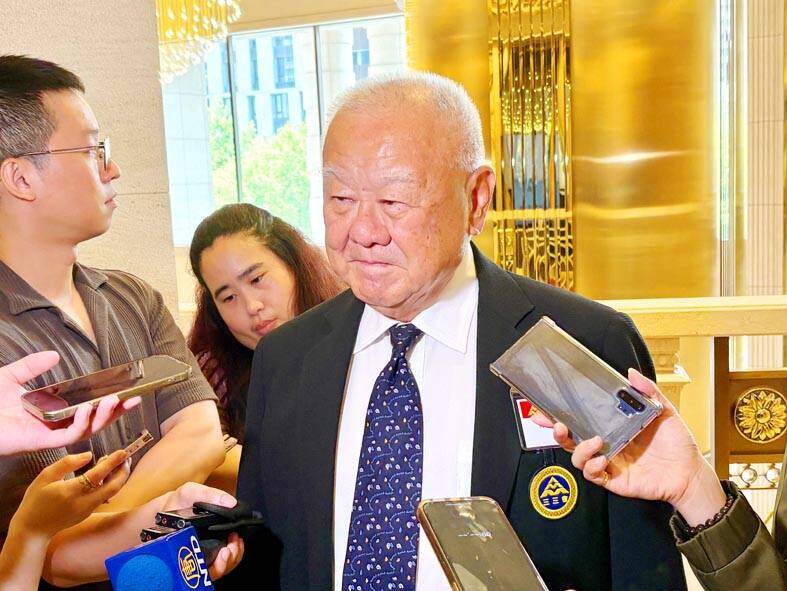
Taiwan’s shortage of readily available low-carbon electricity could deter investment in artificial intelligence (AI) data centers despite the country’s technological strengths, a renewable energy executive said yesterday.AI data centers require more than electricity: They need power that is available around the clock, scalable, affordable, low-carbon and deliverable within their development timelines, INA Energy Corp (寶晶能源) chairman Norman Tsai (蔡佳?) said at an energy transition forum in Taipei.Large facilities can require between 50 megawatts and several hundred megawatts of power, with some reaching gigawatt scale, Tsai said.
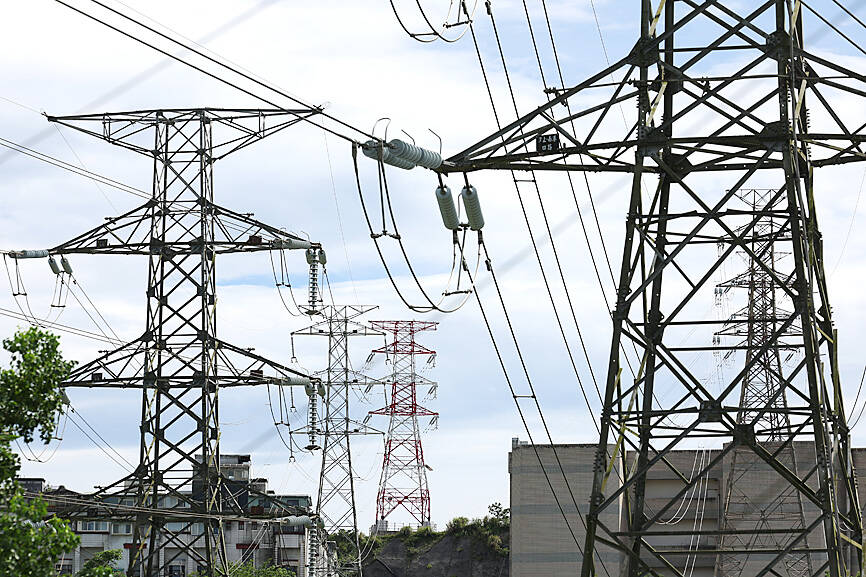
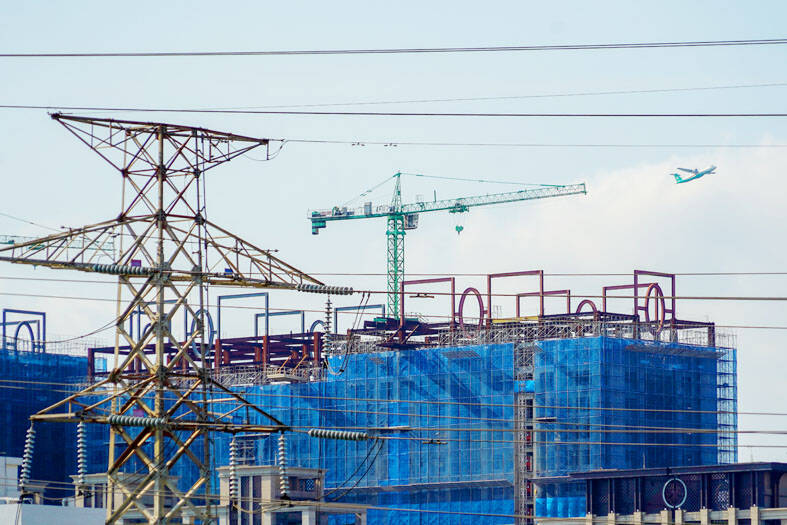
A high-voltage electricity pylon is pictured near a building under construction in Taipei on March 25.
The required power infrastructure must also be available quickly because data centers can be completed within 12 to 24 months, while new transmission lines or substations often take five to 10 years, he said.“To achieve firm power, you need what I would call a combined approach,” Tsai said. “It involves not only power generation, but also the grid.”
“Taiwan is technologically strong, but it lacks sources of electricity, and that is why AI data centers are reluctant to establish operations here,” he said.More specifically, Taiwan lacks green electricity, Tsai said, adding that identifying an adequate low-carbon power source would be the first challenge facing an AI date center operator seeking to establish a facility in the nation.Citing the International Energy Agency, Tsai’s presentation said global data center electricity demand was projected to rise from 485 terawatt-hours (TWh) last year to 950TWh in 2030.Corporate demand for green electricity is also spreading through the semiconductor supply chain because one company’s emissions from purchased energy, known as Scope 2 emissions, become part of its customers’ indirect Scope 3 emissions, Tsai said.As a result, major Taiwanese semiconductor companies are helping their suppliers purchase or invest in green power, he added.European Economic and Trade Office trade section head Christoph Saurenbach told the forum that Taiwan and the EU face similar difficulties reconciling decarbonization with industrial competitiveness.Taiwan’s challenges are compounded by its geographic and geopolitical position and its heavy reliance on imported fossil fuels, he said.The green transition is not only an economic and environmental necessity for Taiwan, but also “a strategic and political and security necessity,” Saurenbach said.Rapidly expanding AI and semiconductor industries would make the transition more difficult and require greater investment and support from those sectors, he added.European companies are major investors in Taiwan’s offshore wind sector, giving the EU and Taiwan a shared interest in the success of the nation’s renewable energy transition, Saurenbach said.He also cited the Strait of Hormuz crisis as demonstrating the risks of long-term dependence on imported energy.“Investment in renewables really is an obligation,” Saurenbach said. “There are absolutely no alternatives.”