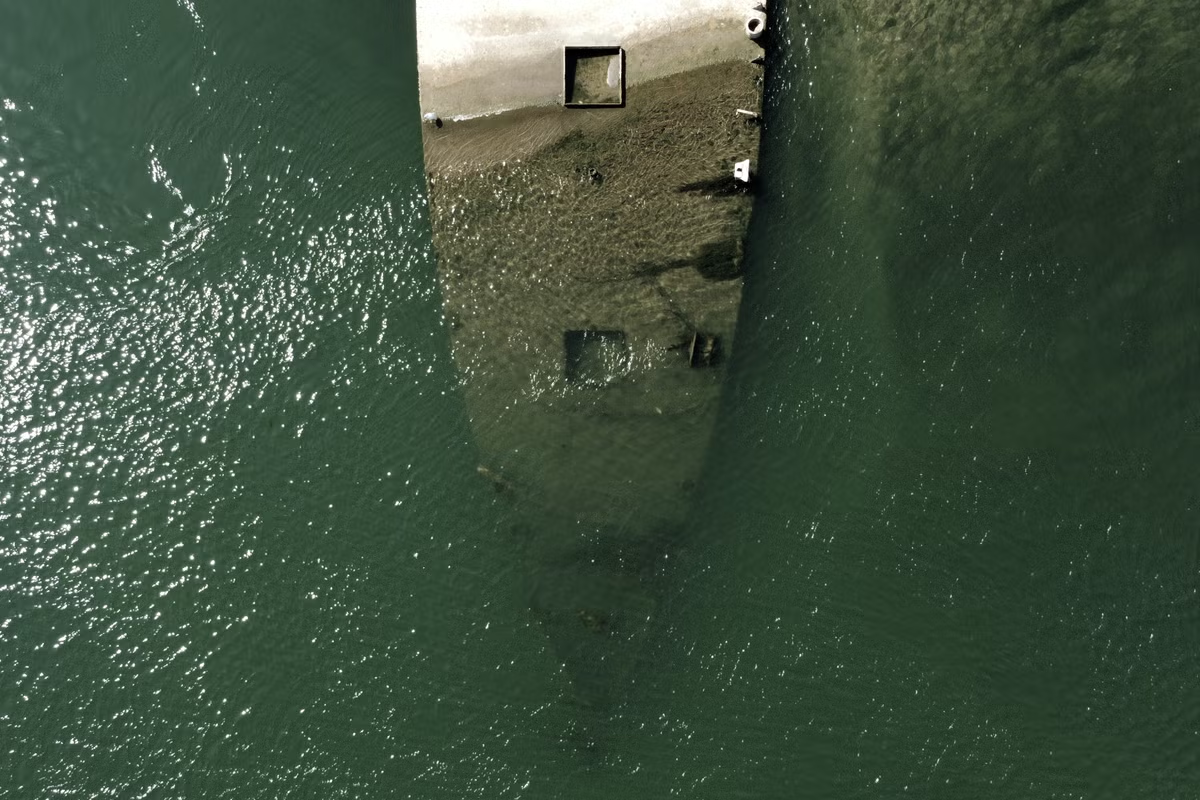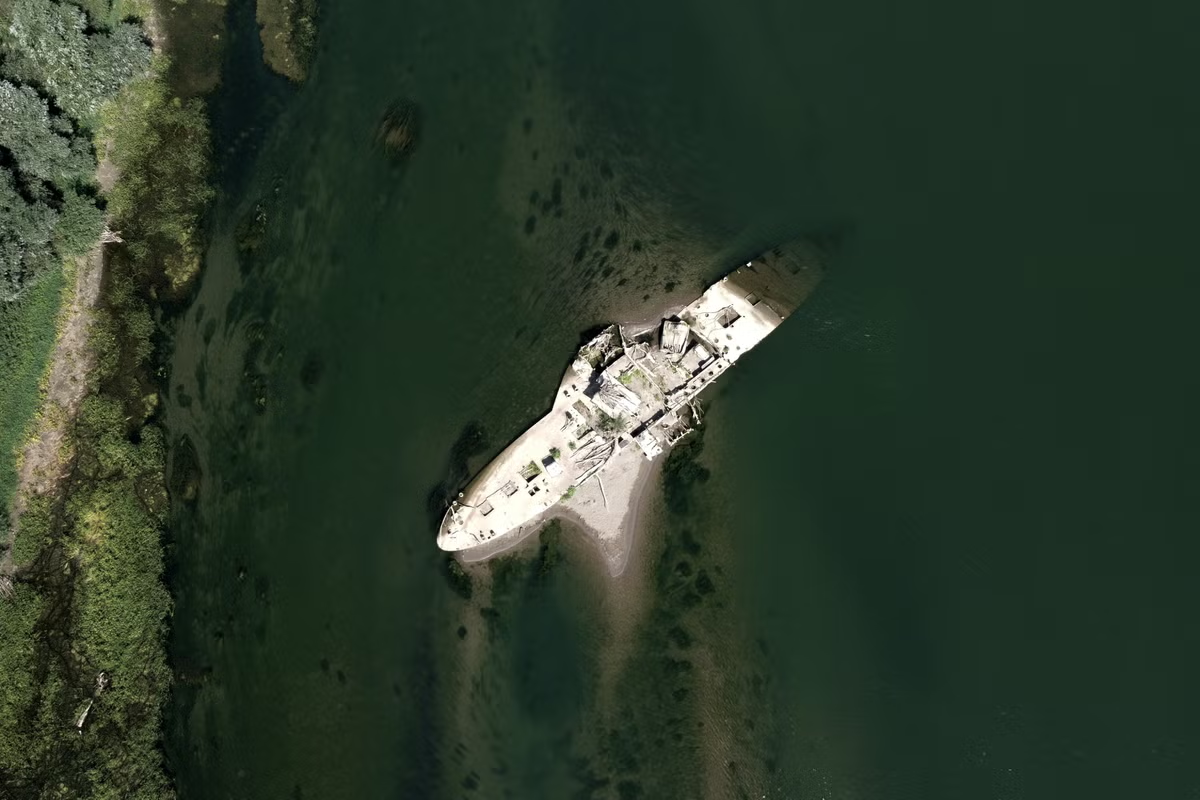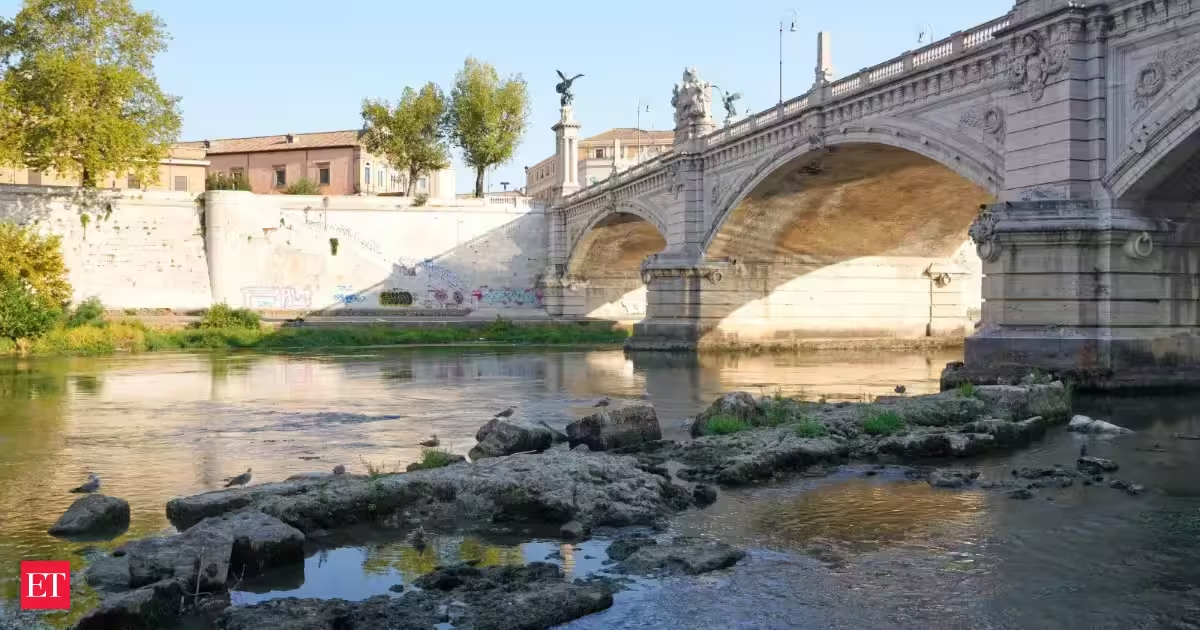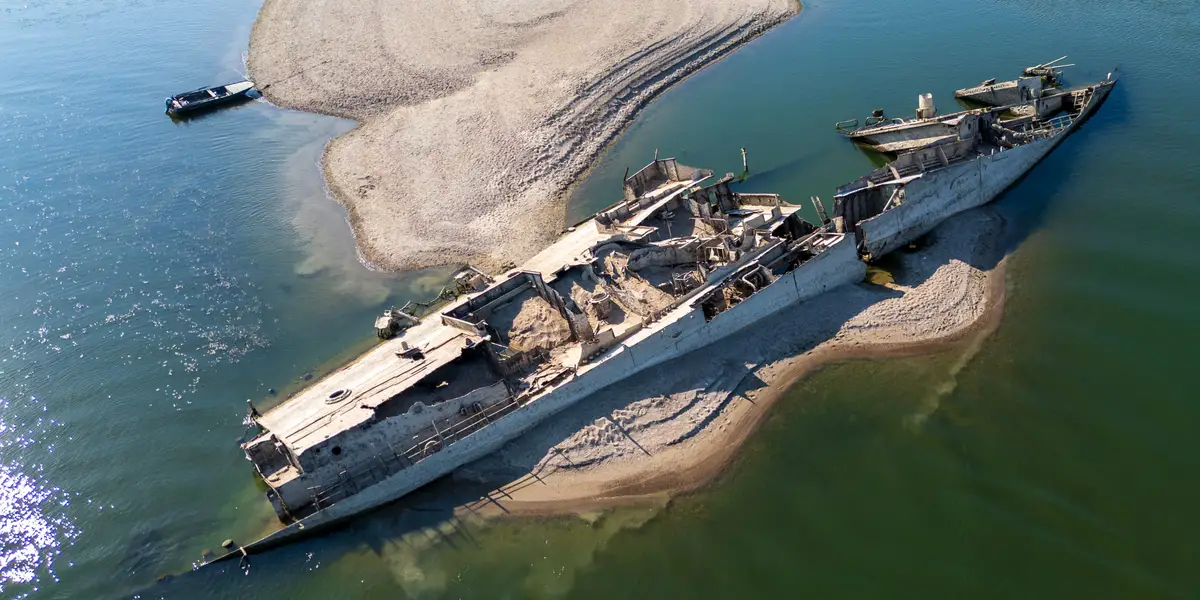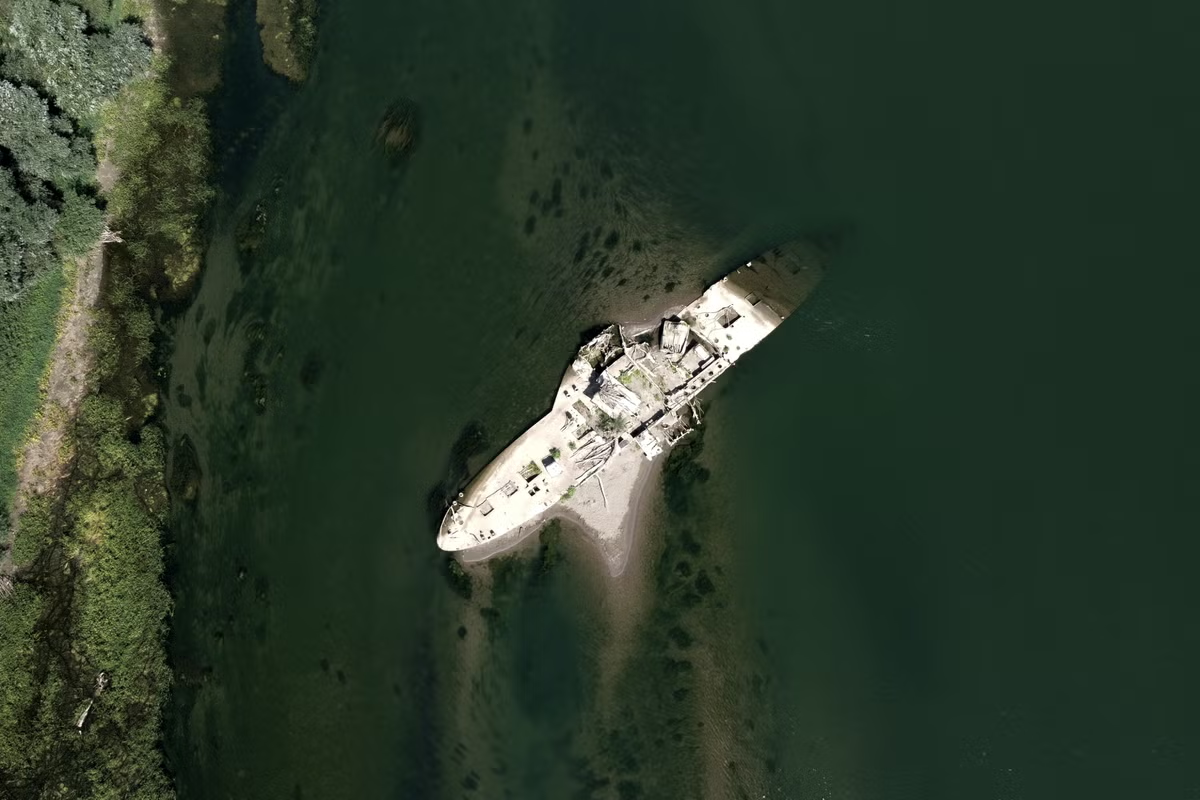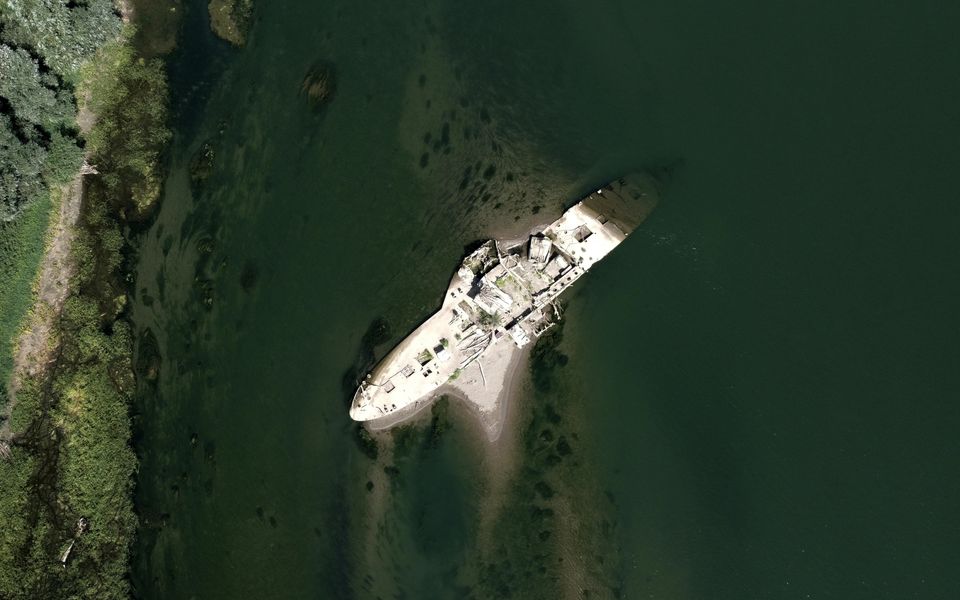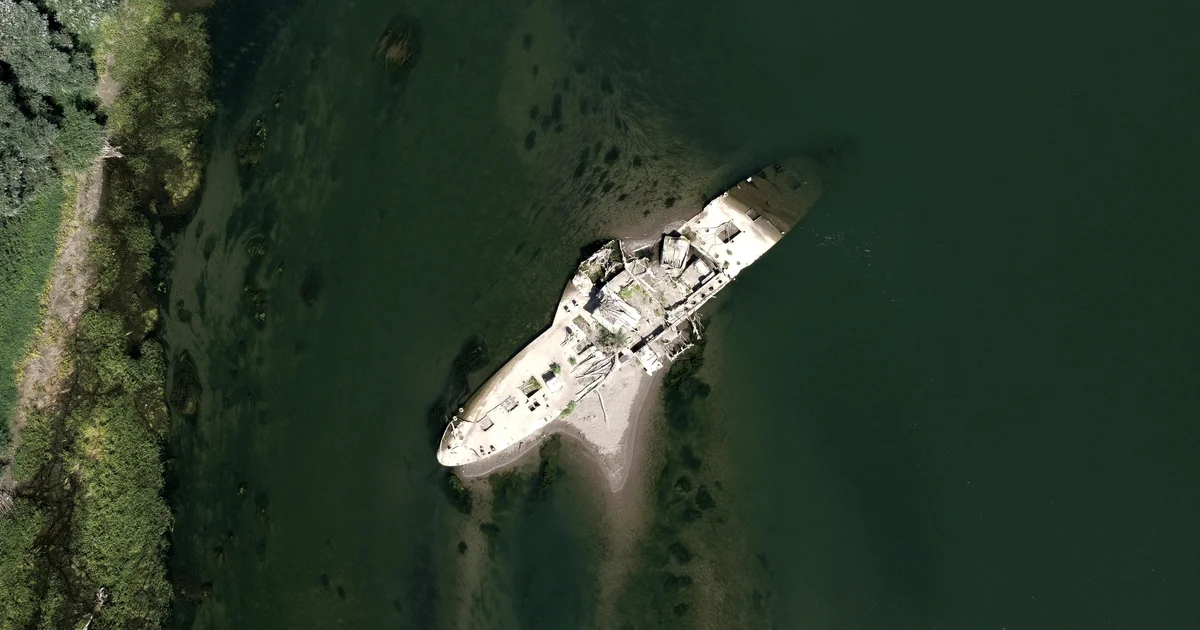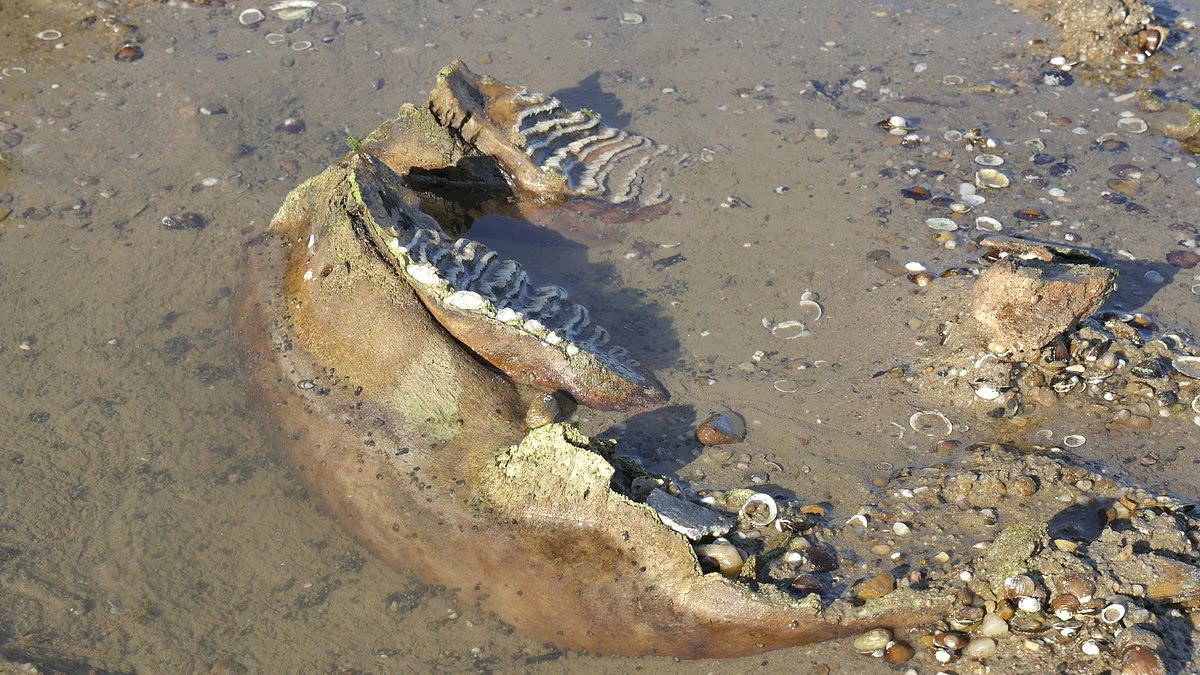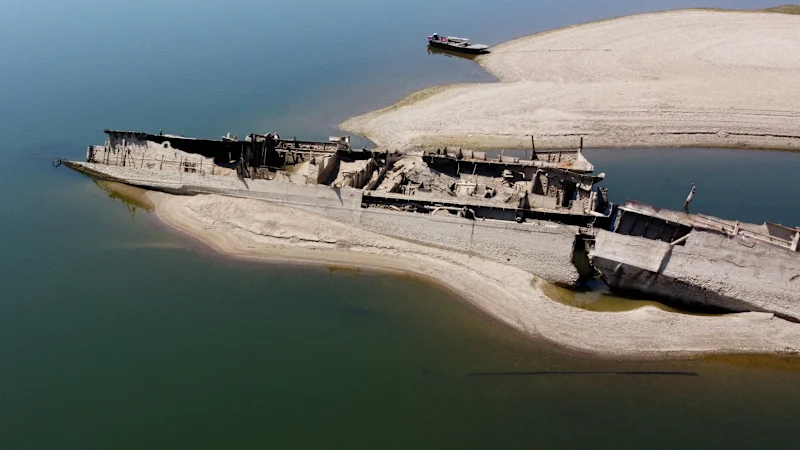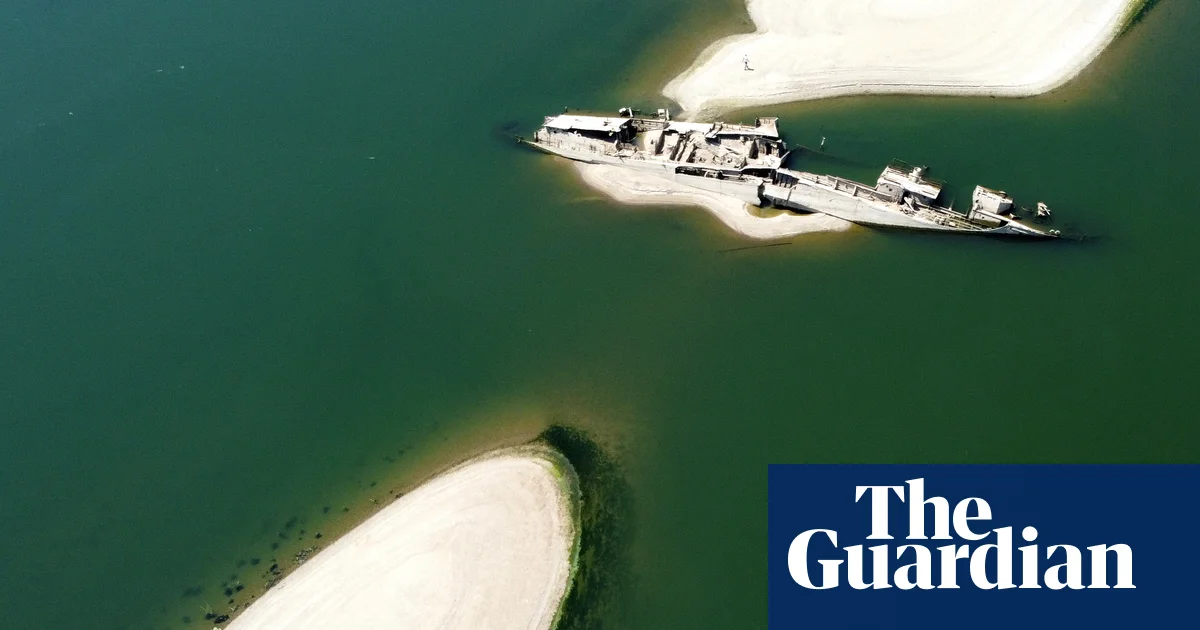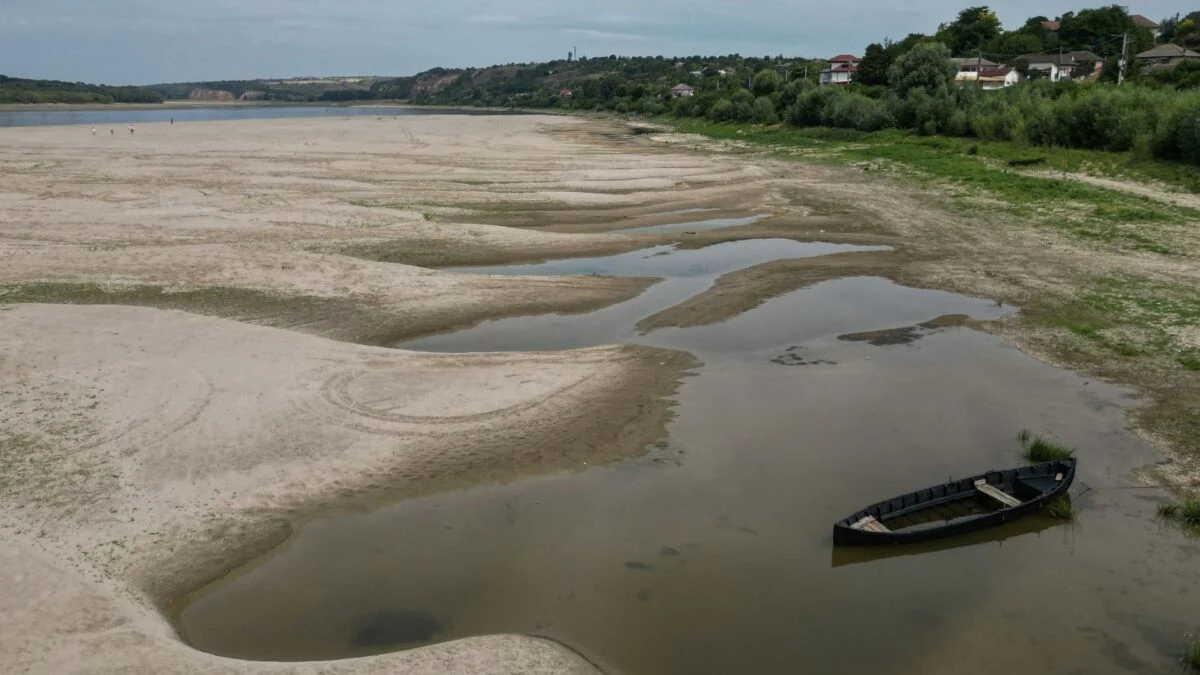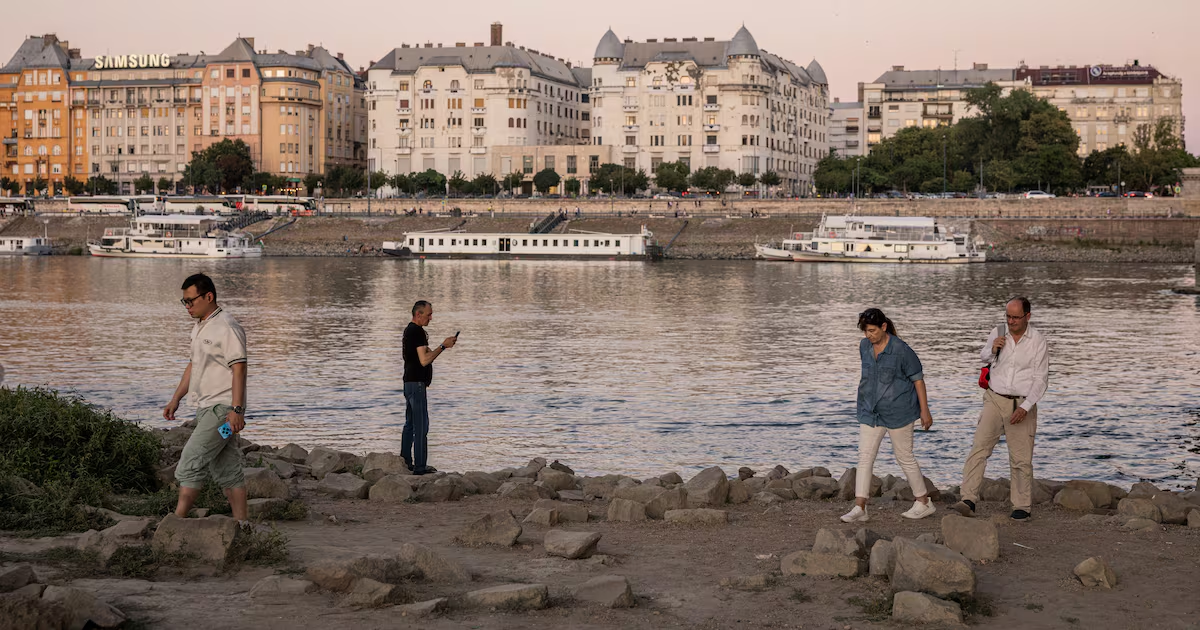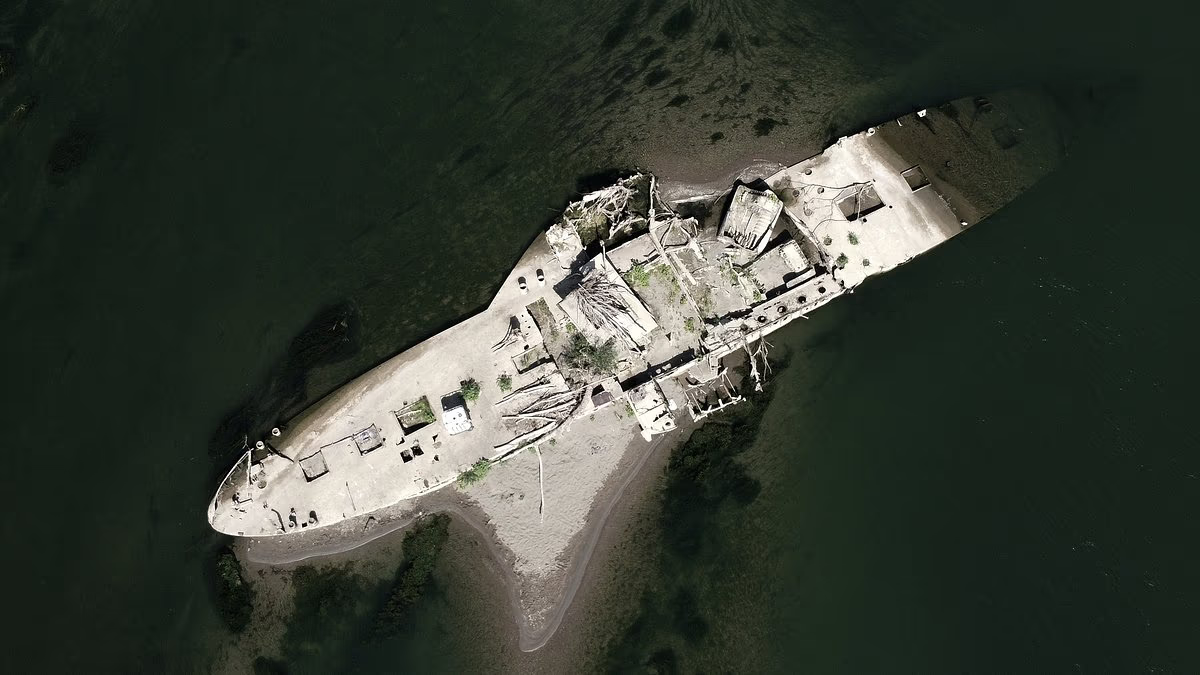
The wreck of a steam tugboat more than 100 years old and a WWII mine detonated by police are among the latest secrets to emerge from the shrinking waters of the Danube River.The waterway, which runs across ten countries from southern Germany to the Black Sea, is in the grip of an intense dry spell and has revealed a number of relics as a result.A famed vessel known as the Slovenian surfaced earlier this month from the Sava River near the Serbian town of Sremska Mitrovica.While parts have appeared above the surface before, the locals say the wreck has never been so exposed.'It's been several years since it was last seen, so there is quite an interest,' said historian Andrija Popovic, who is the head of the town museum.'It's truly something you don't see every day,' he added about the boat, which has been dubbed 'Sava's Titanic' by Serbian media.A controlled mine which dates back to World War II was also found before bomb disposal experts executed its detonation.Video footage released by Slovakian police shows they first approached the mine in water then brought it to land and covered it with sand for the detonation. The wreck of a steam tugboat more than 100 years old is among the latest secrets to emerge from the shrinking waters of the Danube River The rusting hull - once a famed vessel known as the Slovenian - surfaced earlier this month from the Sava River near the Serbian town of Sremska Mitrovica A controlled mine which dates back to world war two was also found before bomb disposal experts executed its detonationA record-low Danube River has severely impacted nuclear power plants in Hungary and Romania and halted traffic along Europe's second-largest waterway. A monthslong drought has ravaged crops from the Netherlands to Bosnia and caused water shortages that extend as high as the Alps.According to Mr Popovic, the Slovenian was made in 1913 in a shipyard in Budapest, Hungary, then part of the Austro-Hungarian empire.It measured roughly 54 meters (177 feet) in length and was initially named Vag, which is Hungarian for Slovakia´s longest river, Vah. With a steam engine, the boat pulled heavy cargo between Budapest and other towns along the Danube.During World War I, the boat largely paused its routes, Mr Popovic added. As the war ended and the Austro-Hungarian empire was dismantled, the boat's ownership switched to the newly formed Kingdom of Serbs, Croats and Slovenians - which would later become Yugoslavia - as part of war reparations, he said.The Slovenian is not the only relic that has emerged from Europe's drying rivers.On Serbia's eastern border with Romania, rusty remains of German ships are sticking out from the slumped Danube waters.Some still laden with weapons, the ships belonged to Nazi Germany´s Black Sea fleet that was deliberately sunk near the end of the war as German troops retreated from Romania and Soviet forces advanced deeper into Europe.Just last week the remains of a woolly mammoth as well as dozens of Nazi shipwrecks were found. Scientists were seen gathered around a large bone belonging to a woolly mammoth on the banks of the river near the village of Ryahovo in northern Bulgaria.So far they have identified a jaw bone, fragments of tusks, part of a shoulder blade and a femur with its articular head among the stash found at the end of July.The remains were remarkably well-preserved, with images appearing to show teeth still lining the jaw bone.Woolly mammoths co-existed with early humans, who hunted them for food and used their tusks and bones as tools. rts executed its detonation. Video footage released by Slovakian police show they first approached the mine in water A forklift was used to carry the bomb from water to land before the explosion Police then brought it to land and covered it with sand for the detonation The Dabube River, which runs across ten countries from southern Germany to the Black Sea, is in the grip of an intense dry spell and has revealed a number of relics as a result While parts of the Slovenian have appeared above the surface before, locals say the wreck has never been so exposed The wreckage of the old steam boat is visible due to the low level of the Sava river A white heron stands on the wreckage as Europe experiences a severe drought The Slovenian was reportedly made in 1913 in a shipyard in Budapest, Hungary, then part of the Austro-Hungarian empireA Second World War German military motorcycle was also discovered on the banks of the river in Budapest.The vehicle was spotted on the banks of the river in the Hungarian capital opposite the country's parliament building and was later hauled out and cleaned up by soldiers.Despite the bike being thoroughly rusted, it had still retained its form after decades under the water.It has since been put on display at the depot of the Institute and Museum of Military History in Budapest.Several Nazi warships have also been found across the Danube.One ship was spotted in front of the Djerdap II dam between Romania and Serbia that was all but destroyed, though some parts remained intact.Another was seen on the riverbed in Baja, Hungary, which had large parts of the hull still together as well as what appeared to be a motor.Meanwhile in the village of Gigen, Bulgaria, the foundations of the ancient Constantine Bridge – commissioned by Roman emperor Constantine I and inaugurated in 328 AD – were revealed by the record-low water level.While the lowered water levels of the twisting river may have provided historians with revelatory new material to investigate, it has also presented a huge problem for Europe's infrastructure.Hungary was forced to switch off its only nuclear plant earlier this month as the water from the Danube that cools it could not reach the reactor.The river fell to record lows in recent weeks amid a prolonged heatwave and drought across much of Europe, forcing the plant to operate at only around 10 per cent of its capacity with only one of its eight turbines left running.Droughts this summer have wreaked havoc on European power production, shipping and public health systems, and the hit to the region's economy can already be measured in the hundreds of billions of euros.Similar problems in Romania, for instance, have forced the declaration of a state of energy emergency throughout August, and the flow of the Danube has been redirected to allow its sole nuclear plant to continue operating for the next few days. The remains of a woolly mammoth were exposed by record-low water levels in the River Danube last week near the village of Ryahovo in northern Bulgaria A German military motorcycle from the Second World War found on the banks of the river in Budapest, opposite the Hungarian Parliament buildingHungarian prime minister Peter Magyar said last week that work to restart a second turbine at Paks began after the Danube rose 19 centimetres above last week's low.The second turbine was expected to start generating electricity on last Monday evening, he said on Facebook.Europe is the world´s fastest-warming continent, with temperatures increasing twice as fast as the global average since the 1980s, according to the European Union´s Copernicus Climate Change Service.Half of the European Union and the United Kingdom was experiencing drought by late July 2026, according to the EU´s European Drought Observatory, with 9 per cent of the territory at the most severe 'alert' level.Scientists warn that climate change is exacerbating the frequency and intensity of heat and dryness.Serbian hydrology expert Dejan Vladikovic said the current drought is the combination of a lack of winter snow and a very dry spring.'What awaits us in the future ... is that such situations will be more frequent,' he said. 'We are entering periods when this will, unfortunately, become a new normalcy.'Even the mountains are suffering. In the Slovenian Alps, lodges that depend on rainwater have restricted the use of water for climbers and hikers, including for showers and toilets.The Triglav Lodge, Slovenia´s highest-altitude guest hut at an elevation of 8,251 feet, is using paper plates this summer to save water on dishes.
Explosive secrets of the Danube revealed by drought!
The waterway, which runs across ten countries from southern Germany to the Black Sea, is in the grip of an intense dry spell and has revealed a number of relics as a result.
1,354 words~6 min read