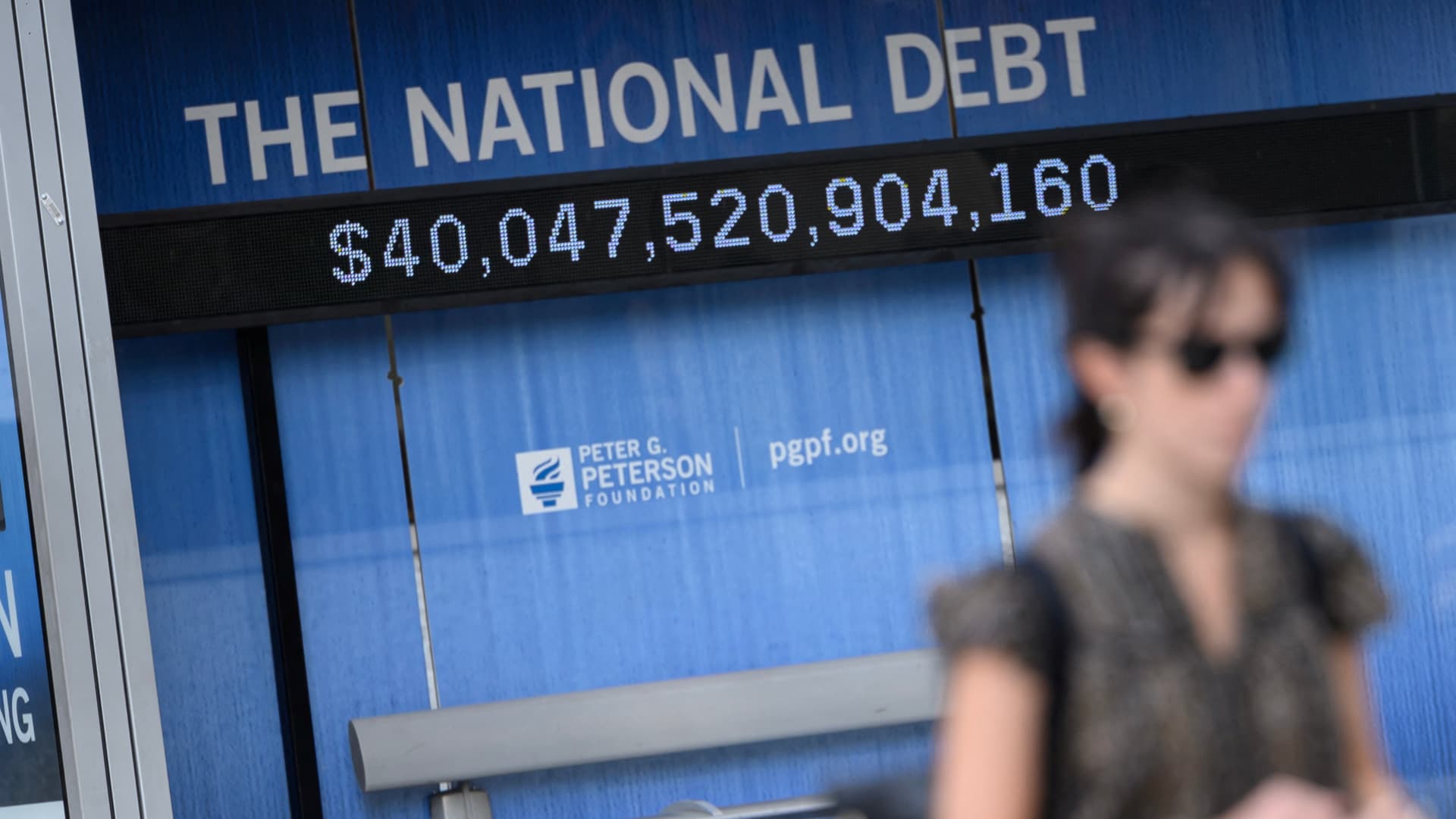
International markets are rattled by global events. That was made clear by the Aug. 18 widespread global selloff of U.S. Treasury securities, raising 30-year yields to roughly 5.34%, the highest level since 2007.There are several causes for the rising investor anxiety. This includes renewed conflict in the Middle East, along with a continued guessing game about the Federal Reserve’s intentions regarding interest rates.Primarily, though, America’s bleak fiscal situation is quelling investor confidence. The U.S. Treasury bond selloff coincided with the nonpartisan Congressional Budget Office’s release of statistics that the national debt is about to cross the $40 trillion threshold. Put another way, existing national debt now consumes 3.3% of the entire U.S. economic output and 19% of every dollar Uncle Sam collects.
And of course, elevated borrowing costs have trickled down to ticked-off consumers; 30-year fixed mortgage rates remain above 6.7%, 70 basis points higher than they were six months ago.An investor warning shot
Bond investors are correctly sounding the alarm that the federal deficit is no longer tenable. CBO has raised its deficit projection for fiscal 2026 by $200 billion to $2.1 trillion. The impending fiscal crisis is not the $40 trillion national debt itself; rather, it’s that deficit spending is growing so rapidly that buyers no longer have the appetite to allow Americans to finance it at the ultra-low rates we’ve relied on for the past 20 years.Even if the flood of red ink seems an academic exercise to many, higher buyer costs are sure to get voters’ attention a bit over two months out from the Nov. 3 midterm elections. President Donald Trump‘s administration has a chance to limit the damage by making one final stab at a deficit-reducing bill on Capitol Hill. Big-spending congressional Democrats are never going to play ball legislatively. So, this would have to be done through the budget reconciliation process, which allows the Senate to skirt its normal 60-vote threshold to overcome a filibuster and pass legislation with a simple majority of 51 votes in the 100-member chamber.The proposal would have to be large enough in spending cuts to actually move Treasury investors, politically palatable enough to garner the support of the MAGA base and a party-line vote in Congress, and limited enough in scope to pass muster with the Senate Parliamentarian. So, instead of spending energy on the SAVE America Act, rewriting the entire immigration system, or (as I would prefer) taking a hammer to Social Security, all of which are banned from being included in reconciliation packages, Reconciliation 3.0 ought to take a selective approach to reforms. Including targeting spending on noncitizens, Medicare waste, and inefficient visa allocation. Crucially, it cannot raise taxes on citizens and impede the economic growth that we’re relying on to avoid a debt crisis.Debt-slashing reconciliation legislation