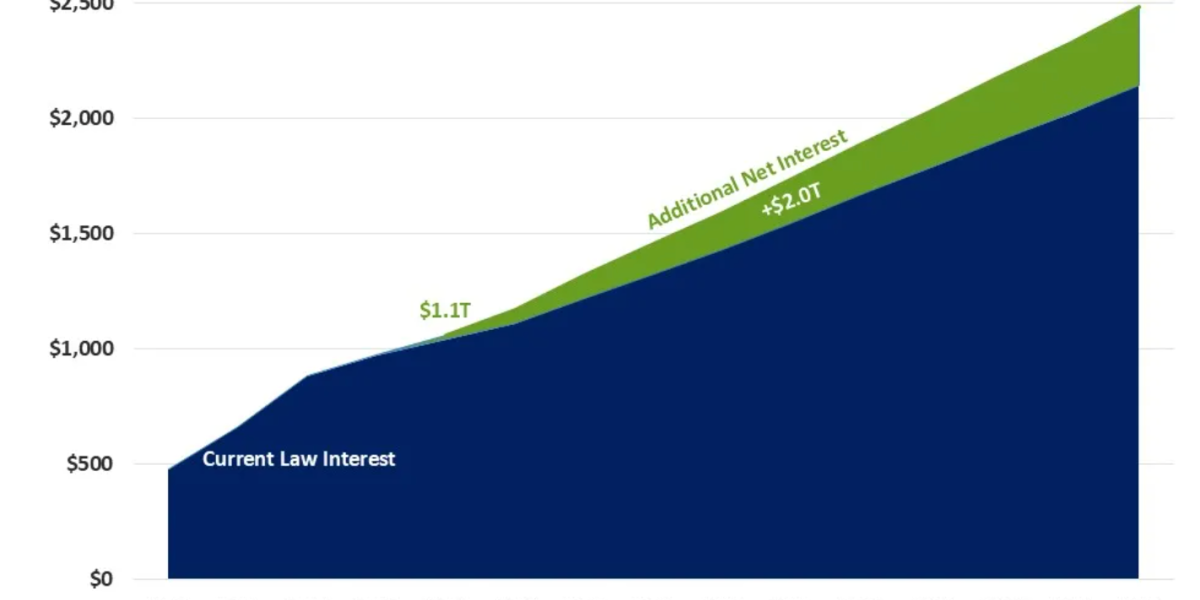
In the days before the Memorial Day weekend, rates on 30 year Treasury bonds hit their highest level in 19 years at 5.2%, and the benchmark 10-year reached 4.7%, the top reading since mid-2007. If those kinds of yields take hold, the scenario for federal interest expense posited in the CBO’s “Budget and Economic Outlook: 2026 to 2036,” released in February, descends from dire to near-disastrous. Takeaway: America’s track to fiscal safety has lost all margin for error, and nothing demonstrates that better than the long-term impact of loftier than expected rates. America’s got so little room to maneuver that even yields that modestly exceed the CBO’s “baseline,” as the numbers compound in the years ahead, deliver a huge extra blow by crowding out big chunks of revenue that would otherwise go towards funding such essentials as Defense, Social Security and Medicare.
The CBO forecasts that yields on the 30 and 10-year Treasuries will respectively average about 4.65% and 4.15% through FY 2036. That’s roughly 55 basis points lower than the multi-year summit briefly notched in late May. Doesn’t sound like much of a difference, right? And if the interest expense on our gigantic and ballooning national debt of $39 trillion weren’t already running at nearly $1 trillion a year, bigger than Medicare spending and equaling two-thirds of Social Security outlays, the half-point upward shift would likely prove manageable.