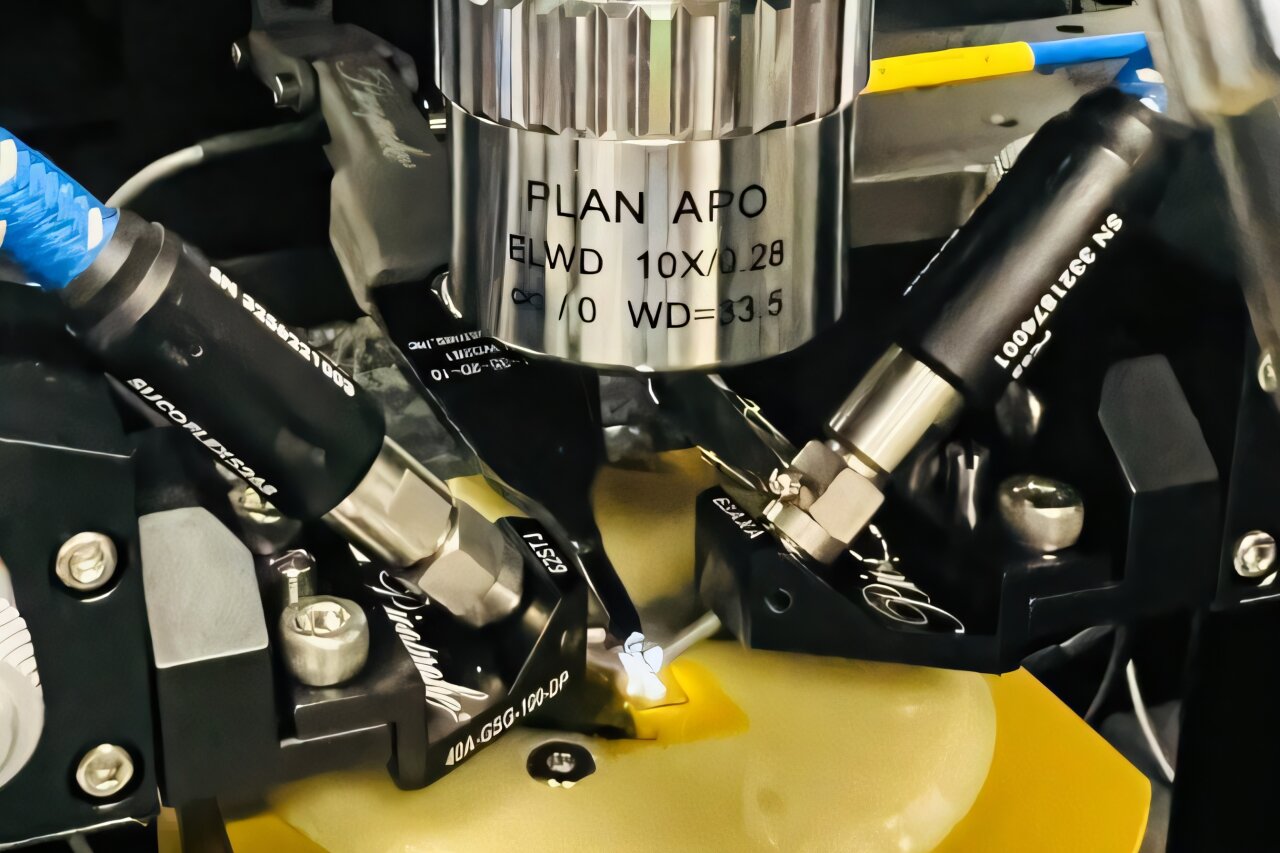
The instrument and configuration the team used to measure ultrafast ferroelectric switching, with GSG probes on the left and right, delivering rapid voltage waveforms and measuring ferroelectric response currents. At the back is a high-impedance active probe used to monitor the voltage across the ferroelectric capacitor in real time. Credit: Yi Liang, Ferroelectronics Lab, University of Michigan
A new physics-based analytical model can accurately predict ferroelectric behavior under real-world, complex voltages, according to a study led by University of Michigan Engineering. The model bridges the longstanding gap between fundamental switching physics and practical device engineering.
"We are looking to understand the nature of the behavior of ferroelectric materials and to design it for technology. We have growing interest in the device and circuit aspects of ferroic materials-based computing, which presents the opportunity for logic-in-memory and other novel AI computing schemes with high energy efficiency and throughput," said John Heron, an associate professor of materials science and engineering at U-M and senior author of the study published in Advanced Materials.
Why ferroelectric materials?