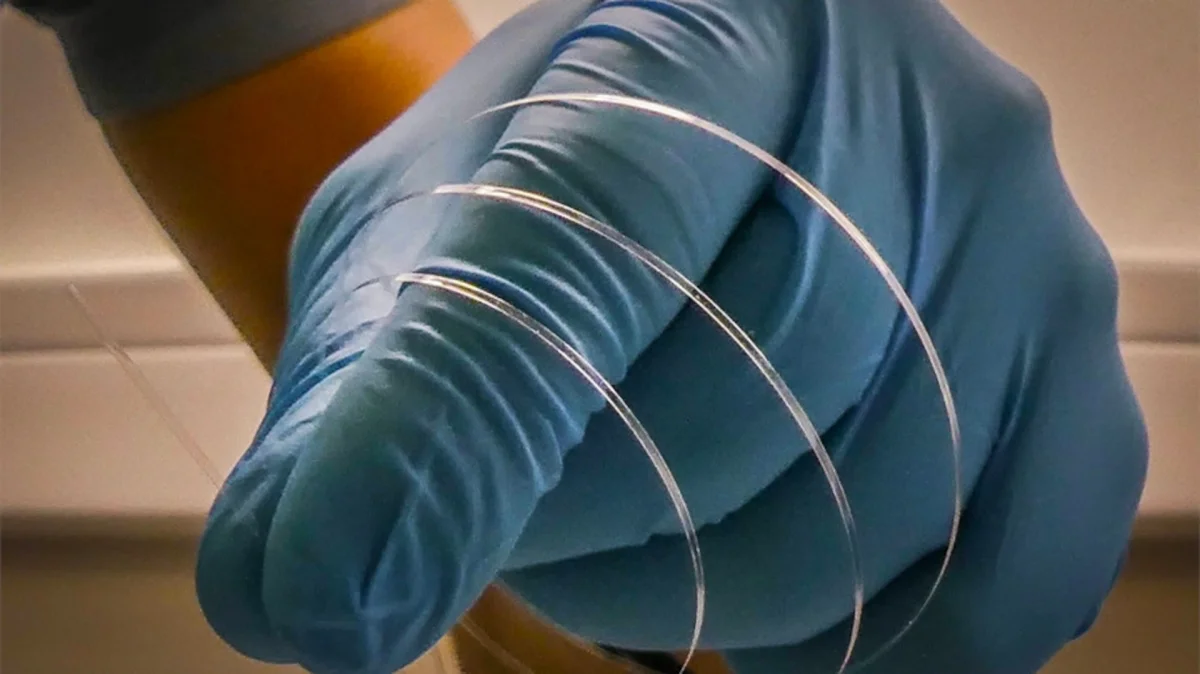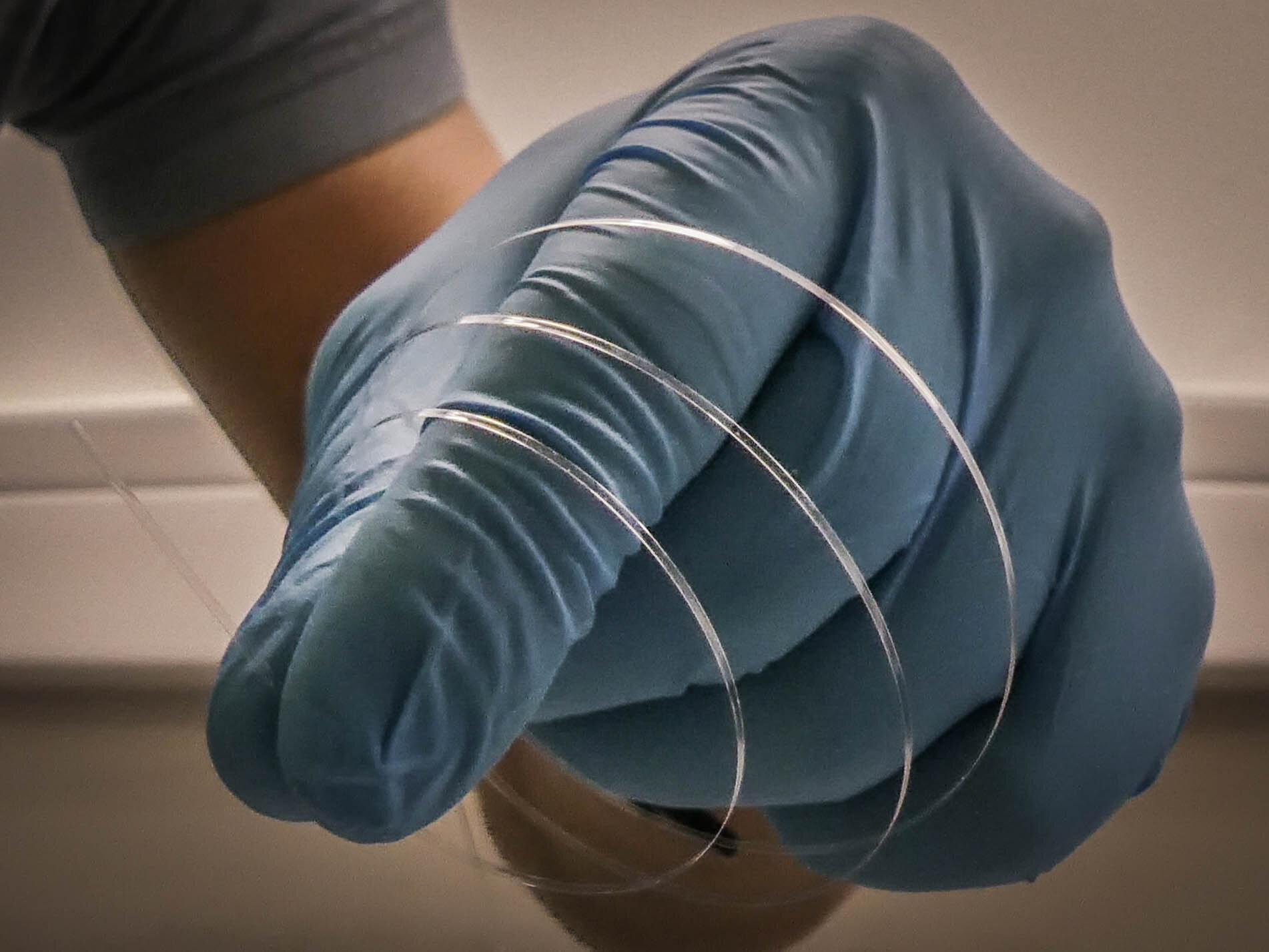
A section cut from more than 100m of flat optic fiber developed by researchers at KTH Royal Institute of Technology and University of Southampton. In lab demonstrations, the fiber proved 1,000 times more sensitive than standard optic fiber in measuring pressure. Credit: Pawel Maniewski
Optical fiber has already transformed the modern world. New research now suggests it could do even more. A new flat-fiber fabrication technique produces a high-fidelity sensor for a wide range of applications, from batteries to bridges, according to a recently published study.
Researchers from KTH Royal Institute of Technology in Stockholm and the University of Southampton in the UK have developed a new type of flat silica optical fiber that performs differently from conventional round fiber. The work, published in Nature Communications, introduces a high-aspect-ratio platform that can be engineered to respond strongly to pressure, temperature and other physical changes.
By creating a ribbon-like geometry with controlled internal microstructure, the team showed that the shape of the fiber can be used as a functional part of a sensor. Instead of the widely used technique of flattening a round fiber, the researchers created a method to preform it from the beginning, and they used laser-based glass processing to add internal features like air channels or metal fillings.