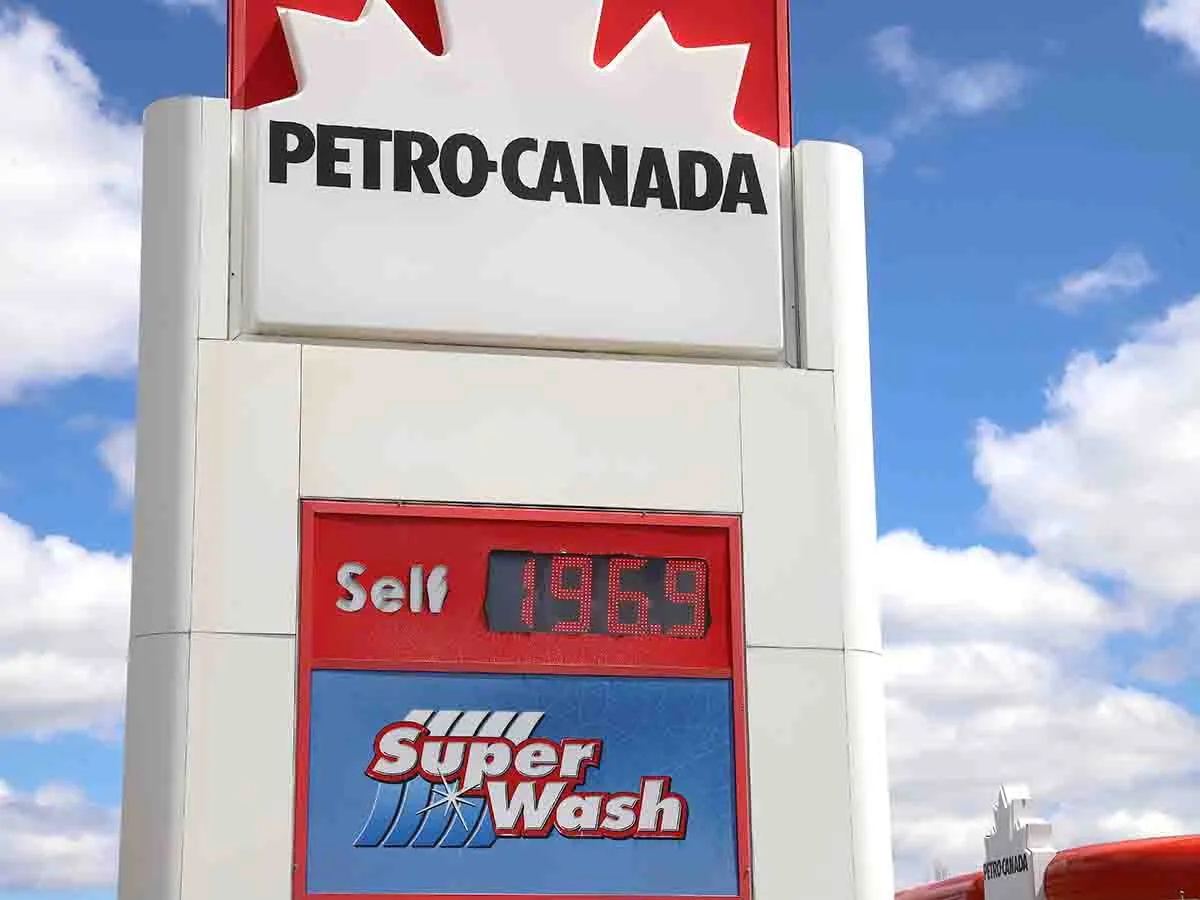
Skip to Content News Archives Economy Energy Oil & Gas Renewables Electric Vehicles Mining Commodities Agriculture Real Estate Mortgages Mortgage Rates Finance Banking Insurance Fintech Cryptocurrency Work Wealth Smart Money Wealth Management Investor Personal Finance Family Finance Retirement Taxes High Net Worth FP Comment Executive Women Puzzmo Newsletters Financial Times Business Essentials More Innovation Information Technology FP500 Podcasts Small Business Lives Told Tails Told Shopping Financial Post Store Obituaries Place a Notice Advertising Advertising With Us Advertising Solutions Postmedia Ad Manager Sponsorship Requests Classifieds Place a Classifieds ad Working Profile Settings My Subscriptions Saved Articles My Offers Newsletters Customer Service FAQ News Economy Energy Mining Real Estate Finance Work Wealth Investor FP Comment Executive Women Puzzmo Newsletters Financial Times Business Essentials HomeNewsEconomyHigher gas prices expected to nudge Canada's inflation rate back near 3% in July, economists sayInflation cooled down to 2.8% in June due to lower gas prices but the cost of filling up spiked again last month You can save this article by registering for free here. Or sign-in if you have an account.Gas prices soared to almost $1.97 a litre at some gas stations in Greater Sudbury, Ont. on Tuesday May 5, 2026. Prices at the pump retreated in June only to rise again in July. Photo by John Lappa /Sudbury Star/Postmedia NetworkHigher gas prices are expected to push Canada’s inflation rate back up near three per cent for July, but economists believe the spike will only be temporary.Subscribe now to read the latest news in your city and across Canada.Exclusive articles from Barbara Shecter, Joe O'Connor, Gabriel Friedman, and others.Daily content from Financial Times, the world's leading global business publication.Unlimited online access to read articles from Financial Post, National Post and 15 news sites across Canada with one account.National Post ePaper, an electronic replica of the print edition to view on any device, share and comment on.Daily puzzles, including the New York Times Crossword.Subscribe now to read the latest news in your city and across Canada.Exclusive articles from Barbara Shecter, Joe O'Connor, Gabriel Friedman and others.Daily content from Financial Times, the world's leading global business publication.Unlimited online access to read articles from Financial Post, National Post and 15 news sites across Canada with one account.National Post ePaper, an electronic replica of the print edition to view on any device, share and comment on.Daily puzzles, including the New York Times Crossword.Create an account or sign in to continue with your reading experience.Access articles from across Canada with one account.Share your thoughts and join the conversation in the comments.Enjoy additional articles per month.Get email updates from your favourite authors.Create an account or sign in to continue with your reading experience.Access articles from across Canada with one accountShare your thoughts and join the conversation in the commentsEnjoy additional articles per monthGet email updates from your favourite authorsSign In or Create an AccountorStatistics Canada is scheduled to publish its latest Consumer Price Index report on Monday morning, which will give an overview on inflation in July.Forecasts from CIBC Capital Markets suggest inflation reached three per cent in July after lower gas prices in June cooled it down to 2.8 per cent. A reading above three would be the highest since May, when inflation rose to 3.2 per cent due to the global oil price spike caused by Iran war.Andrew Grantham, executive director and senior economist at CIBC Capital Markets, said gasoline prices experienced a “partial rebound” after the United States and Iran renewed strikes in early July, but didn’t reach the peaks hit when the conflict first started earlier this year.SUBSCRIBER EXCLUSIVE: FP West: Energy Insider brings you behind the oilpatch’s closed doors with exclusive insights from insiders every Wednesday morning.By signing up you consent to receive the above newsletter from Postmedia Network Inc.A welcome email is on its way. If you don't see it, please check your junk folder.The next issue of FP West: Energy Insider will soon be in your inbox.We encountered an issue signing you up. Please try againHe also expects the recent gas price spike to be temporary, but noted that some prices are still under pressure.“We’re still seeing that initial pass through from the first spike in global oil prices that we had over the spring,” Grantham said in an interview, singling out higher airfares. “They’re not as high as what we saw earlier this year, but these are year-over-year inflation rates, so they’re still a lot higher than they were a year ago.”Nathan Janzen, assistant chief economist at RBC Economics, expects inflation edged up slightly to 2.9 per cent in July.Janzen added that, despite higher gas prices, there is little evidence of broader inflationary pressures on Canadian consumer prices.Core inflation — which excludes volatile components such as food and gasoline prices — have remained relatively stable for most of the year, with measures like CPI-trim and CPI-median hovering at under two per cent year-over-year in June.“That will generally continue in the July data. Oil prices have moved higher again, but they are still below the peak levels seen in April and May, so not at the levels we would expect to see a pass-through to broader consumer prices beyond the immediate impacts on the price of gasoline and airfares,” he said in an interview.Both economists also expect grocery inflation to remain elevated, even if the pace of price growth is expected to slow again in July.Grocery prices rose by about 3.9 per cent on a yearly basis in June after rising by 4.3 per cent in May, marking the 17th consecutive month in which grocery inflation outpaced overall inflation.“(Increasing grocery prices) can be tied to persistently elevated raw food commodity prices, which have remained relatively high,” Janzen said.“But it’s not just a phenomenon in Canada. We are seeing food price growth running above broader inflation rates across most advanced economies, so something is going on that is more global and structural in nature.”Overall, both economists warned that there is still a risk that the conflict of the Middle East re-escalates, causing broader inflationary pressures.They expect the Bank of Canada to hold its key interest rate at 2.25 per cent for the rest of the year before raising rates by the end of 2027, as long as oil prices don’t reach previous peaks.“For the Bank of Canada to feel forced into raising interest rates, we would need to see an escalation to such an extent that oil prices go past their previous peaks and also stay there for a prolonged period, which is the time where you could start to see that pass through into other areas,” Grantham said.“I think given that weak link between oil prices and core inflation that we’ve seen recently, you would need quite a big escalation for the Bank of Canada to feel pressured to raise interest rates either this year or very early next year.” Join the Conversation This website uses cookies to personalize your content (including ads), and allows us to analyze our traffic. Read more about cookies here. By continuing to use our site, you agree to our Terms of Use and Privacy Policy.
Higher gas prices expected to nudge Canada's inflation rate back near 3% in July, economists say
RBC and CIBC forecasts suggest inflation reached 3% in July after lower gas prices in June cooled it down to 2.8%. Keep reading here.
1,176 words~5 min read